









Comply with environmental standards to demonstrate a commitment to environmental responsibility

Against the backdrop of the climate crisis and the urgent need for ecological transition, compliance with environmental standards has become an essential commitment for businesses. Whether to meet regulatory requirements, improve their image, or enhance their competitiveness, businesses have no choice but to adopt a structured approach to reducing their environmental impact.
But what exactly is an environmental standard? Which certifications are essential? And, most importantly, how can they be effectively integrated into a sustainable business strategy? This article provides a comprehensive overview of the topic, with a focus on tools like Decarbo’Solution®’s Decarbo’Solution® to help you take action.
Contents
Why Environmental Standards Are Essential for Businesses
Environmental standards are not merely bureaucratic requirements. They play a strategic role in a company’s sustainable development. Here’s why:
- Répondre aux exigences réglementaires (ISO, CSRD, loi AGEC, etc.)
- Reducing Your Carbon Footprint and Waste
- Earning the trust of customers, partners, and investors is the key to long-term success
- Improving Energy Efficiency
- Structuring Your CSR Approach
- Anticipating Legislative Changes
Today, companies that fail to comply with these standards risk losing market share and facing direct and indirect penalties.
Understanding What an Environmental Standard Is
An environmental standard is a technical or methodological guideline—often recognized internationally—that defines best practices for environmental protection.
Two main categories:
| Standard Type | Description |
| Regulatory |
Mandatory, required by law or European directives ` (e.g., REACH, CSRD) |
| Volunteer | Adhésion volontaire à un cadre reconnu (ex : ISO 14001) pour structurer une démarche environnementale, souvent intégrée à une démarche QSE (qualité, sécurité, environnement) |
They may relate to products, services, buildings, or management systems.
Key Environmental Standards You Should Know
The benchmark for environmental management
The ISO 14001 standard is the most widely recognized. It provides a framework for continuous improvement through an Environmental Management System (EMS). It enables:
- To manage environmental risks
- To optimize processes
- To promote legal compliance
: Controlling your energy performance
This standard enables the implementation of an energy management system. It helps companies to:
- Reduce their energy consumption
- Reduce the associated costs
- Reduce GHG emissions
The carbon footprint of products
The ISO 14067 standard is based on a Life Cycle Assessment (LCA) and is used to calculate the Product Carbon Footprint (PCF). This standard is essential for evaluating:
- The environmental impacts of a product at each stage of its life cycle
The Actual Environmental Performance of an Offer
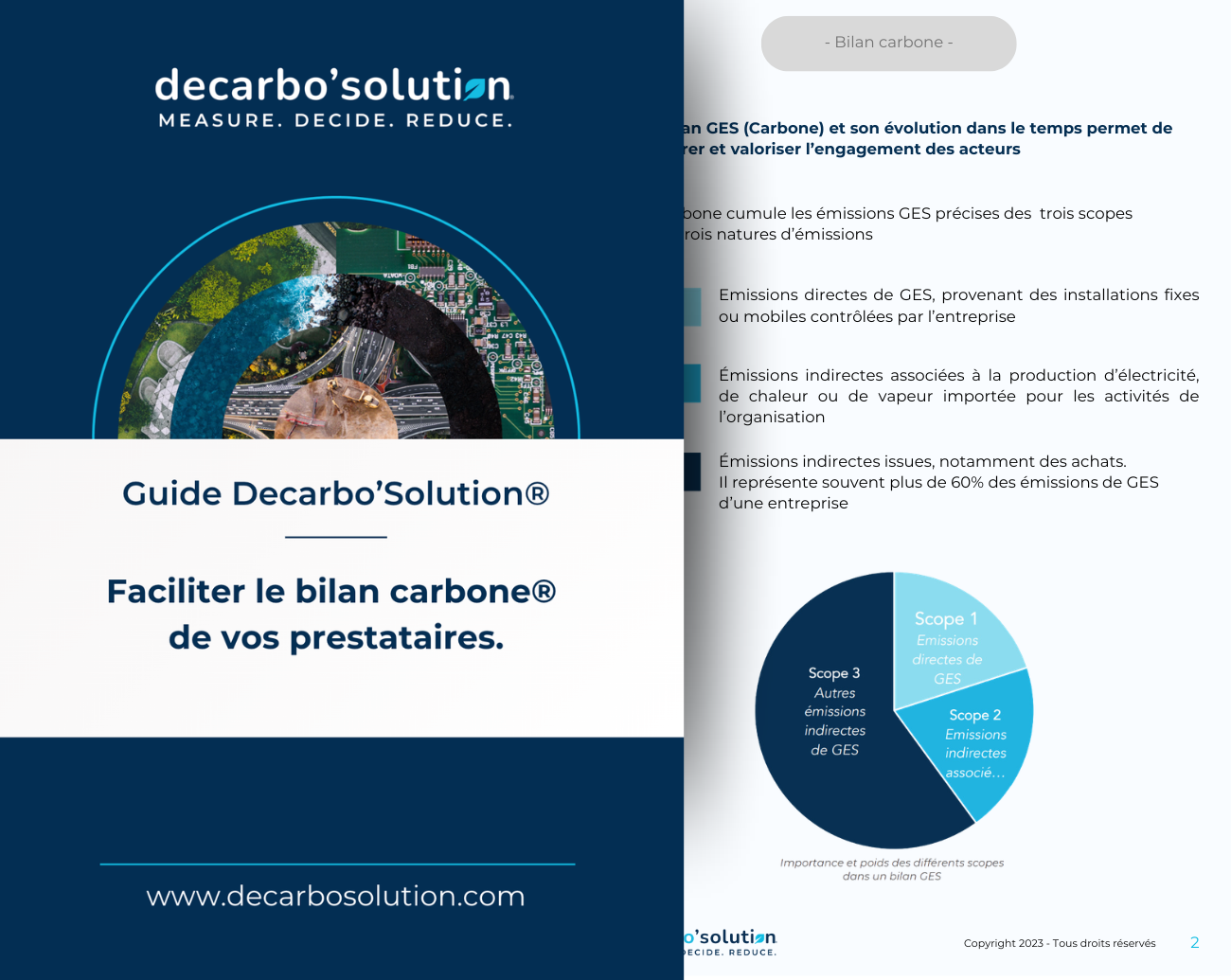
Simplify the GHG assessment for your service providers
The Relationship Between Standards, Certifications, and Environmental Performance
Environmental standards are not merely reference documents. When combined with a certification process, they become powerful tools for driving change and managing a company’s overall performance, regardless of its industry —from manufacturing and services to construction.
Why is certification so important?
Certification by an accredited third-party organization confirms that the company complies with the requirements of a given standard (e.g., ISO 14001, ISO 50001). This enables:
- To obtain credible and recognized external validation
- To strengthen the confidence of customers, investors, and authorities
- To structure the company's environmental governance
From Standards to Environmental Performance
Une norme telle que l’ISO 14001 impose une logique d’amélioration continue adaptée aux enjeux de chaque secteur, permettant :
- To reduce environmental risks (pollution, non-compliance)
- To protect the environment and human safety
- To optimize resources in each activity
Example: Companies certified to ISO 50001 can reduce their energy consumption by up to 20% over three years through better management of their facilities and operational practices.
Key Performance Indicators (KPIs) to monitor:
| Indicator | Objective |
| CO2 Emissions per Unit Produced | Reducing carbon intensity |
| Energy consumption per square meter of building area | Monitoring Energy Efficiency |
| % of waste recycled | Achieving Zero Waste |
| Regulatory Compliance Rate | Reducing Risks |
The Tangible Benefits for Businesses
Complying with environmental standards and pursuing certification is not a burden: it is a strategic investment that yields numerous measurable benefits, both economic and reputational; it is a commitment to responsibility.
- Cost Reduction
- Reduction in Energy Consumption (Thanks to ISO 50001)
- Reduction of waste and the associated taxes
- Optimization of work processes (e.g., reduction of material waste)
- Easier access to markets and bids
- Environmental standards are becoming an increasingly important selection criterion in both public and private procurement
- With tools like Decarbo’Tender®, companies can highlight their low-carbon performance in bid proposals
- Better brand image
- A Credible Commitment to the Green Transition
- Ability to appeal to consumers who value ethics and transparency
- Enhancing the appeal of HR (particularly to young talent)
- Competitive Advantage in Carbon Competitiveness
With the help of solutions such as Decarbo’Supply®, companies can measure and manage their Scope 3 emissions, thereby reducing their Carbon Tax Base®, improving their Carbon Competitiveness®, anticipating future regulations, and engaging in effective communication with all stakeholders regarding their environmental performance.
New Requirements: CSRD, Taxonomy, AGEC Act
CSRD (Corporate Sustainability Reporting Directive)
Requires large European companies to publish detailed non-financial reports on their environmental, social, and governance (ESG) impact.
European Taxonomy
As a common framework for identifying sustainable activities, it applies not only to investors but also to companies that wish to demonstrate their contribution to the ecological transition.
AGEC Act
French law to reduce waste and promote the circular economy. Major impact on products, packaging, and waste management.

The 7 Benefits of Conducting a GHG Assessment for Your Company.
How to Implement an Environmental Management System (EMS)
An EMS (Environmental Management System) such as the one outlined in the ISO 14001 standard is based on a rigorous process, but one that is accessible when the right methodology is used.
Key Implementation Steps
|
Step |
Objective |
Tips |
|
1. Initial Environmental Analysis |
Identify environmental impacts and risks (emissions, waste, water, energy) |
Use a tool such as the GHG Assessment or an LCA |
|
2. Definition of the Environmental Policy |
Set General Objectives and Management Commitments |
Involve top management to ensure adequate resources |
|
3. Action Planning |
Identify priority actions, responsibilities, and resources |
Use tools such as Decarbo’Target® to model different scenarios |
|
4. Implementation |
Implement initiatives, raise awareness among teams, and collect data |
Train teams, implement Decarbo’Supply®, and establish management routines |
|
5. Monitoring and Evaluation |
Measure results, analyze variances, conduct audits |
Establish clear KPIs |
|
6. Continuous Improvement |
Review actions, incorporate feedback, and correct discrepancies |
Conduct annual management reviews |
Practical Tips
-
- Start small: Begin by targeting a pilot site or a strategic service
- Digitize tracking and save time: with tools like Decarbo’Solution®’s SaaS platform for continuous data management
- Engage stakeholders: suppliers, employees, customers
Decarbo’Solution®: A Powerful Tool for Ensuring Compliance with Standards
Companies looking to structure their environmental initiatives can rely on Decarbo’Solution®, a comprehensive and auditable suite of online services that comply with ISO, CSRD, and GHG Protocol standards.
Managing your low-carbon strategy
Enables the development of a structured carbon transition plan, including emission reduction scenarios, indicator tracking, and budget projections (OPEX/CAPEX).
integrating carbon criteria into calls for tender
This module helps you request and obtain reliable carbon data (My-PCF®/My-CIF®) during supplier consultations by ensuring:
- Transparency and Consistency
- Traceability and Audibility
- Rigorous Carbon Positive® Discrimination
Involving suppliers in decarbonization
Using tools such as Supplier’Connect®, this solution enables companies to onboard their suppliers, collect their PCFs (Product Carbon Footprints), and accurately calculate their Scope 3 “purchasing” emissions, which account for 60 to 90 percent of a company’s carbon footprint.

CSRD: Implementing a strategy to comply with environmental standards is no longer an option, but a necessity.
This doesn’t simply mean “checking boxes” to comply with regulatory requirements. It is a profound, lasting transformation that touches the very foundations of the company: its organization, procurement, services, products, and its relationship with its entire ecosystem.
Far from being a burden, compliance with environmental standards is a true driver of performance, resilience, and innovation. It enables companies to stand out, anticipate market shifts, attract talent, and inspire confidence.
Thanks to Decarbo’Solution®’s Decarbo’Solution®, companies now have access to practical tools that are easy to implement, audited, and compliant with ISO standards and sustainability reporting requirements (Taxonomy, CSRD, etc.). This modular suite supports every step of the process: from assessment to management, including measurement,supplier engagement, andcontinuous improvement.