








Calculate and Improve Your Company's GHG Footprint
Decarbo’Solution® adapts to the specific nature of your business, prioritizes the areas with the highest emissions, and identifies the key avenues for reduction within your company.




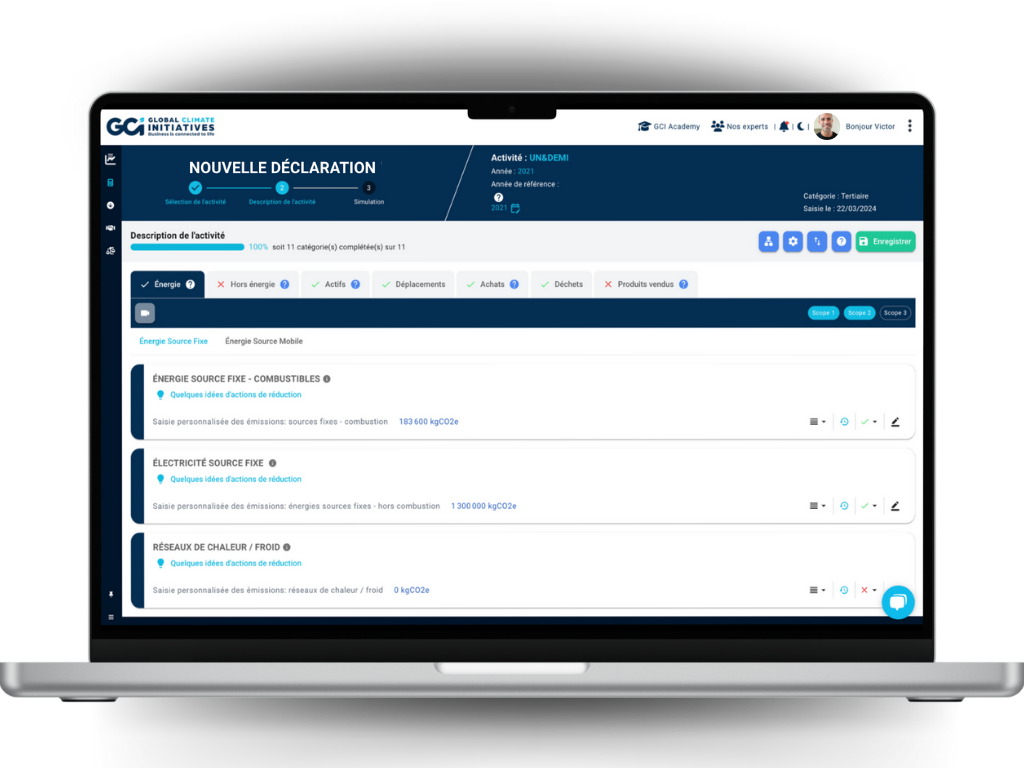

Accurately measure your carbon footprint.

A comprehensive and compliant GHG inventory covering all three scopes.

Can be tailored to the specific needs of your business or organization.

Identify the top areas for reduction.

Definition: What is a GHG inventory?
A greenhouse gas emissions inventory (GHG inventory), sometimes incorrectly referred to as a “carbon footprint” (a registered trademark of ADEME), is a comprehensive assessment that quantifies all GHG emissions generated directly or indirectly by an organization.
It is based on the methodology defined byADEME and the ISO 14064-1 standard, and covers three scopes of emissions:
Scope 1
Direct Emissions
Burning of fossil fuels, refrigerant leaks, company vehicles.
Scope 2
Indirect Emissions — Energy
Consumption of purchased electricity, heat, or steam.
Scope 3
Other Indirect Emissions
Purchases, travel, transportation, and end-of-life disposal of products. These factors often account for more than 80% of the total footprint.
Conducting a GHG inventory makes it possible to identify emission sources, prioritize the largest sources of emissions, and develop a decarbonization action plan aligned with national and international climate goals.
Why Conduct Your GHG Assessment with Decarbo’Solution®?
Decarbo’Solution®, a specialist in Scope 3.
Our 12 years of experience guarantee you the most comprehensive and informative service, as well as access to the world’s most extensive database of emission factors, including those from your suppliers.
- A 100% online, user-friendly GHG assessment software
- The most accurate GHG emissions calculator on the market.
- Get started on your own or with the help of a carbon expert to optimize your results.
- An integrated, effective reporting and analysis tool
Data Collection
Let the user-friendly design of Decarbo’Inventory® guide you as you easily create a GHG assessment tailored to your organization and industry.
Questionnaires specifically tailored to your company’s industry.
Online help, tutorials, FAQs, and an expert to guide you and answer your questions.
Choose and develop your level of analysis.
Multi-user, multilingual, centralized data management and monitoring.

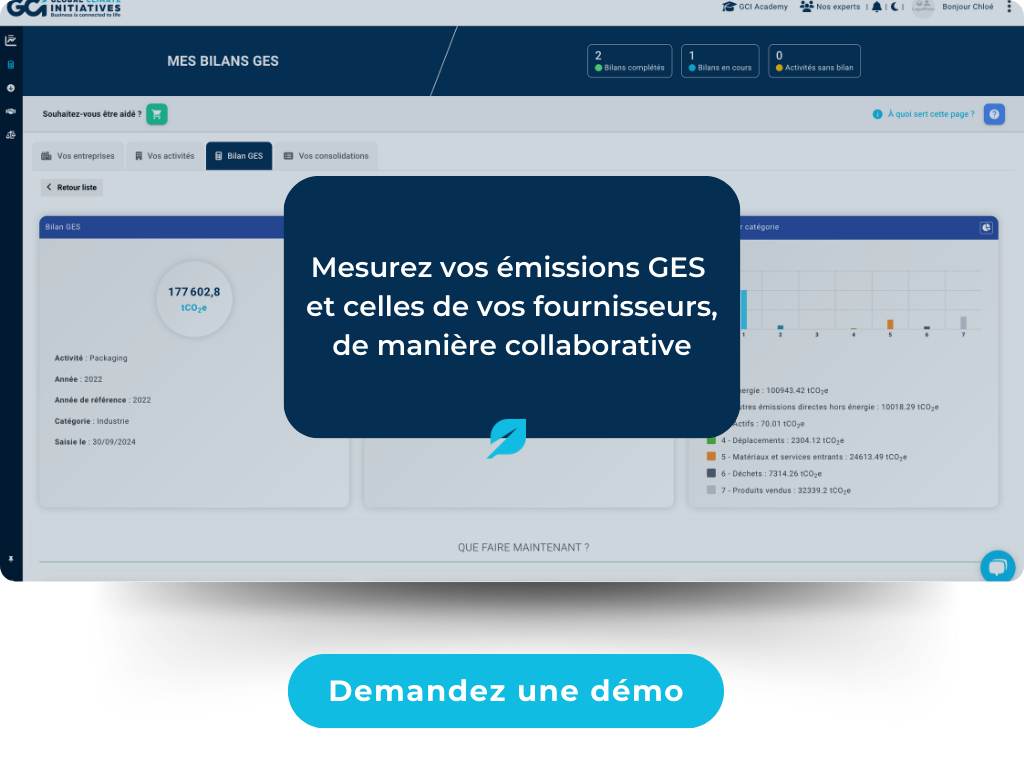
Accurate and compliant calculation
(ISO 14067) of your emission factors and those of your suppliers
Automatic assignment of each emission source calculation to Scope 1, 2, and 3.
The selection of emission factors is open to all reference databases (Base Carbone®, Impacts, EcoInvent, Inies, Beis-Defra, etc.) as well as those used by your suppliers.
EXCLUSIVELY at Decarbo’Solution®: You can invite your suppliers to calculate, free of charge, the emission factors for the goods and services they offer you, in full compliance with ISO 14067.
A Comprehensive, Compliant GHG Assessment That Drives Progress
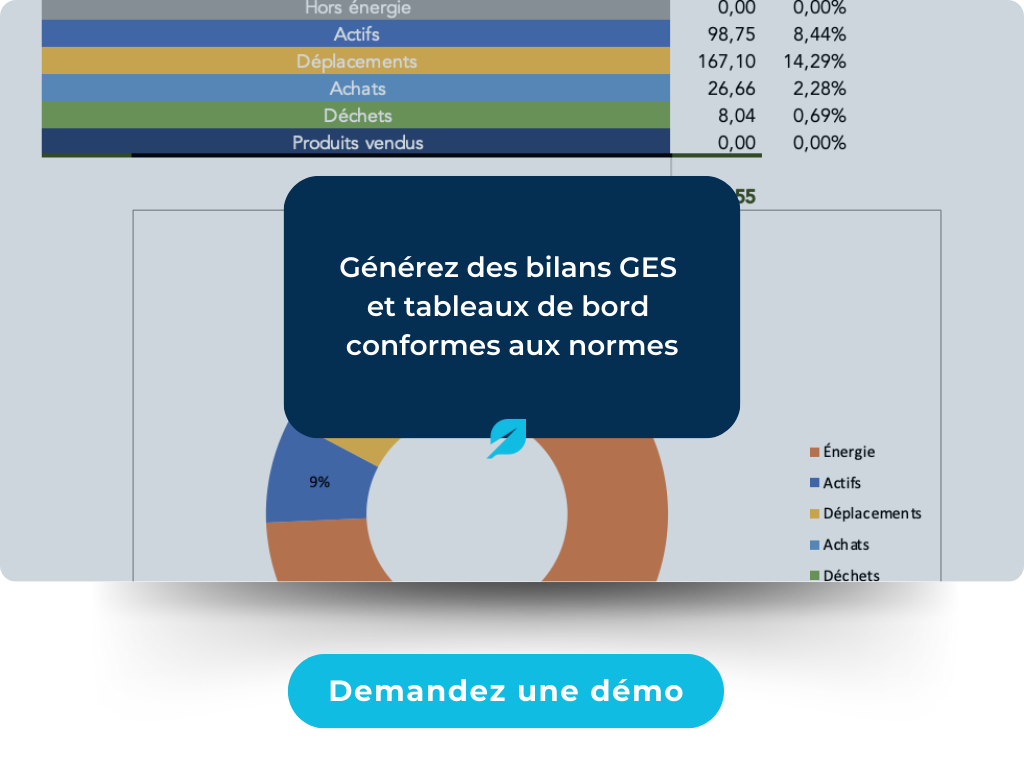
A hierarchical, detailed, and accurate analytical report.
Ways to reduce emissions for each source.
Specific formatting for uploading to the ADEME's dedicated website.
The carbon SaaS that generates cash
Turn your carbon compliance into an economic advantage.
Check your ETS surcharges, reduce your MACF exposure, ensure compliance with CSRD, and win your bids. Activate it online today.
What Sets Us Apart Is Your Strength
The calculator that adapts to your organization

Communication & Multimedia

Distribution, Transportation, and Logistics

Industry & Energy

Technology & Digital

Consulting & Accounting Firm

Health, Environment & Agriculture

Tourism, Hospitality, Events & Sports

Construction, Real Estate, and Building and Public Works

Local Government & Public Organizations
More information on the GHG inventory

Quelles aides financières pour décarboner mon entreprise ?

Qu’est-ce que la méthode PEF européenne ?

Comment identifier et sélectionner des fournisseurs éco-responsables ?

Quelle est l’empreinte carbone des produits alimentaires ?

How do I include my suppliers in my carbon footprint assessment?

SFDR: Definition, How It Works, and Current Developments

Understanding the Carbon Footprint of Food to Make Better Food Choices

How can you find suppliers committed to decarbonization?

How does the European emissions trading market work?

What is the digital product passport, and which companies are affected?
We're here to answer your questions!
How do I calculate my company's GHG footprint?
First of all, conducting a greenhouse gas inventory (GHG) allows a company to accurately assess its carbon footprint and understand the primary source of each of its greenhouse gas emissions.
The main difference between the Carbon Footprint and the GHG Footprint lies in the definition of the scope of emissions accounting.
Under ADEME’s methodology, the calculation of the GHG footprint takes into account the entire life cycle of the products or services provided by a company’s operations. This allows for a comprehensive assessment of the operations’ GHG emissions and helps identify potential areas for reduction.
Greenhouse gas (GHG) emissions are calculated based on energy consumption, using conversion factors specific to each energy source. This allows for standardized measurements and results in an emissions figure expressed in carbon dioxide equivalents (CO2e).
In other words, it involves multiplying its activity data (in kWh, units, liters, or euros) by an emission factor (the average amount of greenhouse gas emissions per unit of its activity data).
Why carry out my GHG assessment?
Beyond regulatory requirements (particularly since Decree No. 2022-982), conducting a GHG inventory is an essential step for a company because it allows it to identify and list the sources of greenhouse gas emissions directly or indirectly related to its operations.
Conducting its first GHG inventory will provide an initial assessment and help identify the main sources of emissions. This will make it all the easier to identify potential reduction opportunities and develop a low-carbon strategy for the company.
Conducting GHG inventories on a regular basis will provide an opportunity to adjust the company’s action plan and ensure that it meets its goals for reducing its environmental impact.
What data do I need to provide?
To accurately measure a company’s greenhouse gas emissions, it is necessary to identify all of its emission sources. It is therefore necessary to collect data on its operations:
- Energy consumption (gas, fuel oil, diesel, gasoline, electricity, etc.)
- Assets under depreciation (real estate, vehicle fleet, IT equipment, furniture, etc.)
- Purchases of goods (raw materials, supplies, food products, etc.)
- Purchases of services (Internet subscriptions, equipment maintenance and installation, service provision, fees, etc.)
- Travel: employees’ commutes to and from work, business travel, visitors and customers, etc.
- Freight Transport
- Disposal
- Use and end-of-life of its products.
Although it is recommended to be as comprehensive as possible over time when identifying sources of spending, you can start with financial data and refine the accuracy of that data over time. We recommend that you take a step-by-step approach to your budget review, starting with your largest expenses at the outset.
How can I reduce my company's carbon footprint?
Reducing your company's carbon footprint involves several steps:
- Calculate Your Carbon Footprint for the First Time
- Identify the largest sources of emissions and identify ways to reduce them by improving the accuracy of the data used for measurement
- Involve your suppliers by asking them to calculate the carbon footprint of the goods and services they provide. This will make the measurement more accurate, and you will then be able to implement a responsible procurement strategy.
- Develop an action plan and a strategy for monitoring progress over time to ensure its successful implementation and effectiveness.
Put BEGES into action
, with Decarbo’Solution®
Legal and Regulatory Framework for GHG Reporting
In France, the preparation of a greenhouse gas emissions inventory is governed by several laws and regulations.
Article L229-25 of the Environmental Code (Grenelle II Act)
Since the Grenelle II Act (2010), the following organizations are required to conduct a regulatory GHG inventory (BEGES) every 4 years (every 3 years for the federal government and local governments):
- Companies with more than 500 employees in metropolitan France (250 in overseas territories)
- Public institutions with more than 250 employees
- Local governments with more than 50,000 residents
- The Government and Its Agencies
This report must be published on the ADEME platform and accompanied by a transition plan outlining the proposed reduction measures.
Decree No. 2022-982 of July 1, 2022
This decree strengthened existing requirements by mandating:
- Inclusion of Significant Indirect Emissions (Scope 3) in the Regulatory Report
- The publication of a transition plan that includes quantified reduction targets and a timeline for implementation
- Financial penalties of up to €10,000 (€50,000 for repeat offenses) may be imposed if the financial statement is not prepared
CSRD (Corporate Sustainability Reporting Directive)
Since January 2024, the CSRD has been gradually expanding non-financial reporting requirements to European companies. It mandates the disclosure of detailed information on GHG emissions in accordance with the ESRS (European Sustainability Reporting Standards), including:
- A comprehensive GHG inventory (Scopes 1, 2, and 3)
- Emissions reduction targets aligned with the Paris Agreement
- A Climate Transition Plan
In 2025, the CSRD will apply to large publicly traded companies, and will then be extended to publicly traded SMEs starting in 2026.
Why plan ahead even if there’s no legal requirement to do so?
Beyond regulatory requirements, conducting a voluntary GHG inventory makes it possible to:
- Anticipate future regulations that will gradually apply to a growing number of companies
- Meeting the expectations of investors, contractors, and customers regarding climate transparency
- Identify opportunities for cost savings by optimizing energy and resource consumption
- Strengthen the company's brand image and employer appeal