









Everything You Need to Know About Environmental Analysis According to ISO 14001

Against a backdrop of the climate emergency and growing pressure from stakeholders, companies are being called upon to rethink their environmental practices. Mitigating climate impacts is no longer an option: it has become a strategic driver of competitiveness, regulatory compliance, and sustainable differentiation.
The ISO 14001 standard, an international benchmark for environmental management, fits into this context. It provides organizations with a structured framework for identifying, assessing, and reducing their environmental impacts throughout the life cycle of their operations, products, and services.
Recognized in more than 150 countries, ISO 14001 certification serves as a common language between businesses and public agencies. It enhances companies’ credibility, facilitates their access to international markets, and encourages steady improvement in environmental practices.
Environmental analysis, a key step in implementing an environmental management system, involves a detailed examination of an organization’s operations, material flows, resources, and waste in order to identify the main risks and define measurable objectives. This analysis, supplemented by regular audits, ensures compliance with legal requirements, enhances the quality of internal practices, and builds trust among customers, investors, and certifying bodies.
Today, beyond simply complying with standards, the integration of digital and collaborative solutions—such as Decarbo’Solution® — facilitates the implementation of concrete measures to reduce emissions. These tools enable companies to align their business strategy with a sustainability strategy that is consistent with international best practices for the low-carbon transition.
Contents
Understanding the ISO 14001 Standard and Its Objectives
Definition of the ISO 14001 Standard
The ISO 14001 standard is a international standard published by theInternational Organization for Standardization (ISO). It defines the criteria for the implementation of a SME effective. Its goal is to provide companies a structured framework to manage their climate-related impacts, improve their environmental performance and ensure their respect with respect to applicable regulations. Unlike a regulation imposed by a public agency, ISO 14001 is based on a proactive approach. The companies choose to pursue this certification in order to demonstrate their environmental commitment, strengthen their CSR and improve their competitiveness. This standard applies to any type oforganization – whether it’sprivate companies, frompublic entities, associations, or local governments. Its strength lies in its flexibility: it adapts just as well to large multinational corporations as it does to small and medium-sized enterprises, regardless of the industry.The Fundamental Principles of Environmental Management
ISO 14001 is based on several key principles that shape an organization’s environmental management system:
- Life-cycle approach: The analysis does not stop at internal activities alone. It takes into account the entire life cycle of products and services, from design and manufacturing through use to end of life. This comprehensive approach makes it possible to better identify the true environmental impacts.
- Continuous optimization: The standard requires companies to go beyond mere compliance with legal obligations. It encourages a mindset of continuous improvement, with environmental goals that are reassessed and adapted over time.
- Prevention of Environmental Risks: Rather than addressing problems after the fact, the EMS aims to anticipate environmental risks associated with operations, products, or services. This helps limit costs related to noncompliance, penalties, or accidents.
- Stakeholder Engagement: ISO 14001 emphasizes communication andengagement with various stakeholders—employees, suppliers, customers, government agencies, and shareholders. This cooperation is essential for a sustainable strategy.
- Link to the company’s overall strategy: Environmental management should not operate in isolation. It must be integrated into the organization’s overall policy, just like quality, safety, and CSR. This is, in fact, the whole point of a QSE (Quality, Safety, Environment) approach, which aims to harmonize these three pillars within a single, coherent management system that drives sustainable performance.
In summary, ISO 14001 certification enables companies to implement a structured system focused on reducing environmental impacts, managing risks, continuous improvement, anda commitment to sustainability.
The Main Requirements of ISO 14001
The ISO 14001 standard is based on a series of requirements that provide a framework for implementing an EMS. These requirements enable organizations to transform their environmental approach into a coherent, measurable, and responsible process.
Initial Environmental Assessment
The first step in developing an EMS is to conduct a thorough environmental assessment.
The purpose of this analysis is to:
- Identify activities, products, and services that have a significant environmental impact.
- Assess environmental aspects (energy consumption, emissions, waste, resources used, discharges, etc.).
- Identify the environmental risks associated with operations and opportunities for improvement.
The ecological assessment is the foundation on which the entire system rests. It provides the data needed to develop an appropriate and realistic ecological strategy.

How to ensure the long-term viability and growth of your business through a successful low-carbon strategy.
Definition of the Environmental Policy
Once the impacts have been identified, the company must establish a environmental strategy clear, which sets out the broad guidelines regarding environmental management. This plan must include:- A commitment to comply with regulations and other applicable obligations.
- A commitment to reducing environmental impacts and contributing to sustainable development.
- Integrating the initiative into the organization’s overall strategy so that it is supported by management and embraced by all employees.
Establishing Measurable Goals and Continuous Improvement
ISO 14001 requires specific and quantifiable environmental objectives. These objectives must be:
- In line with environmental policy and legal requirements.
- Realistic and tailored to theentity's capabilities.
- Accompanied by indicators to measure progress.
A fundamental principle of the standard iscontinuous improvement. Every company must implement a process for monitoring, evaluating, and correcting its practices in order to reduce its environmental impact and improve its environmental performance.
Bidding Processes and Environmental Criteria: The Framework Is Evolving
Incorporating environmental criteria into transportation bids is becoming essential. This encourages transportation companies to invest in lower-emission vehicles, choose alternative fuels, and turn to renewable energy sources. To meet the requirements of the SNBC framework and European regulations, companies must also accurately track their emissions. Digital tools now make it possible to standardize data collection and compare offerings based on their environmental performance, which supports the development of a competitive industry that complies with the law. The development of domestic logistics solutions is accompanied by increased use of clean energy and vehicles optimized for each type of road use.Other Key Requirements of the Standard
In addition to the elements mentioned above, ISO 14001 includes:
- Implementation of a documented EMS: procedures, responsibilities, communication, and information control.
- Training and raising awareness among teams to ensure their commitment.
- Preparation for and response to climate-related emergencies (e.g., leaks, accidental spills).
- Conducting internal audits and an external audit by a certification body to obtain or renew certification.
In short, ISO 14001 is more than just a compliance exercise. It provides a framework for a proactive approach, committing companies to a processof continuous improvement, reducing environmental impacts, and practicing responsible management.
ISO 14001 and the International Dimension
Reconnue dans plus de 150 pays, l’ISO 14001 est l’une des normes environnementales les plus adoptées au monde. Elle offre un langage commun aux entreprises et organismes publics, facilite les échanges dans les chaînes d’approvisionnement internationales et renforce la crédibilité des acteurs engagés. Véritable passeport écologique, souvent exigée dans les appels d’offres et peut être combinée à d’autres référentiels comme l’ISO 14064 (émissions de GES), l’ISO 14067 (empreinte carbone des produits) ou l’ISO 50001 (management de l’énergie).
Dans le secteur du transport et de la logistique, le cadre du GLEC (Global Logistics Emissions Council) complète ces standards en proposant une méthodologie reconnue pour quantifier et réduire les émissions liées aux chaînes d’approvisionnement internationales.
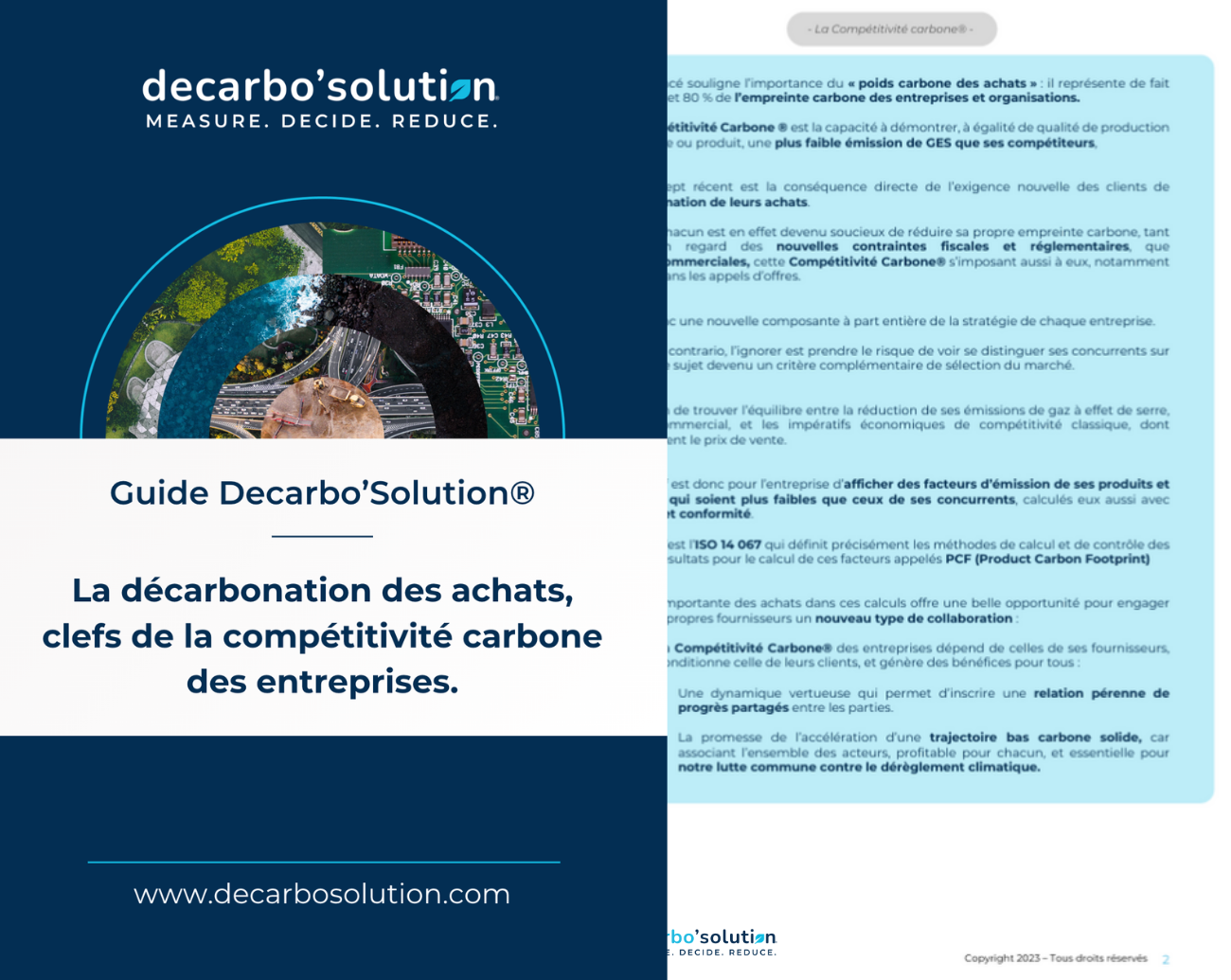
Decarbonizing procurement: the key to companies' carbon competitiveness.
Examples of Innovative Solutions for Businesses
ISO 14001 provides a methodological framework for implementing an environmental management system, but its success depends heavily on organizations’ ability to translate these principles into concrete actions. In this context, several innovative solutions have emerged to help organizations reduce their environmental impacts and achieve their sustainability goals.
Decarbo’Supply®: Decarbonizing Procurement and Improving Carbon Competitiveness
The weight of the purchases is generally between 60% and 90% of Scope 3 of a company. However, this aspect is often the most difficult to measure and manage. The solution Decarbo’Supply® enables organizations to:- Map and analyze their supply chain to identify the suppliers with the highest emissions.
- Engage suppliers through a collaborative platform that is free for them to use.
- Collect reliable data using tools such as My-PCF® (product carbon footprint compliant with ISO 14067) and My-CIF® (Carbon Intensity Factor).
- Integrate this information into their management tools and direct their procurement toward partners whose goals align with their low-carbon objectives.
Decarbo’Tender®: Incorporating a low-carbon criterion into requests for proposals
Public and private tenders are increasingly incorporatingenvironmental criteria. In this context, Decarbo’Tender® offers an innovative tool to:
- Require and compare reliable carbon data in suppliers' responses.
- Standardize and simplify data collection using appropriate data entry forms.
- Promote a transparent selection process by prioritizing the most merit-based proposals.
- Ensure compliance with international standards (SBTi, SNBC, ISO 14067).
This type of solution helps organizations balance economic performance with environmental responsibility, while meeting the audit and traceability requirements set forth by industry standards.
Decarbo’Target®: Steering the Path Toward Emissions Reduction
One of the major challenges of an ISO 14001 initiative is the implementation of a concrete and measurable environmental action plan.
The Decarbo’Target® solution addresses this need by enabling companies to:
- Develop a realistic emissions reduction plan tailored to their operations.
- Simulate various scenarios and measure their climate and financial impact (OPEX/CAPEX).
- Steer the low-carbon transition by tracking specific indicators.
- Engage the ecosystem of stakeholders and suppliers in the reduction effort.
This type of tool makes it possible to turn commitments into concrete results, in full alignment with thecontinuous improvement philosophy of ISO 14001.
A winning trio serving companies
United under the Decarbo’Solution® banner, these three approaches (Supply, Tender, and Target) form an innovative trio that:
- Complements the ISO 14001 methodology.
- Provides operational solutions for managing Scope 3 emissions and reducing emissions.
- Improves the reliability, traceability, and audibility of the collected data.
- Turn organizations' environmental policies into drivers of competitiveness and sustainable performance.

ISO 14001 is not just a certification—it is a strategic tool for placing sustainability at the heart of the company. It provides executives with a clear picture of the implications, risks, and opportunities, while offering a framework for continuous improvement and responsible governance.
Above all, its future lies in the low-carbon transition. Thanks to solutions like Decarbo’Solution®, organizations can go beyond mere compliance to become drivers of ecological transformation: decarbonizing their procurement, incorporating green criteria into their requests for proposals, and managing their emissions trajectories.
By adopting ISO 14001, companies are no longer merely meeting current expectations: they are preparing to tackle the climate challenges of tomorrow and build a more resilient and responsible economy.