









Reducing CO2e Emissions in the Transportation Sector: A Necessity for Businesses

Energy consumption in transportation is a major climate issue in France every year.
The transportation sector is one of the largest emitters of greenhouse gases in France. According toAdeme, it accounts for nearly 30% of national CO2e emissions. Cars, trucks, and airplanes: every kilometer traveled takes a toll on the climate and adds to our collective carbon footprint. Calculating these impacts reveals significant room for improvement.
For businesses, the impacts are manifold. Whether it involves managing vehicle fleets, transporting goods over long distances, or commuting to work,transportation makes a significant contribution to carbon footprints. A striking example: in the service sector, for instance, these areas are often underestimated, even though they represent a key lever for reducing CO2e emissions.
At the same time, not all modes of transportation have the same impact. A gasoline-powered vehicle emits, on average, 10 times more CO2e per passenger-kilometer than a train. The road transport sector remains by far the dominant one, well ahead of rail and waterway transport.
Dans ce contexte, et alors que la Stratégie nationale bas carbone impose une trajectoire ambitieuse à l’horizon 2050, il devient indispensable pour les entreprises d’agir : mieux planifier les déplacements, repenser les usages, électrifier les voitures, ou miser sur la logistique bas carbone.
But where do I start?
Above all, what actions are truly effective in reducing the impact of transportation on an organization’s greenhouse gas (GHG) footprint?
2. How can we reduce CO2e emissions in the transportation sector?
2.2 Energy Transition for Vehicle Fleets
3. Case Studies and Best Practices
3.1 Concrete Examples of Emissions Reductions in Transportation
The Challenges of CO2e Emissions in Transportation
🚗 Passenger transportation: a major factor in financial statements
Passenger transportation is the largest source of GHG emissions in France. According to an annual report by the High Council for Climate, it alone accounts for 52% of the transportation sector’s CO2e emissions. Private cars remain the most widely used mode of transportation. They are also the most polluting, second only to air travel.
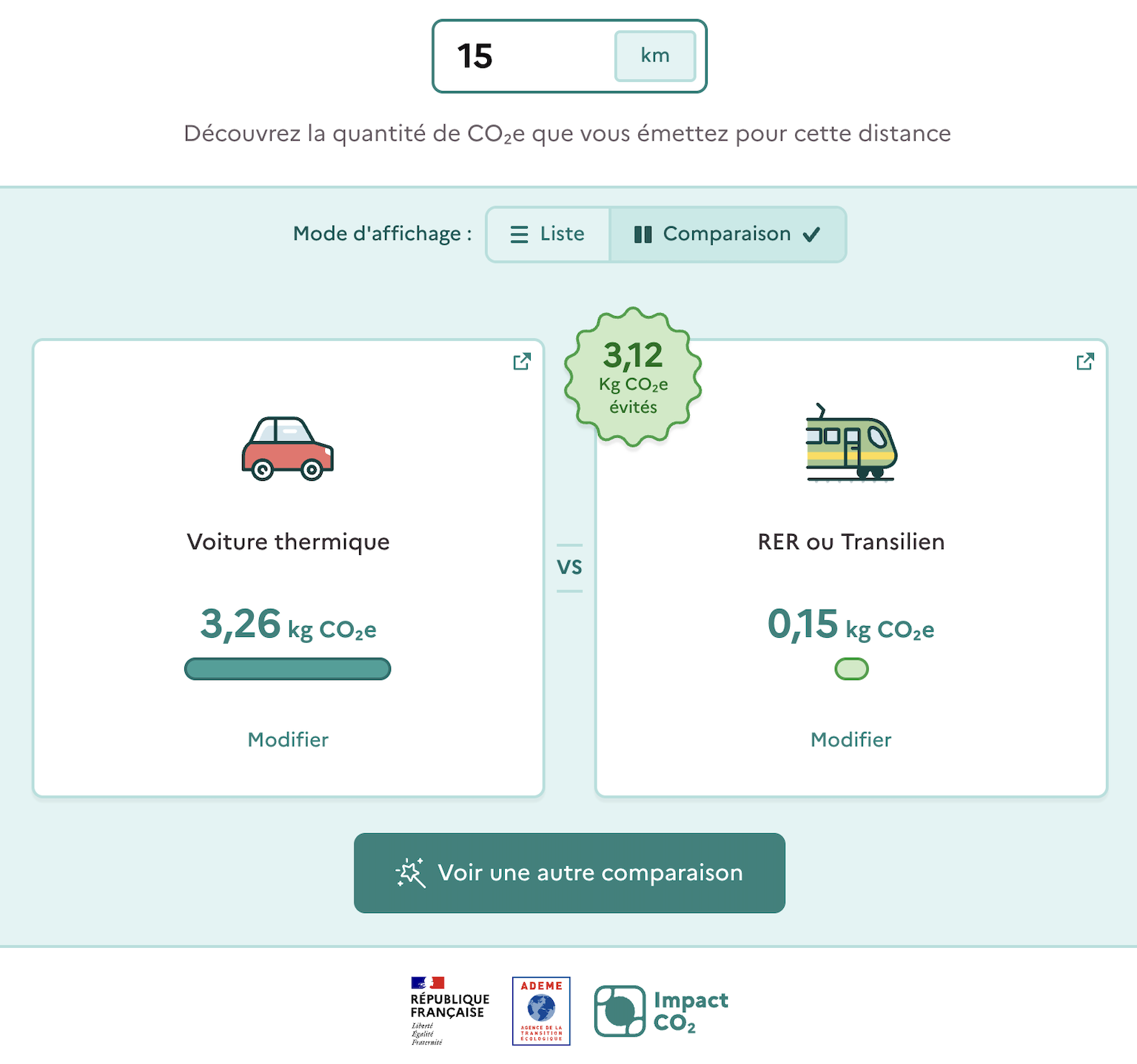
According to data, a passenger traveling 15 kilometers in a gasoline-powered car emits an average of 3.26 kg CO₂e, compared with just 0.15 kg CO₂e on the RER. For commutes to and from work or business trips, this choice therefore has a significant impact on organizations’ carbon footprints. The distance traveled directly influences the climate impact.
The companies in the service sector are directly affected. Their GHG inventories often show that a significant portion of their emissions is related to transportation.
Location also plays a role. In the Île-de-France region, public transportation is more developed. But in many areas, cars remain indispensable. As a result, CO2e emissions from travel are skyrocketing.
🚚 Freight transportation: a key challenge for businesses
Freight transport accounts for 42% of the transportation sector’s CO2e emissions. In France, freight transport relies primarily on road transport. However, a heavy-duty truck emits an average of 903 g of CO2e per metric ton-kilometer. The calculation of greenhouse gas (GHG) emissions must take into account both the quantity of goods transported and the number of trips made.
Companies that ship, receive, or deliver products are therefore affected, whether they are shippers, distributors, or logistics providers. For some, such as those in e-commerce or manufacturing, transportation accounts for a major portion of their greenhouse gas (GHG) emissions.
Regulatory pressure is mounting. In Europe, the Green Deal aims for carbon neutrality by 2050. In France, the National Low-Carbon Strategy mandates a drastic reduction in emissions from the road transport sector. Companies must therefore plan ahead.
✈️ Air travel: a disproportionate impact
Air travel has a significant carbon footprint, even though it accounts for only a small portion of all travel (less than 2% of the kilometers traveled in France). The reason: a very high carbon intensity per kilometer.
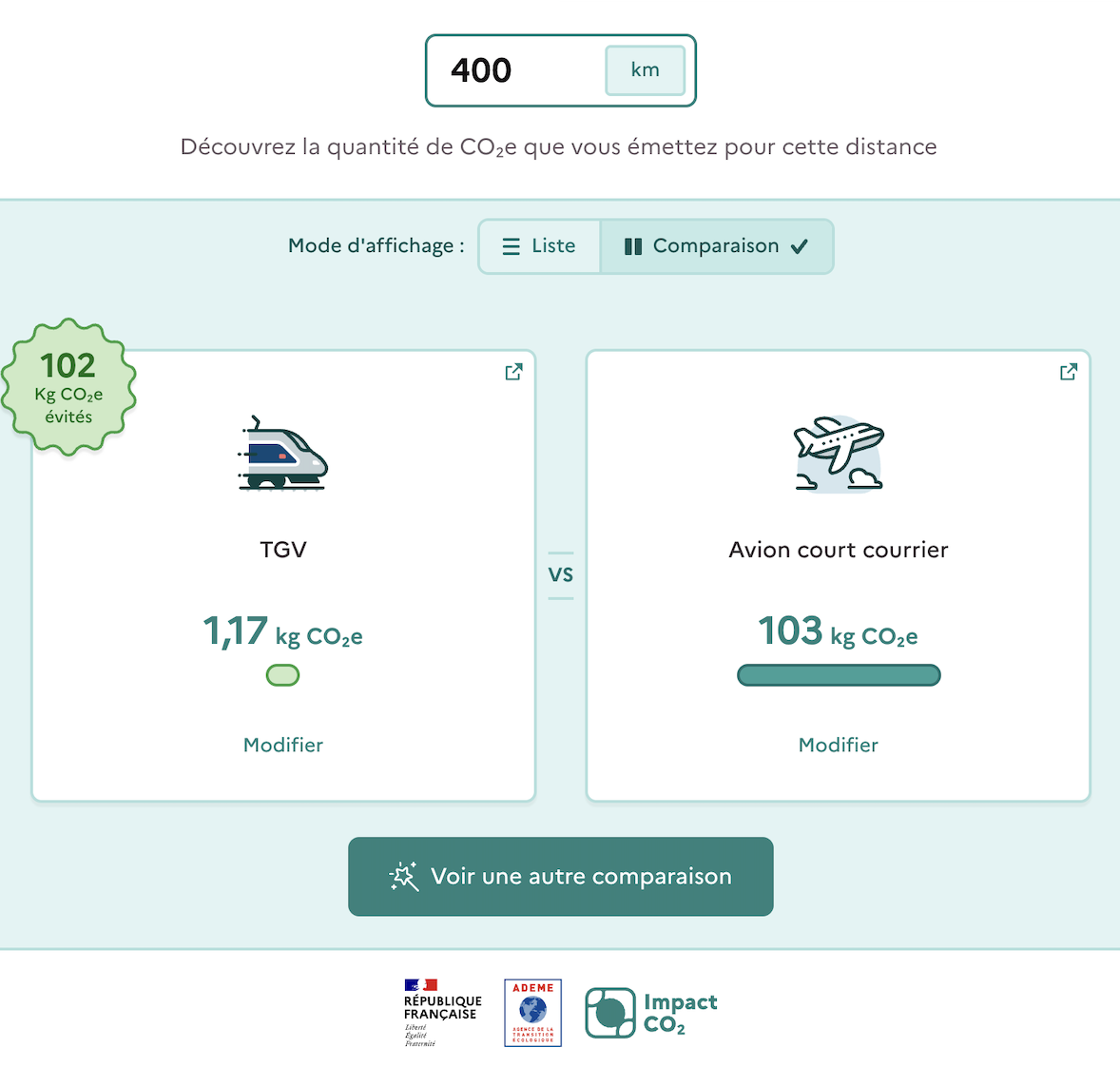
According to data fromADEME, a passenger on a flight emits approximately 103 kg of CO₂e, compared to 1.17 kg of CO₂e on a TGV.
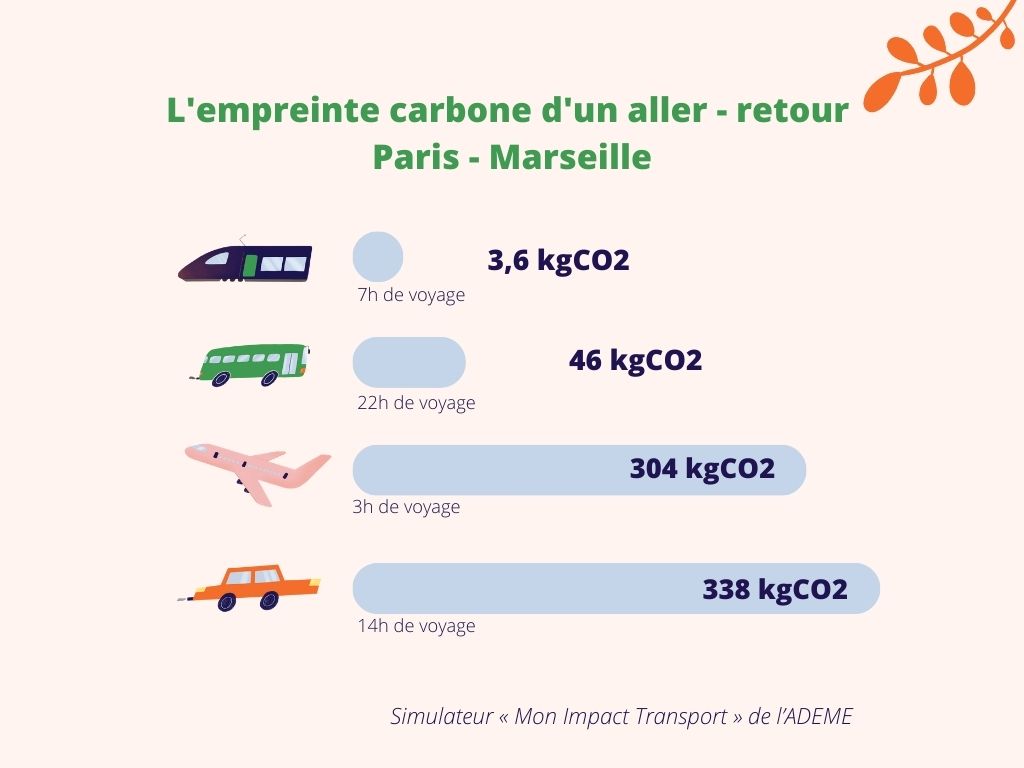
Domestic and business travel significantly contributes to companies’ GHG emissions. A round-trip flightfrom Paris to Marseille can generate up to 304 kg of CO₂e per person.
Some companies are now incorporating distance and travel time criteria to limit the use of air travel. Others are promoting train travel for trips under 4 hours as part of a low-carbon mobility policy. These are simple measures, but they have a significant impact on the overall carbon footprint.

The 7 Benefits of Conducting a GHG Assessment for Your Company.
How can we reduce CO2e emissions in transportation?
🧭 Optimizing Routes: A First Concrete Step
The first step—one that is often underestimated—is route optimization. For businesses, this means rethinking how those kilometers are traveled.
When it comes to freight transport, this involves:
-
- consolidating shipments,
- reducing the distance traveled with an empty load,
- improving the load factor,
- logistics pooling among French shippers.
Each improvement helps save metric tons of CO2e while reducing costs.
In terms of employee mobility, the key factors are:
-
- the growth of telecommuting,
- promoting carpooling,
- easy access to public transportation,
- the implementation of corporate mobility plans.
These solutions can be incorporated directly into a GHG inventory to measure their effectiveness.
⚡ Energy Transition: Electrifying Fleets and Diversifying
Switching to electric vehicles is a major driver of change. In France, electric vehicles emit 22% to 81% less CO2 than gasoline and diesel cars.
For corporate fleets, the switch to electric vehicles can significantly reduce emissions. It’s also a way to prepare for future low-emission zones (LEZs), which are already in effect in Paris and other major cities.
Decarbonizing the road transport sector remains a challenge. But solutions are emerging for heavy-duty vehicles: electric trucks, hydrogen, and biogas. These options are still expensive but are becoming increasingly accessible.
🛰️ Technology and Innovation: Accelerating the Transition
Emerging technologies open up new possibilities. For example:
- real-time emissions monitoring systems,
- intelligent route planning software,
- inter-company resource-sharing platforms,
- tools for accurately measuring the carbon footprint by flow.
These solutions integrate with carbon footprint assessments and facilitate decision-making. Some companies are already using these tools to refine their low-carbon strategies and manage their emissions down to the ton.
In France, as in Europe, these innovations receive public support (grants, tax credits, and calls for proposals from ADEME). This presents an opportunity for any company looking to accelerate its growth.

How to ensure the long-term viability and growth of your business through a successful low-carbon strategy.
Case Studies and Best Practices
🏢 Concrete examples of emission reductions in transportation
Many companies have already taken concrete steps to reduce transportation-related CO2e emissions. The results are measurable, provided these items are included in an accurate and comprehensive carbon footprint assessment.
Feedback from several organizations that have conducted their GHG assessments using Decarbo’Solution® highlights the diversity of approaches. These testimonials illustrate strategies tailored to each specific activity.

Gaëtan COUREUL | Amaury Sport Organisation
A.S.O. has chosen Decarbo’Solution® to assess the carbon footprint of its events, starting with the Tour de France.

Benjamin GRIZBEC | French Badminton Federation
The FFBad has commissioned Decarbo’Solution® to conduct a carbon assessment of its operations and is proceeding with the preparation of GHG inventories for 20 affiliated clubs.

Christophe CHRISTEN | SCHMIDT Group
The Schmidt Group was able to bring 80% of its suppliers on board (in terms of financial volume) and achieve a reduction of 242metric tons of CO2.

Marlène PIVARD | Natural Grass
Natural Grass worked with the carbon experts at Decarbo’Solution® to conduct its first GHG emissions assessment.
-
- The deployment of electric vehicle fleets,
- The increased use of rail or river transport for freight,
- The widespread adoption of telework to reduce commutes,
- The implementation of management software to optimize delivery routes,
- Internal awareness-raising on the impact of business travel.
🚛 Example: Optimized logistics for a shipper
In 2020, PepsiCo France joined the FRET21 initiative, led by ADEME and the Ministry of Ecological Transition, with the goal of reducing its transportation-related CO₂e emissions by 16% over three years.
To achieve this goal, the company has implemented several strategies:
- Route optimization: Modifying the sourcing and distribution network to reduce travel distances, resulting in a reduction of 2,300 metric tons of CO₂e.
- Reducing empty runs: developing backhauling solutions in partnership with suppliers to improve truck load factors.
- Strengthening rail transport: establishing multimodal rail-road connections, particularly between the depots in Le Quesnoy and Saint-Alban-les-Eaux, resulting in a reduction of 1,100 metric tons of CO₂e.
These initiatives are part of a comprehensive strategy to decarbonize the supply chain, demonstrating the positive impact that optimizing transport flows has on reducing greenhouse gas emissions.
🚗 Example: Fleet Transition at a Service Company
A service company based in the Paris region has gradually replaced its gasoline-powered cars with electric vehicles. It has also implemented a system to track mileage and an internal carpooling platform.
This strategy has made it possible to cut emissions related to employee commuting in half, while improving employee comfort and reducing fuel costs.
💡 These initiatives show that it is possible to significantly reducethe carbon footprint associated with transportation without sacrificing efficiency.
Provided that reliable data is available, the right indicators are tracked, and the approach is aligned with the objectives set forth in the National Low-Carbon Strategy.

Whether it's freight or passenger transportation, solutions are available:
- optimize routes,
- adopt new powertrains,
- take advantage of innovations,
- use a structured carbon footprint assessment to guide decision-making.
This approach applies to all types of organizations:
👉 a public company must align its practices with regional policies,
👉 a very large company must address mobility challenges across its entire supply chain,
👉 an association can influence its members’ travel habits,
👉 an event can anticipate the impact of transportation as early as the design phase,
👉 a local government can play a leading role in the transition of its economic actors,
👉 even digital services have an indirect component related to business travel or the delivery of equipment.
Regardless of the type of organization, incorporating transportation into a low-carbon strategy is now essential.
The challenge is enormous. But it also paves the way for economic, social and environmental gains.
Sources
- https://empreinte-baroudeuse.fr/quel-moyen-de-transport-pollue-le-plus/
- GHG emissions from passenger transportation
- Freight Emissions
- A heavy-duty truck emits an average of 903 g of CO2e per ton-kilometer
- Electric vehicles emit 22% to 81% less CO2 than gasoline and diesel cars
- PepsiCo France
- Strengthening Rail Transportation