









Balancing Economic and Environmental Performance in the Air Transportation Sector

Did you know? In 2019, global air travel emitted approximately 1 gigatonne of carbon dioxide(CO₂e), accounting for between 2 and 3 percent of global greenhouse gas (GHG) emissions. Behind this statistic lies a rapidly growing sector that is vital for connecting regions but is also a major source of carbon emissions. As the fight against global warming intensifies, aviation still too often remains outside the scope of binding emissions reduction measures.
In France, while overall emissions declined in 2023 across several industries, emissions from aircraft began to rise again, revealing a concerning trend. Air travel remains one of the most polluting modes of transportation per passenger-kilometer, due to its use of jet fuel and the sustained growth in commercial, private, and cargo flights.
Many people are now calling for trains to be the preferred mode of transportation for medium-distance trips. This would help reduce GHG emissions and limit the climate impact of each flight.
How can we balance economic and environmental performance in the airline industry?
A rapidly growing sector despite climate challenges
The year 2023 confirmed a strong post-pandemic recovery in the aviation industry. According to the International Air Transport Association, more than 4 billion passengers traveled by air. That number is expected to double within 20 years.
In France, emissions from commercial air travel reached 21.2 million metric tons of CO₂e in 2023, according to the Ministry of Ecological Transition:
👉Of which 79.7% was attributable to international flights (16.9 Mt of CO₂e, up 17%).
👉Domestic flights generated 4.3 Mt, including 2.7 Mt related to flights to overseas territories
In addition to the increase in passenger traffic, the airline industry is also experiencing strong growth in the cargo sector. According to a press release issued by IATA on January 29, 2025, global demand for air cargo, measured in cargo ton-kilometers (CTK), increased by 11.3% for the full year 2024 compared to 2023.
December 2024 confirmed this trend, with strong performance:
- Total demand was 6.1% higher than in December 2023;
- Available capacity increased by 3.7% over the same period;
- Freight yields rose 6.6% compared with December 2023 and remain 53.4% higher than those in December 2019 (before the pandemic).
Sectoral Disparities and Problematic Practices
While air travel has become an essential part of our global trade, GHG emissions continue to rise, driven by the burning of fossil fuels. This increase in air travel is exacerbating global warming at an alarming rate.
✈️ Low-cost airlines
In 2023, low-cost airlines operating in France exceeded their 2019 emissions levels, according to France T&E. Flights departing from France increased by 10% compared to 2022, totaling 700 , 000 takeoffs and emitting 20.3 million metric tons of CO₂e, a 12.5% increase.
“This rebound in air travel is being driven by low-cost carriers, which increased their number of flights by 13% last year,” notes Jo Dardenne, Aviation Director at Transport & Environment.
🛩️ Private Jets
According to a survey conducted by Le Monde, global CO₂e emissions from private jets increased by 46% between 2019 and 2023, reaching 15.6 million metric tons of CO₂e in 2023.
It is worth noting that nearly half of the flights were for distances of less than 500 km.
📦 Air Freight
Since 2019, greenhouse gas emissions from aircraft have increased by 25 percent. In 2023, the airline industry recorded 300,000 additional flights, with the volume of cargo carried rising by 30 percent. The United States alone accounted for more than 40 percent of global air cargo emissions.
It is important to note that air freight is about 80 times more polluting than shipping or road transport, making it one of the most carbon-intensive modes of transportation.
Dr. Devyani Singh, co-author of an analysis reported by The Guardian, warns: “The expansion of air freight poses a new threat to the climate and human health. Companies must break their dependence on air transport and prioritize more sustainable modes such as rail or shipping.”
From low-cost carriers to private jets and air cargo, each segment of the industry has its own dynamics, but they all share a common imperative: to drastically reduce emissions to protect our planet.
What are some ways to reduce aviation's carbon footprint?
Reducing the aviation sector’s carbon footprint is a major challenge, given its continued growth and reliance on fossil fuels. Several measures are being implemented at various levels—technological, economic, and regulatory—to limit its CO₂e emissions.

How to ensure the long-term viability and growth of your business through a successful low-carbon strategy.
🛢️ Sustainable Aviation Fuel (SAF)
Sustainable aviation fuels(SAF) are one of the most promising avenues for reducing aviation’s carbon footprint. Produced from biofuels derived from biomass, waste, or synthesized fromgreen hydrogen and captured CO₂e, they offer an alternative to fossil kerosene.
En 2023, les SAF ne représentaient que 0,3 % de la production mondiale de carburant pour l’aviation. Leur disponibilité reste donc très limitée face à la forte consommation énergétique utilisée par les avions. Two generations, two carbon footprints:- First-generation biofuels derived from crops can, paradoxically, emit as much or even more CO₂e than kerosene (up to 1.5 times as much) when the entire production cycle is taken into account.
- In contrast, second-generation biofuels, produced from residues or waste, can reduce emissions by 20% to 80%, depending on the processes used.
Their price remains a major obstacle:
- About $1 to $1.50 per liter for SAF produced using HEFA technology,
- Compared to about $0.50 per liter for conventional jet fuel (with a barrel priced at over $80).
The ReFuelEU Aviation plan, adopted by the European Union, calls for a phased rollout:
- 2% of jet fuel must be sustainable by 2025,
- approaching 70% by 2050.
💶 Carbon Tax
The European aviation sector is part of the EU Emissions Trading System (EU ETS), which requires organizations to purchase emission allowances to offset their CO₂e emissions.
Problem?
The European Union Emissions Trading System (EU ETS) currently applies to CO₂e emissions from flights operated within the European Economic Area (EEA), that is, intra-European flights. International flights departing from or arriving in the EU are not covered by this system, which limits its effectiveness in reducing overall emissions from the aviation sector.
In 2023, Air France paid only 46 million euros under the European Union Emissions Trading System (EU ETS). However, if all of its flights departing from Europe had been subject to a carbon tax, the bill would have totaled nearly 700 million euros.
Ce décalage met en lumière les failles du marché carbone européen. Qu’il s’agisse d’organisations aériennes traditionnelles comme Air France ou de transporteurs low cost, le principe pollueur-payeur reste mal appliqué.
The revision of the EU ETS (European Union Emissions Trading System) in the aviation sector aims to ensure that the aviation industry contributes to the EU’s climate goals by phasing out free allowances and applying the enhanced linear reduction factor to aviation.
🌍 International Regulation
Launched bythe International Civil Aviation Organization (ICAO), CORSIA (Carbon Offsetting and Reduction Scheme for International Aviation) is the world’s first mechanism designed to offset CO₂e emissions from international flights.
- Goal: to stabilize emissions at 2020 levels.
- How it works: Companies must offset excess emissions by purchasing certified carbon credits (reforestation, renewable energy projects, etc.).
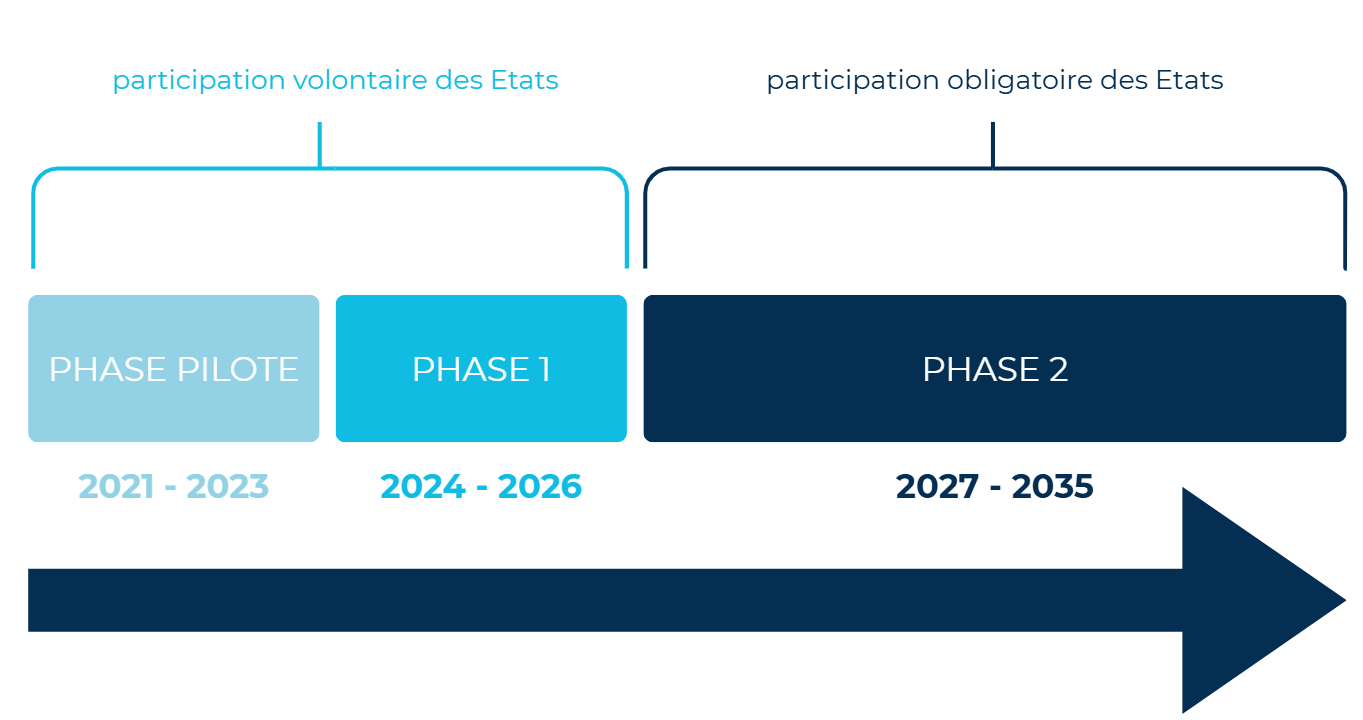
The CORSIA program consists of three phases and ends in 2035
- Limitations:
- Domestic flights not covered;
- Participation will remain voluntary until 2027;
- Doubts about the effectiveness and quality of certain carbon credits.
✈️ Reducing Air Travel
Beyond technical and economic measures, reducing demand for air travel remains a powerful but politically sensitive strategy. It relies on several levers:
- Shifting to rail for short-distance travel
- Reduce business travel through the use of digital tools (videoconferencing, remote meetings).
- Raising travelers' awareness of the climate impact of air travel
This restraint in consumption—sometimes referred to as “energy efficiency”—complements technological efforts. It is essential for limiting the growth of emissions in a sector where every technological advance remains, for now, constrained by rising demand.
Given that air pollution from maritime transport contributes not only to greenhouse gas emissions but also to the emission of fine particulate matter, every player in the industry must rethink its business model.
- Fuel accounts for an average of 50 to 60 percent of a ship’s operating costs
- Even a slight reduction in consumption therefore directly reduces financial expenses.
In France, as elsewhere, regulatory and societal pressure is mounting to accelerate the energy transition. Using energy more efficiently is becoming not only an economic imperative but also a strategic opportunity.
Furthermore, by planning ahead for future carbon taxes (such as the EU’s proposed maritime carbon tax scheduled for 2026) and the quotas imposed by the European Union’s Emissions Trading System (ETS) for maritime transport, companies can avoid heavy financial penalties.
The international aviation sector faces a major challenge: reducing its impact on the climate while meeting growing demand for air travel. Biofuels offer a promising alternative. However, they are not enough to offset the rise in energy consumption resulting from the increase in the number of flights. Furthermore, their production raises questions about the sustainability of the resources used and competition with other global energy needs.
To accelerate the transition, it is essential to have access to reliable, accessible, and action-oriented tools.
This is precisely the goal of Decarbo’Solution®, through its SaaS platform dedicated to measuring, tracking, and reducing CO₂e emissions. Thanks to its expertise and highly accurate data, Decarbo’Solution® enables various organizations to:
- Accurately measure their carbon footprint,
- Identify specific ways to reduce[...],
- Proactively manage their climate strategy,
- Offset residual emissions
🌱 In a world where environmental responsibility is becoming the norm, Decarbo’Solution® positions itself as a key partner in driving a more responsible aviation industry, aligned with planetary boundaries and societal expectations.

Sources
- https://www.senat.fr/rap/r23-650/r23-6507.html
- Common misconception: Aviation accounts for less than 3% of greenhouse gas emissions
- Record Growth in Air Freight Traffic in 2024
- Air Traffic-Related Gas Emissions | Ministries of Land Use Planning and Ecological Transition
- https://www.transportenvironment.org/te-france/articles/emissions-aviation-en-2023-inquietant-rebond-compagnies-low-cost
- https://www.lemonde.fr/planete/article/2024/11/14/les-jets-prives-utilises-comme-des-taxis-ont-quasi-double-leurs-emissions-carbone-en-cinq-ans_6392797_3244.html
- https://wwws.airfrance.gp/information/developpement-durable/carburants-aviation-durables
- https://www.boursorama.com/bourse/actualites/zoom-sur-le-developpement-des-carburants-d-aviation-durable-les-saf-54ab667410b9f49471f5b7c57441a802