









Local Governments and CO2: How Can We Decarbonize?

At a time when combating climate change, promoting sustainable development, and decarbonizing the service sector have become critical issues, local governments play a leading role in implementing ambitious strategies. As local stakeholders, they are at the heart of the transition toward a more sustainable and resilient future.
Whether it involves financial resources, compliance with applicable regulations, or choosing the right methods to assess their carbon footprint, this publication explores the many challenges local authorities face. You’ll learn about the obstacles to overcome and the solutions to adopt in order to meet these challenges.
1. How can local governments help achieve the goals of the National Low-Carbon Strategy (SNBC)?
2. Local Governments and Environmental Commitment: What Are Their Obligations?
3. Are you a local government? Trust Decarbo’Solution® to conduct your Bilan Carbone® assessment

How can local governments help achieve the goals of the National Low-Carbon Strategy (SNBC)?
In 2022, the Institute for Climate Economics (I4CE) published a study on the role of local governments in achieving France’s carbon neutrality goals by 2050, as outlined in the National Low-Carbon Strategy (SNBC).
As a reminder, the SNBC is the roadmap established by France to combat climate change. It provides guidance on how to implement the transition to a circular, sustainable, and low-carbon economy across all sectors. The roadmap focuses on two major objectives: achieving carbon neutrality by 2050 and reducing the carbon footprint of French consumer spending. What role should local authorities play in achieving this goal?
According to I4CE, to accelerate their environmental commitments, local governments must double their climate investments and significantly strengthen their engineering capabilities. But why is this necessary?
First, local governments will need to invest 12 billion euros each year from 2021 to 2030 to meet the SNBC’s goals. This represents 18% of their current total investment budget, distributed across three key sectors:
🚲Mobility, which accounts for 67% of investments, particularly for bicycle infrastructure (3.3 billion euros per year) and funding for rail and public transportation (3 billion euros per year).
🏢 Energy-efficiency renovations of public buildings (2.7 billion euros per year).
💡Energy efficiency in street lighting and district heating systems (1.1 billion euros per year).
With regard to engineering needs, the study highlights the need for local authorities to increase their human resources for climate engineering, which entails an increase in operating expenses. This applies to both the launch and oversight of climate investments, as well as fostering decarbonization efforts among businesses and other stakeholders in their communities.
Thus, at least 25,000 staff members dedicated to managing local governments’ climate actions would be needed to meet the SNBC’s goals. This represents approximately 1.5 billion euros in annual payroll costs.
As you can see, financing the fight against climate change requires significant human and financial investments. Local authorities therefore have a vital role to play in this effort. By investing heavily in key sectors such as transportation, energy-efficient renovations of public buildings, and energy efficiency, they will actively contribute to achieving the goals of the SNBC.
Furthermore, by strengthening their engineering capabilities and mobilizing dedicated staff, they will ensure the effective implementation of environmental measures in their region. The commitment of local authorities is therefore crucial to achieving these ambitious goals and building a more sustainable future.

Local Governments and Environmental Commitment: What Are Their Obligations?
Local authorities are bound by a variety of obligations designed to strengthen their commitment to climate action.
📋 The Territorial Climate, Air, and Energy Plan (PCAET)
The PCAET is a planning approach that is both strategic and operational and encompasses all sectors of activity. Its goal is to mobilize all economic, social, and environmental stakeholders under the coordination of a lead local government. It aims to achieve the following objectives:
✅ Reducing the community’s greenhouse gas (GHG) emissions to combat climate change (the “mitigation” component);
✅ Adapting the region to the effects of climate change in order to mitigate its economic, social, and health impacts, among others (the “adaptation” component);
✅ Improving air quality to protect the health of local residents.
The PCAET, which is revised every 6 years and includes a midterm evaluation, consists of four main parts:
✅ A regional assessment;
✅ A strategy (strategic and operational objectives and a costed transition plan);
✅ An action plan;
✅ A system for monitoring and evaluating results.
Who is affected?
The development of a PCAET is mandatory forall intermunicipal communities with their own taxing authority that have more than 20,000 residents (“mandated” EPCIs), while it is only recommended for smaller intermunicipal communities (voluntary PCAET).
📝 The Sustainability Report
To encourage local authorities to highlight their contribution to sustainable development (SD) in their communities, the Grenelle 2 Act of July 12, 2010, requires certain local authorities to prepare and submit a report on the status of sustainable development prior to the Budget Orientation Debate (DOB).
This report, viewed as a tool for local dialogue, enables local authorities to reevaluate their public policies, operations, and approaches with a view to promoting sustainable development in their region.
This requirement is intended to encourage in-depth reflection and promote the integration of sustainable development principles into their policies.
Who is affected?
👉 Municipalities with more than 50,000 residents
👉 Public intermunicipal cooperation entities with their own taxing authority serving a population of more than 50,000
👉 The departments
👉 The regions
👉 The Regional Authority of Corsica
📊 The Bilan Carbone® “Heritage and Skills” and “Region”
Required under the PCAET and Decree No. 2011-829 of July 11, 2011, the Bilan Carbone® is an essential tool for assessing the carbon footprint of local governments. There are two types of Bilan Carbone®:
The Bilan Carbone® “Patrimoine et Compétences” (P&C): focuses on the real estate assets held by the local government and on the exercise of its specific responsibilities.
The Bilan Carbone® “Territory”: takes a broader geographic approach, considering the entire locality and the activities of all stakeholders operating there. This assessment takes into account:
Direct emissions: emissions that occur locally, regardless of the source
Indirect emissions: emissions generated by entities in the region. They occur outside the locality but contribute to its functioning; examples include emissions associated with the transportation of “imported” goods, emissions associated with the manufacture (outside the region) of a product consumed by a local entity, and so on.
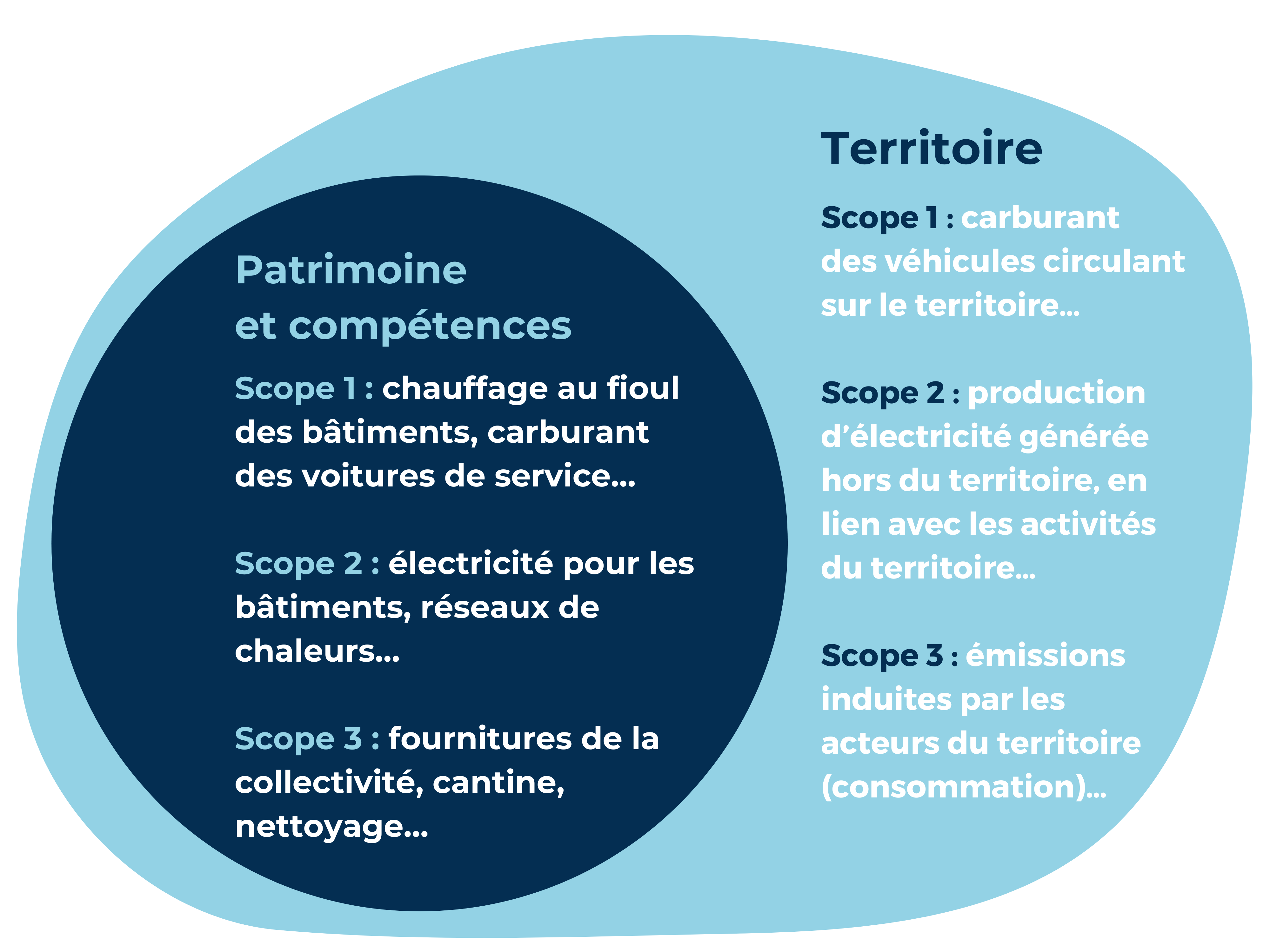
Local authorities have three methods at their disposal for preparing their Bilans Carbone®:
Inventories: These methods focus on accounting for direct emissions (Scope 1) generated locally.
Aggregate methods: These methods take into account all emissions from a region or local government (P&C), whether they originate from sources within or outside the locality. These methods include emissions from the three categories: Scope 1, Scope 2, and Scope 3 (indirect emissions).
The regulatory BEGES method: This method, provided for in Article 75 of the Grenelle 2 Act, covers a portion of the emissions associated with the local government’s assets and responsibilities (P&C).
These different approaches provide them with flexible options for assessing and quantifying their greenhouse gas emissions. They thus enable companies to better understand the environmental impact of their activities and to implement appropriate measures to reduce their carbon footprint and contribute to the transition to a more environmentally friendly economy.

💪 What measures can local governments take to comply with the SNBC and applicable regulations?
According to I4CE, there is a wide range of actions that local authorities can implement:
🏢 Energy-efficient building retrofits: The Tertiary Sector Energy Efficiency Program (DEET), also known as the “Tertiary Decree,” mandates a reduction in building energy consumption of 40% by 2030, 50% by 2040, and by 60% by 2050, compared to 2010 levels, and applies to all commercial buildings or business premises with a usable floor area of 1,000 m² or more;
🌱 La réduction de l’artificialisation des sols : la Loi Climat et Résilience adoptée en 2021 fixe l’objectif, à horizon 2030, de diviser par deux le rythme d’artificialisation par rapport à la consommation d’espaces observée depuis 2010 et d’atteindre un état de zéro artificialisation nette (ZAN) à horizon 2050.
💡Energy efficiency in street lighting: The Environmental Code identifies facilities that must be covered by a policy designed to prevent, reduce, and limit energy consumption.
🚙 Making local government vehicle fleets more environmentally friendly: Article 76 of the Mobility Framework Act (LOM) requires a minimum proportion of low-carbon vehicles when local governments purchase or replace their fleets;
🌿 Establishment of Low-Emission Zones (LEZs): The Climate and Resilience Act extends the requirement to establish a LEZ to municipalities with more than 150,000 residents.
🚊Developing a sustainable mobility policy for the locality: The Transportation Code requires Mobility Planning Authorities (AOMs) whose jurisdiction includes more than 100,000 residents to develop a Mobility Plan.
🍽️ Decarbonizing institutional food service: The Egalim Act, passed in 2018, sets a target of sourcing 50% of products from responsible, high-quality sources, including 20% from organic farming.
🛒 Low-carbon procurement policy: The Law on Energy Transition and Green Growth (LTECV), adopted in 2015, mandates the implementation of plans to promote socially and environmentally responsible procurement (SPASER) for public entities with procurement budgets exceeding 50 million euros.
📉 Developing an action plan consistent with the SNBC objectives: The LTECV mandates that EPCIs with more than 20,000 residents develop and implement Territorial Climate, Air, and Energy Plans (PCAETs); At the regional level, the development of the SRADDET was also made mandatory by the NOTRe Act adopted in 2015.
Implementing these measures gives local authorities the opportunity to transition to more environmentally friendly practices, while ensuring compliance with current laws and preparing for potential future regulations.
Are you a local government? Trust Decarbo’Solution® to conduct your Bilan Carbone® assessment and decarbonize your procurement
Decarbo’Solution® (Decarbo’Solution®) helps local governments address today’s environmental challenges through its 24/7 online service platform, which assists local authorities in calculating and reducing their carbon footprint while complying with applicable laws, guidelines, and standards. Its exclusive service, Décarbon’achats®, makes it possible to drastically reduce the area that is traditionally the largest source of carbon emissions: the purchase of products and services.
The services offered by Decarbo’Solution® are characterized by their ease of use and extremely affordable cost. They enable local authorities to commit with confidence and to engage their service providers, subcontractors, and suppliers in a shared effort to reduce greenhouse gas emissions in the region.
The Decarbo’Solution® network of Certified Experts also helps promote best practices among local authorities, enabling them to address the challenges posed by climate change.
Through these services, local authorities benefit from the development of a roadmap to excellence that incorporates all recognized practices for accounting for, reducing, and reporting greenhouse gas emissions.
If necessary, local governments also have the option of partnering with Decarbo’Solution® on a carbon offset program to achieve a short- or long-term carbon neutrality goal. In this way, local authorities receive comprehensive support to help them take concrete action on climate change.
For more information:
- Discover the Environmental Impact of Mid-Sized Companies (ETI)
- How can nonprofit organizations take responsibility for their carbon footprint?
- GHG reduction measures to lower the company’s transportation footprint
- How do you calculate an event’s carbon footprint?
- Local Governments and CO2: How Can We Decarbonize?
- How Is the Financial Sector Becoming a Key Player in the Green Transition?
- Specific Characteristics of Digital Activities and Services in Carbon Footprint Assessments
- SFDR: A New Turning Point for European Financial Markets
- Carbon Footprint: The Impact of Very Large Companies