







Eco-design: A Key Driver of Responsible and Sustainable Innovation
In 2020, 75% of companies had already incorporated eco-design into their strategy, according to the ADEME survey. What about you—are you ready to take the plunge?
Eco-design is now emerging as an essential solution for combining economic performance with environmental responsibility. This approach aims to optimize the use of resources and minimizethe impact of products and services from the design stage onward, while promoting more sustainable development for the company.
But in practical terms, what is eco-design?
Il s’agit d’intégrer des principes environnementaux dès la phase de conception d’un produit ou d’un service afin d’en réduire l’impact tout au long de son cycle de vie. Cela concerne aussi bien le choix des matériaux, l’optimisation de la fabrication, la logistique, l’utilisation du produit que sa fin de vie (réparabilité, recyclabilité, réemploi). Les ressources numériques, comme les logiciels d’analyse du cycle de vie, jouent un rôle clé pour mesurer et améliorer l’empreinte des produits et services. A savoir que les sites web eux-mêmes ont une empreinte carbone non négligeable, liée à la consommation d’énergie des serveurs, au stockage des données et au trafic en ligne. Pour aller plus loin, découvrez comment réduire l’impact environnemental des data centers.
In a world where regulations are becoming stricter and consumers are increasingly demanding when it comes to sustainability, eco-design represents a powerful driver of innovation and differentiation for businesses. Let’s take a closer look at its fundamental principles, the key steps for implementing it, and the benefits it offers.
The Fundamentals of Eco-Design
♾️What is eco-design?
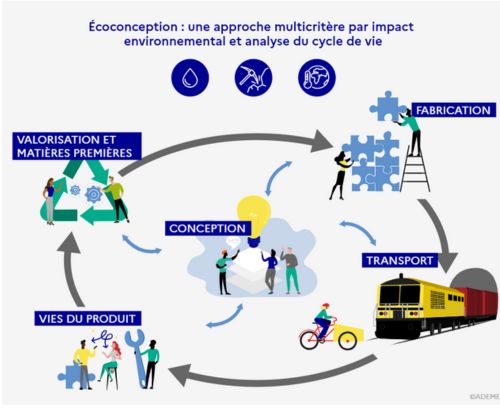
Eco-design is an approach that aims to reduce the environmental footprint of a product or service from the design stage onward, taking into account its entire life cycle.
Unlike traditional practices, which focus primarily on optimizing costs and performance, eco-design takes a more comprehensive and sustainable approach, thereby contributing to a culture of responsible innovation.
It is based on several key principles:
- Minimize resource extraction: prioritize recycled, bio-based, or low-impact materials.
- Optimize production: reduce energy consumption and waste during manufacturing.
- Extend the product's lifespan: promote repairability, modularity, and upcycling.
- Facilitating the end of a product's life: considering recycling and reuse from the design stage.
ADEME
🗝️Environmental and Economic Challenges
Eco-design addresses two challenges: environmental and economic.
🔹 Reducing environmental impacts
- Reduction in CO₂ emissions from manufacturing and transportation.
- Reduced consumer waste through the use of recyclable and reusable materials.
- Optimizing the energy consumption of products during use.
🔹 Economic and Competitive Benefits
- Reducing costs by optimizing the use of resources and minimizing waste.
- Enhancing brand image and attracting consumers looking for sustainable products.
- Competitive differentiation in a market that is increasingly sensitive to environmental issues.
Eco-design is more than just a trend; it is becoming a genuine strategic objective for any company seeking to ground its projects in a sustainable and innovative approach.
⚖️Standards and Certifications
Eco-design is based on recognized standards that ensure the credibility of the approaches adopted:
- ISO 14006: an international standard that provides guidance to companies on integrating eco-design.
- Eco-labels and certifications: NF Environnement, the European Eco-label, Cradle to Cradle… These labels provide official recognition and give consumers peace of mind.
- European regulations: Under the Corporate Sustainability Reporting Directive ( CSRD ), companies are now required to account for their environmental impact, making eco-design essential.
“For 40% of the companies surveyed as part of the ADEME Eco-design Barometer, eco-designing products and services is a way to anticipate future regulations (CSRD, REACH, Ecodesign, etc.).”
Implement an eco-design strategy
🔄Key Steps in the Process
1️⃣ Conduct a Life Cycle Assessment (LCA)
LCA makes it possible to assess a product’s environmental impacts at every stage: raw material extraction, manufacturing, transportation, use, and end of life. It is a key tool for guiding design decisions.
2️⃣ Design a more sustainable product
- Choice of materials: Give preference to recycled, bio-based, or locally sourced materials.
- Design Optimization: Reducing complexity to facilitate disassembly and recycling.
- Greener production: minimizing waste and reducing the energy footprint of factories.
3️⃣ Optimize distribution and usage
- Reducing the weight and volume of products and packaging to minimize the transportation footprint.
- Promoting responsible consumption (reusable products, easier repairs).
4️⃣ Planning for the End of Life
- Incorporate materials that are easy to recycle from the design stage onward.
- Implement refurbishment or repair solutions to extend the product's lifespan.
⚙️Available Tools and Methods
📊 Specialized software for PCF calculations:
Decarbo’Solution® is positioned as an essential tool for accurately calculating a product’s carbon footprint (PCF). It enables companies to assess and optimize their environmental impact.
Other tools, such as SimaPro, GaBi, and OpenLCA, are also used for life cycle analysis and the assessment of environmental impacts.
📚 Assessment Methods for Businesses: GHG Assessment, Eco-Design Using Design Thinking, Eco-Innovation Matrix.
🛠 Expert support (CSRD compliance, carbon footprint assessment, etc.): specialized engineering firms, sustainability consultants.
💡Examples of Successful Initiatives
- Product: Adidas has partnered with the environmental organization Parley for the Oceans to create shoes made from recycled ocean plastic. The first model, the UltraBOOST Uncaged Parley, launched in 2016, was made from 95% plastic recovered near the Maldives.
- Textiles: To reduce its carbon footprint, Patagonia now incorporates recycled materials and designs that promote reparability.
- Electronics: Apple has made significant progress in incorporating eco-design principles into its products. In 2021, the company used 59% recycled aluminum, 45% recycled rare earth metals, and, for the first time, certified recycled gold in the manufacture of its devices. These initiatives are part of Apple’s goal to achieve carbon neutrality by 2030.
The Benefits and Prospects of Eco-Design
💚Meeting Consumer Expectations
Consumers, investors, and regulators are increasingly demanding transparency and environmental accountability.
- Consumers: According to a study conducted by Poll&Roll and Helios, 52% of French people say they are willing to pay more for environmentally friendly products.
- Businesses: improved brand image, increased customer loyalty, and reduced costs.
- Investors: Growing Interest in Companies Committed to Sustainability Initiatives.
♻️Contribute to a circular economy
L’éco-conception favorise la transition vers une économie circulaire en réduisant les déchets et en valorisant les matières en fin de vie. Une démarche d’ailleurs encouragée par la loi économie circulaire (AGEC).
- Reuse and Repair: Extending the Lifespan of Products.
- Recyclability: Designing products that incorporate materials that are easy to recycle.
- Rental- or sharing-based models: examples include secondhand clothing and car-sharing services.
📢 Toward the Widespread Adoption of Eco-Design
The systematic integration of eco-design into all sectors is becoming a necessity. To achieve this:
- Raising awareness among businesses and consumers about environmental issues.
- Financial incentives: grants and tax credits to encourage green innovation.
- Tighter Regulations: Increasingly Strict Environmental Requirements at the European and Global Levels.
Adopting eco-design is much more than just an environmental initiative: it is a powerful driver of innovation, competitiveness, and differentiation. Faced with growing consumer demands and increasingly strict regulations, companies have every reason to incorporate these principles from the very beginning of the design phase for their products and services.
But how can you actively engage in this transition? Decarbo’Solution® supports you in implementing a low-carbon strategy tailored to your business. From analyzing the life cycle of your products (PCF) to optimizing your processes, we help you reduce your environmental footprint while boosting your economic performance.

Our carbon experts are available to provide a free of our platform with no obligation. 🚀
Sources