









Direct and Indirect Emissions: A Map of Scopes 1, 2, and 3 According to the GHG Protocol

Conducting acarbon assessment® allows an organization to measure its carbon footprint by quantifying all direct and indirect greenhouse gas (GHG) emissions it generates. This provides an accurate assessment of the organization’s environmental impact. To conduct a carbon assessment in compliance with standards, it is necessary to use the scopes.
The Bilan Carbone® (see definition)aggregates the precise GHG emissions from the three scopes, which cover three types of emissions:
Scope 1: Direct GHG emissions from fixed or mobile facilities controlled by the company
Scope 2: Indirect emissions associated with the production of electricity, heat, or steam imported for the organization’s operations
Scope 3: Indirect emissions resulting from, among other things, purchases. These often account for more than 60% of a company’s GHG emissions!
We also refer to these as “scope 4” emissions—that is, emissions avoided.
In short: The Carbon Footprint® classifies greenhouse gas emissions into three scopes defined by the GHG Protocol: Scope 1 (direct emissions), Scope 2 (indirect energy-related emissions), and Scope 3 (other indirect emissions, often accounting for more than 60% of the total). Scope 4 refers to emissions avoided as a result of a product or service. (Updated September 4, 2026)
What are scopes?
Scopes are a classification system used to assess greenhouse gas (GHG) emissions as part of a carbon footprint® assessment. Defined by the GHG Protocol, scopes are key tools for assessing and categorizing the GHGs emitted by an organization. There are three different types of scopes.
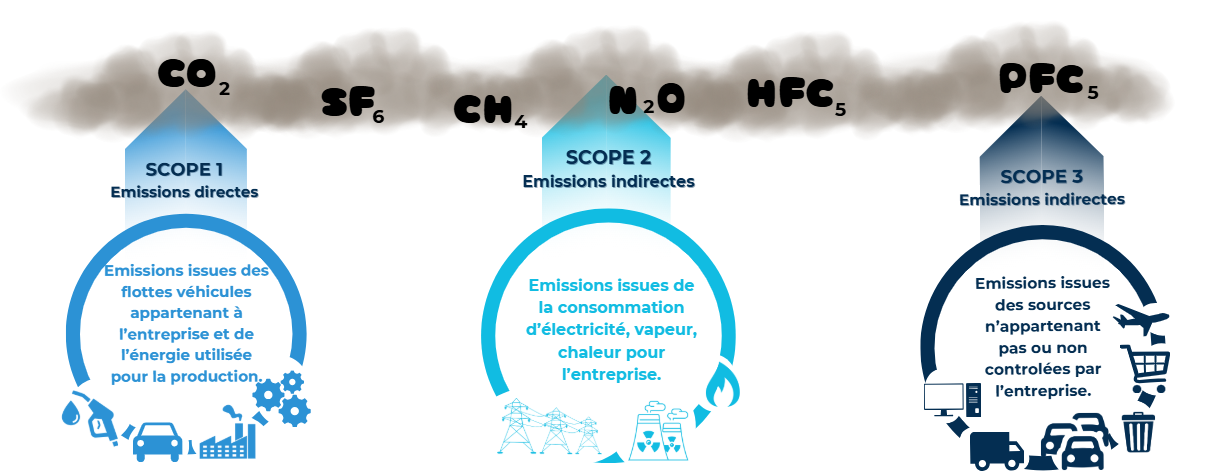
The 3 scopes
🏭 Scope 1
Scope 1 includes all emissions generated directly by the company and its operations: factories, facilities, warehouses, offices, and vehicle fleets owned by the company.

💡 Scope 2
Scope 2 includes all emissions associated with a company’s consumption of electricity, heat, or steam at its facilities or in its vehicle fleets. These are referred to as energy-related indirect emissions (GHG emissions occur at the facilities of the producers and distributors of electricity, heat, or steam).
Scope 1 and 2 emissions are often already being tracked and subject to reduction targets, since they are the company’s direct responsibility and are easy to track because they can be measured directly through its various energy consumption sources.
Company performance is often highly optimized, so it is becoming increasingly difficult to achieve gains in Scopes 1 and 2.

🛒 Scope 3
Scope 3 refers to all other indirect emissions occurring upstream or downstream in the company's value chain.
Even though they are not directly generated by the organization, it is easy to see that they are nonetheless essential to its operations.
They are often poorly optimized, so they offer reduction potential that is often easy to achieve, which is why it is important to analyze and measure them accurately as part of a regulatory GHG inventory. Measuring them is not always easy; the priority seems to be to focus on the major sources—namely, emissions from large Tier 1 suppliers and those associated with upstream and downstream transportation.

It should also be noted that Scope 3 is a very significant category, generally much larger than Scopes 2 and 1.
Generally speaking, the most significant Scope 3 emissions for manufacturing companies are as follows:
✅ Emissions from its direct suppliers and throughout the value chain of its products
✅ CO2 emissions from upstream transportation, as well as those from downstream transportation and distribution
✅ Finally, one category can be particularly significant in certain sectors (such as the automotive industry): emissions associated with the product’s use throughout its lifecycle. This category, however, differs in nature from the others; it goes without saying that, in general, a product’s energy efficiency is directly linked to its quality and design.

What are the main regulations, standards, and methodologies for GHG accounting?
Scope 4: Emissions Avoided
According to the GHG Protocol, Scope 4 includes emissions reduced through the use of a product that replaces other goods or services, while offering similar functions but with a smaller carbon footprint. The GHG Protocol also takes into account emissions reduced through the recycling of a product .
As you can see, understanding and applying the three scopes (Scopes 1, 2, and 3) are essential for comprehensively and accurately assessing an organization’s greenhouse gas emissions.
These scopes provide a framework for accounting for various sources of direct and indirect emissions, thereby enabling organizations to identify levers for action to reducetheir carbon footprint. By adopting a holistic approach and integrating all scopes, organizations can better understand their impact on climate change and develop sustainable strategies to minimize their emissions.
This includes not only reducing direct emissions from their internal operations, but also managing indirect emissions throughout their value chain.
The implementation of emission reduction measures in each scope thus contributes significantly to the transition toward an economy with increasingly lower carbon emissions.
Our carbon experts are available to provide a free of our platform, with no obligation. 🚀
Related topics: