







Sustainable Development Explained Simply

Sustainable development—a concept now at the heart of economic, social, and environmental debates—refers to a new way of thinking aboutgrowthandprogress. More than just a buzzword, it is acomprehensive worldviewaimed at meeting theneeds of the present without compromising the ability of future generationsto meet their own needs. Thisdefinition of sustainable development, taken fromthefamousBrundtland Reportpublished in 1987 by theWorld Commission on Environment and Development, remains the international standard to this day.
From theUnited Nations Conference on the Human EnvironmentinStockholmin 1972 to theEarth Summit in Rioin 1992,developedand emergingcountrieshave gradually come to realize the need to rethink theirdevelopment models. Faced withclimate change, the depletion ofnatural resources, and social inequalities, global institutions—includingthe United Nations (UN)andthe European Union—have established acommon framework for actioncentered on theSustainable Development Goals (SDGs).
TheseSustainable Development Goalsserve as a universal roadmap that guides public policies and private initiatives toward a moreenvironmentally friendly,socially equitable, andeconomically responsible future.
InFrance, as elsewhere, the concept ofsustainable developmentis now an integral part of all public policies andcorporate strategies.TheCorporate Sustainability ReportingDirective (CSRD), implemented bythe European Union—even though its content and scope of application have been scaled back by the Omnibus Regulation—encourages organizations to publish a detailedreporton theirenvironmental,social, and economic impacts. This requirement reflects a newresponsibilityfor economic actors: to ensuresustainable growth based on respect forenvironmental principlesandhuman rights.
But what does the concept ofsustainable developmentreally entail? Where does it come from, what are itspillars, and how is it applied in practice withinmodernbusinessesandsocieties?
In this article, we’llexplain sustainable development in simple terms—from itsoriginsto itscurrent applications—so we can understand its fullimplicationsfor ourplanet, oureconomies, and ourdaily lives—and discover how each Sustainable Development Goal contributes to building a more harmonious future.
Contents
Understanding Sustainable Development: Definition and Origins
Definition of sustainable development according to the Brundtland Report
The term“sustainable development” came into widespread use in the late 20th century thanks to the work of theWorld Commission on Environment and Development, led byGro Harlem Brundtland. In 1987, the commission published a seminal document: theBrundtland Report, titled*Our Common Future*.
This document introduces adefinition of sustainable developmentthat has become universally accepted:
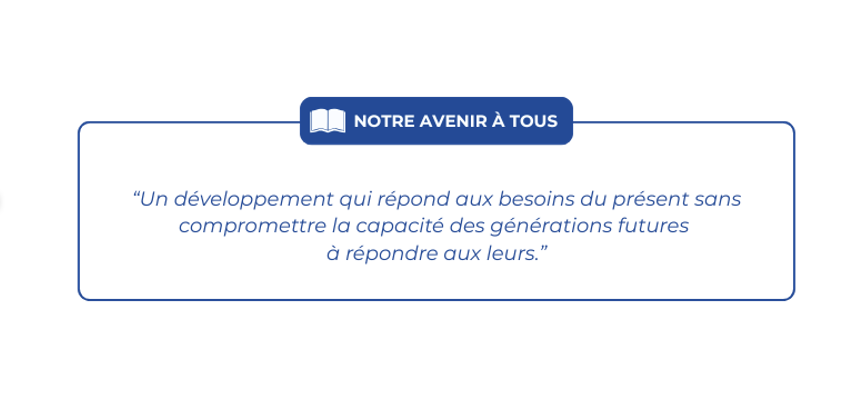
This sentence sums up a key idea: meeting today’s human needs while preservingnatural resourcesand ecological balance for tomorrow.
Sustainable developmentis thus based on three main principles:
- environmental protection,
- social justice,
- andeconomic responsibility.
The goal is to reconcile human success with the protection of the planet, without compromising the future of coming generations. This vision is based on an ethic of responsibility, inspired in particular by the philosopherHans Jonas, who believed that each generation must act with caution toward the next.
From International Conferences to Global Awareness
Long before the publication of the Brundtland Report, environmental issues had already come to the forefront of the international stage. In 1972, theStockholm Conference on the Human Environmentbrought together representatives from more than 100 countries for the first time. This meeting marked the beginning of a global dialogue on the preservation of ecosystems and the management ofnatural resources.
Twenty years later, in 1992, theEarth Summit in Rio de Janeirofurther reinforced this awareness. At the summit, nations adopted several major documents:
- Agenda 21, an action plan for protecting the planet at the local and global levels;
- The Climate Change Convention, which laid the groundwork for the futureParis Agreement;
- The Convention on Biological Diversity, for the protection of species and natural habitats.
These international meetings paved the way for a shared vision ofsustainable developmentbased on cooperation and shared responsibility. They also inspired the adoption, in 2015, ofthe Sustainable Development Goals (SDGs). These 17 goals set global priorities: eradicating poverty, limiting global warming, protecting the oceans, ensuring access to education, and fostering a more equitable society.
The Sustainable Development Goals thus reflect a collective commitment to combining social progress, environmental protection, and economic efficiency. Today, they serve as a benchmark for evaluating public policies and private initiatives around the world
A New Commitment for Businesses: The CSRD Directive
Over the past two decades,sustainable developmenthas become a requirement not only for governments but also forbusinesses. InEurope,the Corporate Sustainability Reporting Directive (CSRD), adopted in 2022—even as watered down by the Omnibus Regulation—reinforces this trend.
This legislation requires large organizations to publish a detailed report on their environmental, social, and governance performance. The goal is clear: to encourage companies to adopt more responsible practices, reduce theirgreenhouse gas emissions, and manage theirnatural resources more effectively.
InFrance, this directive is part of a movement already set in motion byCorporate Social Responsibility (CSR). It encourages economic actors to integratesustainable development goalsinto the core of their strategies.
This translates into:
- greater transparency in reporting environmental impacts;
- an accurate assessment of the risks associated withclimate change;
- and greater consideration of human and social issues.
The sustainability reportthus becomes an essential tool for measuring the progress organizations have made. It is no longer just a matter of limiting the damage, but of anticipating the changes needed to build an economy that is truly respectful of the environment and future generations.
The Pillars of Sustainable Development: A Balance Between the Economy, Society, and the Environment
Preserving the Earth and Rethinking Our Relationship with the Environment
The first pillar of sustainable development is the protection of the planet. This involves adopting a moreenvironmentally friendly approachto address the degradation of our natural habitats and climate change, which are already affecting the entire world.
Since the 1992Rio Conference, several international conventions have been established to provide a framework for combating pollution and deforestation. These initiatives aim to curbglobal warmingand encourage a more thoughtful use of the resources the Earth provides us.
Businesses play a vital role here. Having long focused on financial performance, they are now rethinking their practices to adopt a more environmentally friendly model. In France, as in other European countries, many companies are taking steps to reduce greenhouse gas emissions, promote recycling, and drive green innovation.
The central idea is to maintain a balance between technological progress and protecting the planet. This cultural shift is based on simple principles: limiting negative impacts on nature, using raw materials carefully, and encouraging stakeholders to adopt environmentally friendly solutions.
Every business, every citizen, and every country can contribute to this global movement. The Earth belongs to no one: it must be shared and preserved by all, based on the principles of fairness and solidarity.
Putting People at the Heart of Progress
The second pillar of sustainable developmentemphasizes the human dimension. Behind the grand rhetoric about climate change and biodiversity are people, communities, and societies whose well-being depends on collective choices.
There are manysocial challenges: reducing inequality, improving working conditions, ensuring access to health care and education, and promoting gender equality. TheUnited Nationschampions these values through theSustainable Development Goals (SDGs), which offer aglobal visionof a more just future.
Companies are actively participating in this transformation. By improving the quality oflifeat work, respecting human rights, and supporting the communities where they operate, they are becoming true social actors. This evolution is accompanied by regular monitoring: organizations now publish non-financial reports to account for their practices.
This approach goes beyond mere compliance with regulations. It reflects a new vision of progress: development is meaningful only if it benefits everyone, without exception.Frenchgovernments, local authorities, andbusinessescontribute to this balance by promoting more inclusive models, where human performance is valued just as much as financial results.
Solidarity thus becomes a driving force for action, connecting the people of today and tomorrow through a shared vision of equity and mutual respect.
Toward Responsible and Shared Prosperity
The third pillar of sustainable developmentfocuses on collective prosperity. The challenge is not to slowgrowth, but to make it more equitable and more respectful of planetary boundaries.
Economic actors—companies, governments, and organizations—must now balance efficiency with ethics. This approach is reflected in European policies, such as theGreen Deal, which promotes the transition to cleaner and more low-carbon economic activity.
French companies are innovating in this area: they are investing in green energy, sustainable transportation, waste reduction, and the modernization of industrial processes. These initiatives, evaluated according toenvironmental and social criteria, form the basis of a new business model centered on overall performance rather than immediate profit.
This approach transforms the way we think about growth. It is based on the idea of cooperation: rather than pitting the economy against the environment, it seeks to unite them to build a more balanced future. Governments support this movement through tax incentives, while consumers favor products made with ethical practices in mind.
Ultimately, this third pillar demonstrates that success is no longer measured solely by numbers, but also by positive impacts.
Every organization can thus contribute to a more harmonious world, where ecological and human principles guide collective decisions. This vision, already shared by many European countries, is gradually becoming self-evident: protecting the planet also means protecting the future of our societies.
First, the use of GCI has led to a significant reduction in the uncertainty of the GHG inventory—particularly for Scope 3—from 50% to 5%. The group therefore has data that is 95% accurate.
Using supplier data collected and analyzed by the GCI tool, in-depth analyses were conducted internally on the impact of 35,000 products, grouping suppliers into 170 categories. This represents more than 80% of purchases by volume and value.
Sustainable Development in Action: Toward a Responsible Future
A Roadmap for Shaping Our Future
Adopted in 2015 by the United Nations, a set of global priorities now charts the course for a profound transformation of our societies.
This universal plan seeks to eradicate poverty, protect nature, and ensure a more equitable future for all. It is based on shared values: solidarity, respect for the environment, and a balance between human progress and planetary boundaries.
These commitments now serve as a benchmark to guide not only public policy but also the strategies of private and institutional organizations.
In France, as elsewhere, organizations committed to the ecological transition draw inspiration from them to guide their actions: fostering education, promoting health, reducing pollution, and preserving biodiversity.
The term often associated with this approach is no longer just a political term, but a true ethical compass. It symbolizes the desire to build a harmonious future that respects life in all its forms.
The Vital Role of the Private Sector and Public Organizations
Beyond political decisions, the productive and institutional sectors play a crucial role in ecological and social transformation.
Businesses, nonprofit organizations, and local governments have the power to take concrete action: they design, invest, produce, and innovate.
In France, many organizations are rethinking their operations to align with theenvironmental principlesestablished at the European level. This includes reducing greenhouse gas emissions, promoting the circular economy, reusing materials, and encouraging more sustainable production models.
TheEuropean Commission, through itsGreen Deal, is promoting this transition through funding and support programs. The goal is to stimulategrowththat both creates jobs and preserves environmental balance.
To measure progress, a non-financial report is often prepared. It allows for an assessment of the environmental performance, governance, and social impact of the organizations involved.
To support these assessment efforts, innovative digital tools now facilitate the collection and analysis of key indicators.
Among them, Decarbo’Solution®, developed by Decarbo’Solution® (Decarbo’Solution®), embodies an approach that is both environmentally friendly and strategic.
This solution helps each company structure its reports, accurately measure its carbon emissions, and showcase its efforts within a framework consistent with European requirements and transparency principles.
By centralizing information on resources, social initiatives, and environmental performance, Decarbo’Solution® becomes a true pillar of decision support.
It provides a clear, comparable overview that complies with the standards established by theCSRD Directive, while promoting the integration of environmental values within organizations.
This digital solution, designed and deployed by a French team,perfectly illustrates the concept of a tool that supports collective transformation.
It effectively links environmental and social commitments to measurable results, while strengthening companies’ credibility with their stakeholders.
In the spirit of major international climate conferences, Decarbo’Solution® embodies the commitment to turn pledges into concrete actions.
It symbolizes a simple yet essential principle:making carbon measurement and environmental performance the drivers of sustainable and transparent change, at the heart of the ecological and social model championed by Decarbo’Solution®.
This new approach is aimed not only at profitability, but also at ensuring consistency between economic activity and adherence toethical principles.
By adopting these practices, the French economy demonstrates that responsible prosperity is not only possible but also desirable.
Toward a Shared Environmental Culture
The success of the transition depends above all on a shift in mindsets.
More than just a set of policies, it is acollective culturethat is taking shape, based on an awareness of our interdependence with nature.
Iconic figures such asGro Harlem Brundtland,Hans Jonas, andKofi Annanhave helped shape a new way of thinking about the future.
Their reflections remind us that every generation bears some responsibility toward future generations.
In France, nonprofit organizations, schools, local governments, and public institutions are actively contributing to this growing awareness. Numerous projects are being launched, including renewable energy production, cleaner transportation, soil-friendly agriculture, and energy-efficient architecture…
At the European and international levels, cooperation is intensifying. A series of conferences, from Stockholm to Paris, reflect a growing commitment to limiting global warming. These meetings are based on a fundamental principle: preserving the planet to ensure a livable future.
The term we often use to describe this approach—the word “sustainable”—refers not only to an environmental strategy, but to a true philosophy of action.
It is a way of living in the world, of doing business, and of consuming differently—with moderation and respect.

Each international conferenceon the environment has gradually shaped a shared vision: that of a more balanced world that respects both nature and people. These gatherings—fromRio to Paris— have led to the establishment of major conventions that define the principles now guiding the ecological transition and social responsibility.
The European Union, in collaboration with numerous French and internationalorganizations, has established a clear framework to support this transition. This model is built around three essentialpillars: the environment, society, and a responsible economy. These dimensions—which are complementary and inseparable—form the foundation of a sustainable system, where human prosperity no longer comes at the expense of the planet.
Companies and institutions committed to this transformation rely on measurable criteria to assess their environmental and social performance. They strive to reduce their carbon footprint, conserve resources, and promote more environmentally friendly practices.
These steps are no longer a matter of moral choice, but a genuine necessity in the face of the climate, economic, and societal changes that are upending our sense of normalcy.
Sustainability is based on a fundamental principle: meeting the needs of the present without compromising the needs of future generations. This concept calls for a rethinking of production, consumption, and the organization of human societies. It calls for coherent decisions, more responsible governance, and greater solidarity among nations.
From this perspective, environmental issues affect not only nature but also the social fabric, economic stability, and quality of life.
The environmental and social approach thus serves as a strategic compass: it helps reconcile business performance with respect for natural and human balances.
The future we are building together must be sustainable, equitable, and inclusive. It depends on the collective commitment of citizens, businesses, institutions, and public policymakers.
By applying the environmental principles established by international conventions, measuring progress using specific indicators, and placing sustainability at the heart of every strategy, we can address the challenges of our time and ensure a future in which prosperity and respect for the environment finally go hand in hand.