









CO₂ emissions: a common term… but scientifically inaccurate?

The term “CO₂ emissions” is ubiquitous in the media, climate reports, and discussions about the ecological transition. However, this expression is scientifically inaccurate: carbon dioxide is not simply “emitted,” but is released during combustion processes (such as heating, transportation, or industry), contributing directly to climate change.
Despite this nuance, talking about CO₂ emissions helpsraise broader awarenessof the environmental impact of our activities on the climate. This term evokes the idea of invisible waste that contributes to atmospheric pollution.
In communication, words matter. And while “CO₂ emissions” may not be a scientifically rigorous term, it remains an effective term in everyday language for referring to greenhouse gas emissions. Using this term helps a broad audience better understand carbon-related issues.
The fight against climate change is a majorglobal challenge. Carbon dioxide (CO₂) emissions play a central role in thisglobal phenomenon. In France, a country committed to the ecological transition, the average carbon footprint per capita was estimated at 9.4 metric tons of CO₂ equivalent in 2023.
Globally, greenhouse gas emissions reached 52.6 billion metric tons of CO₂ equivalent in 2021, up 4.2% from 2020. Asdetailedin the European EDGAR database,globalemissions are primarily attributable to the major economic powers: in 2023, the four largest emitters (China,the United States, India, and the EU-27) accounted for more than 55% of total direct emissions.
To achieve the goals set by the Paris Agreement and limit global warming, it is essential to understand the sources of emissions—whether they come fromthe United States,China, or other regions ofthe world—to implement reduction strategies, and to track changes in our carbon footprint at the national level.
1.1 Direct and Indirect Emissions
2. Strategies for Reducing CO₂e Emissions2.1 Energy Transition and Energy Efficiency
2.2 Mobility and Low-Carbon Transportation
2.3 Circular Economy and Resource Optimization
3. Measure and track changes in your carbon footprint3.1 Emissions Calculation Tools
3.2 Performance Indicators and Progress Monitoring
3.3 Examples of Companies That Have Reduced Their CO₂e Emissions
Understanding the Sources of CO₂e Emissions
To develop effective strategies for reducing greenhouse gas emissions, it is essential to understand the various sources of these emissions. CO₂e emissions can be classified into two main categories: direct emissions and indirect emissions.
📊 Direct and indirect emissions
Greenhouse gas (GHG) emissions are classified into three categories, known as “scopes,” which help distinguish the sources of emissions associated with an organization’s activities:
-
- Scope 1 Direct Emissions: These emissions come from sources directly owned or controlled by the organization. They include, for example, the combustion of fossil fuels in stationary facilities (such as boilers) or mobile sources (company vehicles), as well as industrial processes that emit GHGs.
- Scope 2 Energy-related indirect emissions: These are emissions associated with the production of electricity, heat, or steam purchased and consumed by the organization. Although these emissions occur outside the organization’s boundaries, they are attributable to its electricity consumption.
- Scope 3 Other Indirect Emissions: This category encompasses all other indirect emissions resulting from the organization’s activities. This includes, for example, emissions related to the production of purchased goods and services, upstream and downstream transportation, business travel, the use of products sold, and waste management.
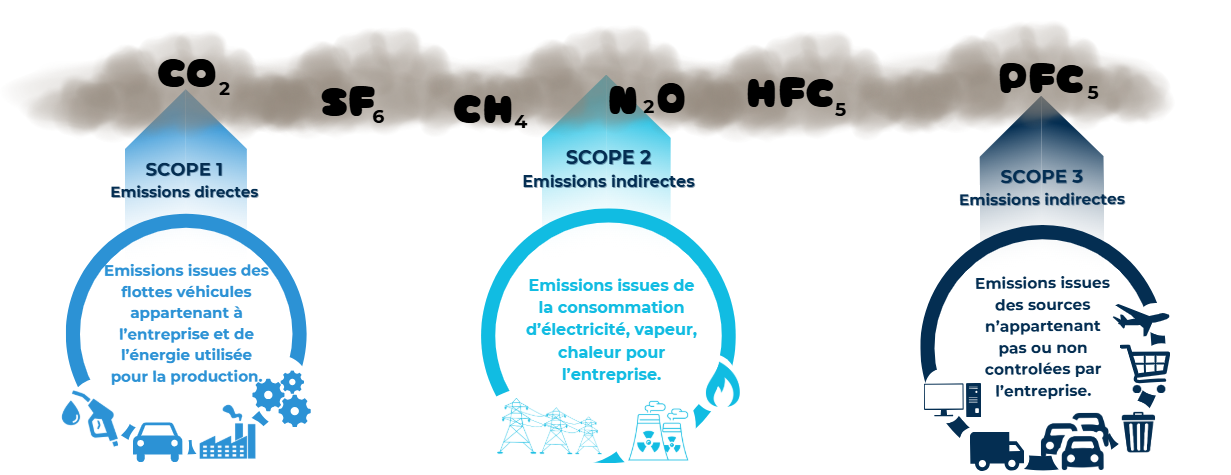
In a country like France, companies with more than 500 employees are required to prepare a Greenhouse Gas Emissions Report (BEGES) every four years, covering primarily Scopes 1 and 2. However, to obtain a comprehensive and complete picture of their carbon footprint in the context of global challenges, it is recommended to also include Scope 3, as indirect emissions can account for a significant portion of an organization’s total environmental impact.
For accurate and up-to-date data on direct and indirect emissions in France within the European and global context, it is recommended to consult the reports from the French Agency for Ecological Transition (ADEME), which provides detailed information on GHG emissions by sector and category, thereby contributing to a comprehensive approach to climate action.

🏗️ The main sectors involved
Several sectors account for the majority of CO₂e emissions in France. Identifying these sectors is crucial for targeting reduction efforts.
-
- 🚛 Transportation: This sector is the largest source of greenhouse gas emissions in France, accounting for about one-third of national emissions. Emissions come primarily from passenger vehicles, heavy-duty vehicles, and air travel. To meet its climate goals, the French government is aiming for a 31% reduction in transportation emissions between 2022 and 2030.
-
- 🏭 Industry: French industry contributes significantly to CO₂e emissions, particularly through the production of cement, steel, and chemicals.
-
- 👷 Buildings: The residential and commercial sectors generate emissions primarily from building heating, particularly in buildings that use oil- or gas-fired boilers. Replacing these systems with more environmentally friendly solutions, such as heat pumps, is encouraged to reduce the carbon footprint of this sector.
-
- 🌾 Agriculture: Although it emits less CO₂, the agricultural sector is responsible for other greenhouse gases, such as methane (CH₄) and nitrous oxide (N₂O). Reducing the use of nitrogen fertilizers and promoting agroecological practices are measures being considered to reduce these emissions.
Understanding the distinction between direct and indirect emissions, as well as identifying the main emitting sectors, is essential for developing effective climate policies and achieving CO₂e emission reduction targets in France.
Ways to Reduce CO₂e Emissions
To achieve the carbon neutrality targets set by France for 2050, it is essential to activate several levers to reduce GHG emissions. These levers mainly concern the energy transition, sustainable mobility and the circular economy.⚡ Energy Transition and Energy Efficiency
- Renewable Energy Development: Increasing the share of renewable energy in the electricity generation system helps reduce dependence on fossil fuels. The National Low-Carbon Strategy (SNBC) calls for a significant reduction in emissions in the energy sector.
- Improving Resource Efficiency: Optimizing energy consumption in buildings, industry, and transportation is crucial. Measures such as thermal insulation of buildings and the modernization of industrial equipment contribute to this improvement.
🚗 Mobility and Low-Carbon Transportation
- Promoting public transportation and active transportation: Encouraging the use of public transportation, bicycling, and walking reduces emissions associated with individual travel. The French government has set new targets to reduce greenhouse gas emissions in the transportation sector.
- Electrification of the vehicle fleet: Replacing internal combustion engine vehicles with electric vehicles reduces CO₂e emissions. French companies, such as those participating in the Climate Act, are committed to reducing their carbon footprint by adopting fleets of electric vehicles.
♻️ Circular Economy and Resource Optimization
- Waste Reduction and Recycling: Establishing industrial processes designed to minimize waste and promote recycling helps reduce emissions associated with the manufacture of new materials. These practices help limit emissions into the atmosphere while conserving water resources, as demonstrated by the European Union’s environmental policies.
- Use of Sustainable Materials: Choosing low-carbon materials in the building sector—whether for construction, renovation, or the manufacture of building components (insulation, window and door frames, cladding, etc.)—can significantly reduce greenhouse gas emissions. The European regulatory framework, particularly through the Energy Performance of Buildings Directive, imposes strict requirements in this regard. The impact is far from negligible: in Europe, the building sector is responsible for approximately 40% of CO₂e emissions.
- Outlook for France and Europe: The gradual replacement of coal with renewable energy sources, encouraged by European policies, is contributing to this transition. France, like its European neighbors, must balance economic development with environmental protection, particularly the protection of water resources.
These efforts are part of a global drive to reduce emissions. The European Union is playing a leading role in this area, with ambitious climate goals that take into account the source of emissions, whether they stem from local manufacturing or imports.
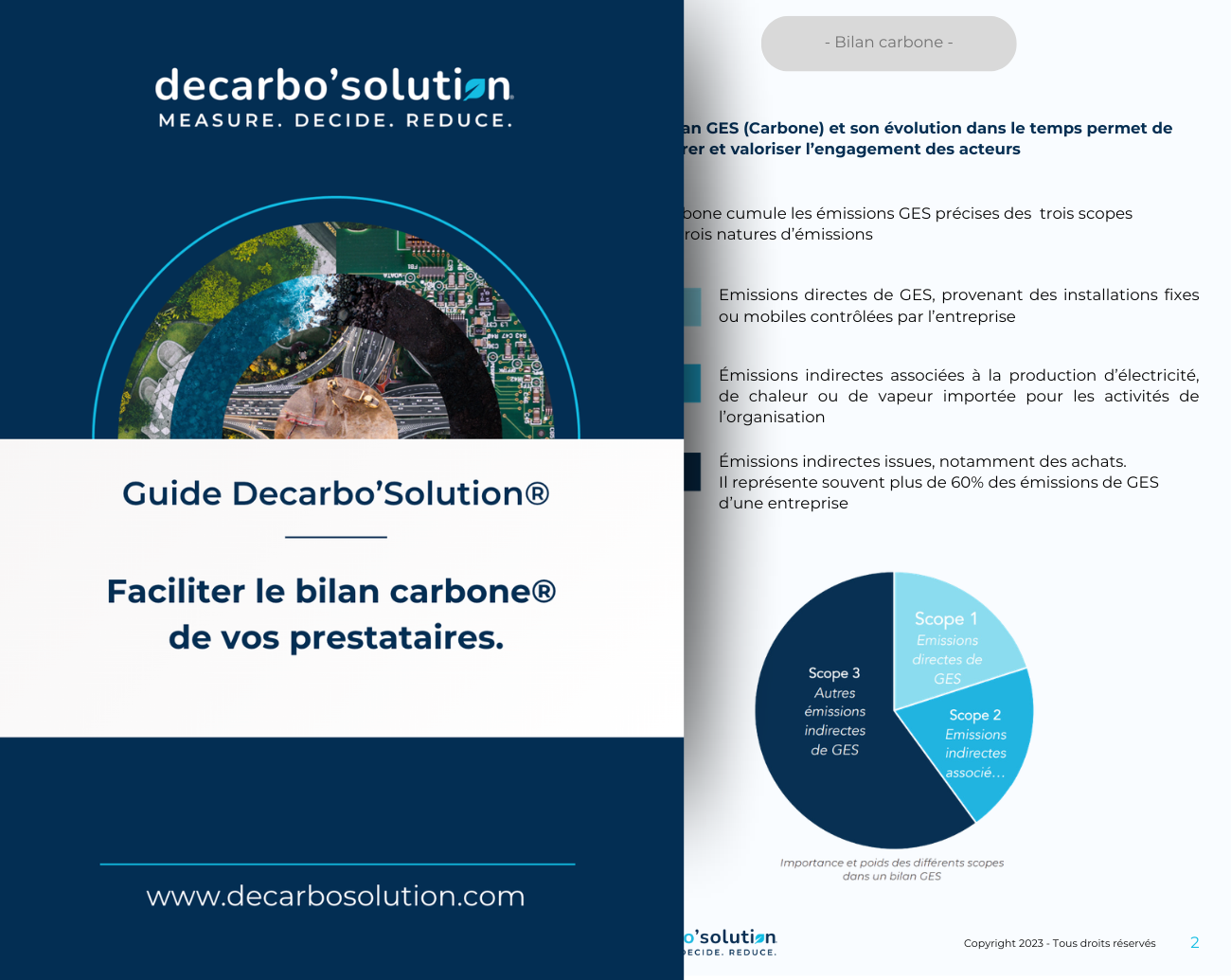
Simplify the GHG assessment for your service providers
Measuring and Tracking Changes in Your Carbon Footprint
To achieve CO₂e emission reduction targets, it is essential to accurately measure one’s carbon footprint and regularly track progress. This approach relies on the use of appropriate calculation tools and the definition of relevant performance indicators.
🧮 Emissions Calculation Tools
- ADEME’s Carbon Database: The Carbon Database® is an official public database developed by ADEME. It provides the emission factors needed to conduct greenhouse gas emissions inventories.
- Our Climate Actions: This online simulator allows individuals to estimate their carbon footprint based on their lifestyle and suggests ways to reduce it.

Gaëtan COUREUL | Amaury Sport Organisation
A.S.O. has chosen Decarbo’Solution® to assess the carbon footprint of its events, starting with the Tour de France.

Benjamin GRIZBEC | French Badminton Federation
The FFBad has commissioned Decarbo’Solution® to conduct a carbon assessment of its operations and is proceeding with the preparation of GHG inventories for 20 affiliated clubs.

Christophe CHRISTEN | SCHMIDT Group
The Schmidt Group was able to bring 80% of its suppliers on board (in terms of financial volume) and achieve a reduction of 242metric tons of CO2.

Marlène PIVARD | Natural Grass
Natural Grass worked with the carbon experts at Decarbo’Solution® to conduct its first GHG emissions assessment.
📉 Performance Metrics and Progress Tracking
Once the carbon footprint has been assessed at the level of an individual, a company, or even a nation, it is crucial to define performance indicators to track changes in emissions released into the atmosphere or generated by imports. These indicators may include the total amount of emissions (in metric tons of CO₂ equivalent), carbon intensity per unit of production or per unit of revenue, and the percentage reduction in emissions compared to a baseline year.
🏅 Examples of companies that have reduced their CO₂e emissions
-
- Amaury Sport Organisation (ASO): ASO, organisateur d’événements sportifs majeurs tels que le Tour de France et le Dakar, a entrepris une démarche de réduction de son empreinte carbone. En 2021, l’entreprise a réalisé son Bilan de Gaz à Effet de Serre (GES) avec l’aide de Decarbo’Solution® (Decarbo’Solution®), identifiant ainsi les principales sources d’émissions liées à ses activités. Cette analyse a permis à ASO d’établir des actions ciblées pour diminuer ses émissions de CO₂e.
-
- Schmidt Groupe: Specializing in interior design, Schmidt Groupe has adopted a low-carbon strategy by actively involving its suppliers. By conducting its GHG assessment with Decarbo’Solution®, the company identified that 90% of its emissions were linked to its procurement activities. This realization led Schmidt to collaborate closely with its suppliers to reduce the carbon footprint of its supply chain.
-
- Natural Grass: Specializing in the development of hybrid turf for sports facilities, Natural Grass conducted its GHG assessment using Decarbo’Solution®. This analysis enabled the company to better understand the environmental impact of its products and services and to identify ways to reduce its CO₂e emissions, thereby strengthening its commitment to the environment.
These examples illustrate how companies in various sectors can—by accurately measuring their carbon footprint and tracking appropriate performance metrics—develop effective strategies to reduce their CO₂e emissions and actively contribute to the fight against climate change.
La maîtrise des émissions de CO₂e est un enjeu crucial pour limiter le réchauffement climatique et atteindre les objectifs fixés par l’Accord de Paris. Les entreprises, les États et les citoyens ont un rôle clé à jouer en adoptant des solutions adaptées à chaque secteur.
La transition vers une énergie décarbonée, l’amélioration de l’efficacité des ressources et la transformation des modes de transport sont des leviers essentiels pour réduire l’empreinte carbone. De plus, l’économie circulaire et l’optimisation des ressources permettent de limiter la consommation de matières premières et de diminuer les émissions de CO₂e.
Enfin, mesurer et suivre précisément les changements des émissions grâce aux outils développés par des institutions comme l’ADEME, Eurostat et d’autres organismes est indispensable pour ajuster les stratégies de réduction.
Face à l’urgence climatique, les pays de l’Union Européenne mettent en place des politiques visant à réduire leur impact sur l’environnement. Toutefois, des efforts restent nécessaires, notamment dans des pays fortement émetteurs comme l’Iran et le Qatar.
Our carbon experts are available to provide a free of our platform with no obligation. 🚀
Sources
https://www.statistiques.developpement-durable.gouv.fr/edition-numerique/chiffres-cles-du-climat/fr/
https://www.ecologie.gouv.fr/politiques-publiques/suivi-emissions-gaz-effet-serre
https://concertation-strategie-energie-climat.gouv.fr/les-grands-enjeux-de-la-ppe-3
https://petitsfrenchies.com/climate-act-startup-environnement-empreinte-carbone/