









Post-Carbon Footprint Assessment Action Plan: Avoiding the “Drawer Effect”

For many companies, greenhouse gas emissions accounting has become an essential part of their environmental transition strategy. Conducted using the methodology developed byADEME or in accordance with international standards such asISO 14064, it allows for the precise measurementof an organization’senvironmental footprint by assessing its greenhouse gas (GHG) emissions.
But one thing is clear: all too often, this meticulous work ends with a report. Without concrete follow-up, it ends up filed away in a folder or stored on a server, with no real impact on the reduction trajectory. This “drawer effect” is one of the main risks associated with conducting a carbon assessment.
However, at a time when the National Low-Carbon Strategy (SNBC) andthe Paris Agreement set ambitious targets—reinforced by Decree 2022-982, which requires companies to adopt an ambitious transition plan —companies can no longer simply measure their emissions. They must now demonstrate their ability to take action by developing and implementing a coherent, structured, and continuously monitored carbon footprint action plan that is coherent, structured, and monitored over time.
It is only under this condition that a carbon footprint assessment becomes a true strategic tool, rather than a mere administrative exercise. The challenge is twofold: to avoid greenwashing and to set the company on a credible transition path.
Contents
Why the Action Plan Is the Turning Point in the GHG Assessment
The GHG inventory: an essential but incomplete snapshot
Conducting a GHG inventory is now an essential step for any company that wants to understand its environmental footprint. This tool, defined in France byADEME and internationally by the ISO 14064 standard and the GHG Protocol—and incorporated into French and European regulatory requirements—enables organizations to quantify the greenhouse gas emissions associated with their activities: energy consumption, employee travel, production, logistics, product life cycles, and more.
The GHG inventory thus provides an accurate assessment that identifies the main sourcesof emissions and sheds light on the environmental challenges specific to each organization. But it is merely a snapshot: measurement does not reduce emissions. Without operational follow-through, the inventory remains a theoretical analysis that does nothing to change the company’s practices.
This is where the real challenge lies: transforming this snapshot into a concrete action plan capable of guiding strategic decisions and producing tangible results.
The Risk of the “Sliding Door” Effect and Greenwashing
A GHG assessment that is not followed up with action poses a major risk to companies. All too often, the report is filed away in a folder or shared on an ad hoc basis, without any operational follow-through. This phenomenon, known as the “drawer effect,” strips the initiative of its substance.
Beyond the lack of environmental impact, this situation can quickly fuel accusations of greenwashing. In a context where the National Low-Carbon Strategy (SNBC) sets a clear course for achieving carbon neutrality by 2050 and wherethe Paris Agreement mandates a global emissions reduction trajectory, stakeholders are demanding more than just intentions.
- Customers want to work with partners who are committed to a genuine environmental initiative.
- Investors and lenders are now incorporating strict climate criteria into their decisions.
- Employees themselves are paying close attention to the sincerity of their employers' climate commitments.
A GHG assessment without a concrete plan can therefore backfire: far from bolstering the company’s credibility, it can undermine its image and harm its competitiveness
The Action Plan: Turning the Assessment into a Reduction Strategy
The real turning point lies in the transition from the GHG inventory to the action plan. It is this transition that makes it possible to move from assessment to transformation. A successful action plan must:
- Identify and prioritize reduction strategies: target the most significant sourcesof emissions to achieve a rapid and measurable impact.
- Set quantifiable and realistic goals: for example, aligned with the targets set by the SNBC or ISO standards.
- Plan the implementation: set a timeline, assign responsibilities, and allocate budgets.
- Monitor progress over time: establish performance metrics to assess the effectiveness of the measures and make adjustments as needed.
In this context, Decarbo’Solution® plays a key role: its platform offers structured guidance and dedicated tools that transform a GHG inventory into a customized action plan. This approach ensures that the data collected does not go to waste but becomes a strategic lever for transformation and sustainable commitment.
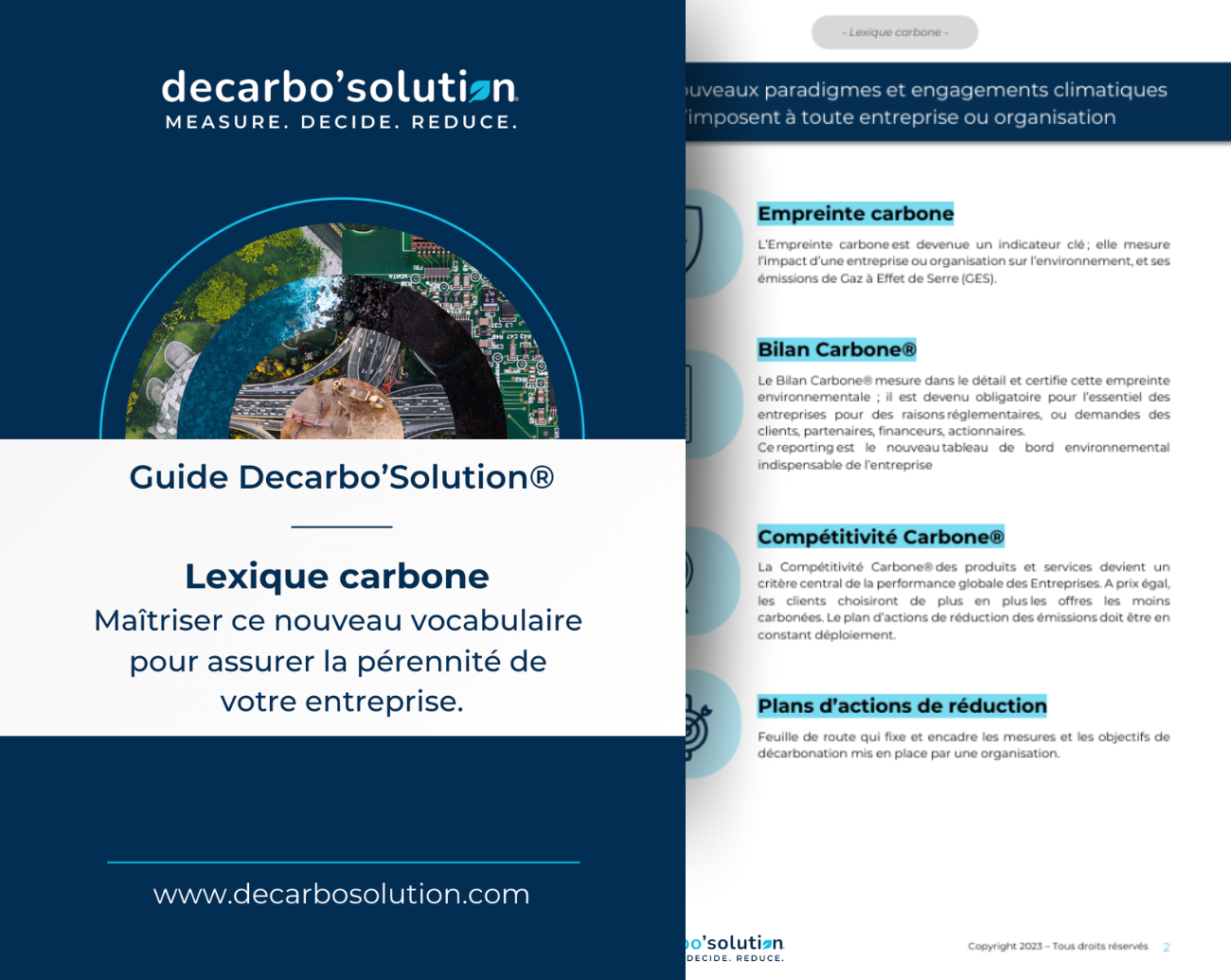
Master new vocabulary to ensure the long-term success of your business.
Three Common Pitfalls to Avoid
A plan that is too generic and out of touch with reality
One of the most common pitfalls is developing a GHG assessment action plan that is too general. Due to a lack of time or a desire to quickly meet a regulatory requirement, some companies simply copy and paste standard measures: reducing energy consumption, limiting business travel, improving recycling, and so on.
Although these measures are relevant in absolute terms, they lack effectiveness when they are not linked to the organization’s actual sources of emissions. For example, an industrial company whose carbon footprint is primarily driven by energy consumption at its production sites will have little impact if it focuses its action plan solely on employee commuting.
An effective plan must therefore be based on the specific results of the GHG assessment in order to target the areas with the greatest reduction potential. Without this tailored approach, the initiative risks remaining superficial and lacking credibility in the eyes of stakeholders.
The lack of concrete implementation
A second challenge lies in the failure to implement the GHG inventory action plan. Many plans, even those well-designed on paper, never make it past the stage of actual implementation. They sometimes include a list of ambitious actions but lack:
- deployment schedule,
- designated person in charge,
- dedicated financial resources.
The result: the intentions remain, but nothing changes in practice. This lack of oversight turns the plan into a document of intent, incapable of producing results.
However, to be effective, a plan must be designed as a true roadmap. Each action must be assigned a person in charge, a budget, intermediate milestones, and monitoring indicators. It is this structure that ensures the initiative does not remain theoretical but translates into actual reductions in GHG emissions.
An approach carried out in isolation, without the involvement of the teams
Le troisième écueil concerne la gouvernance du projet. Trop souvent, le plan action bilan GES est conçu au sein d’un petit cercle restreint – direction RSE, équipe QSE ou consultants externes – sans implication des métiers opérationnels.
This siloed approach severely limits the effectiveness of the measures, since the levers for reduction lie at the heart of the company’s functions:
- procurement, which can incorporate environmental criteria into requests for proposals,
- logistics, which plays a major role in optimizing flows,
- commercial real estate, which has a significant impact on energy consumption,
- Human resources, which can promote sustainable mobility practices.
Without the involvement of these stakeholders, the plan remains disconnected from the organization’s day-to-day operations and struggles to be implemented.
It is precisely to avoid these pitfalls that the support offered by Decarbo’Solution® is so valuable. The reduction plan developed through the platform and its Decarbo’Target® tool is based directly on data from the GHG inventory and is integrated into the company’s overall strategy. It prioritizes actions and provides costed scenarios (OPEX and CAPEX), thereby facilitating decision-making and securing buy-in from various stakeholders.
We aim to meet ministerial requirements and guidelines by promoting a more responsible approach to sports and raising awareness among our members and the general public.
Making the Action Plan a Dynamic and Strategic Tool
Align actions with the company's strategic functions
A GHG inventory action plan should not be viewed as a stand-alone document, but rather as a tool integrated into theorganization’s overall strategy. To be effective, it must be linked to the company’s main activities and key functions:
- Purchasing: By incorporating environmental criteria into requests for proposals, the company reducesthe environmental impact of the goods and services it purchases. Tools such as Decarbo’Tender® from Decarbo’Solution® help align supplier selection with ecological and sustainable principles.
- Logistics and transportation: Optimizing logistics flows using tools such as TK’Blue, adopting low-carbon transportation solutions, and streamlining employee travel can significantly reduce Scope 3 emissions.
- Manufacturing and Energy: Improving the energy efficiency of work processes, increasing the use of renewable energy, and reducing waste generation are key strategies for achieving carbon neutrality.
- Real Estate and the Workplace: Rethinking building use, reducingenergy consumption, and promoting eco-friendly workspaces are concrete steps toward ensuring the sustainability of this approach.
By directly linking the plan’s objectives to the company’s business lines, we ensure that the strategy is not abstract but is fully integrated into day-to-day operations.
Developing a Scalable and Realistic Roadmap
The definition of a GHG inventory action plan cannot be limited to a static listof actions. It must be part of an evolving process capable of adapting to constraints and progress made.
An effective plan is generally structured around a 3- to 5-year roadmap. This timeframe makes it possible to set achievable intermediate goals while placing the organization on a long-term path toward carbon neutrality.
To ensure its relevance, the roadmap must:
- define clear steps for implementation,
- incorporate quantified milestones based on data from the GHG inventory,
- Establish mechanisms for continuousimprovement in order to adjust priorities over time.
This methodological framework prevents the plan from becoming obsolete and enables the company to remain aligned with regulatory frameworks such as the National Low-Carbon Strategy (SNBC), voluntary commitments such as the SBTI, and ISO standards.
Establish long-term monitoring and management
The success of a GHG inventory action plan depends on the ability to track its effects over time. Monitoring should not be limited to collecting one-timedata, but should constitute a true management system.
This involves:
- establish performance indicators tailored to each activity (energy consumption, waste streams, travel-related emissions, etc.),
- regularly compare the results achieved with the established goals,
- share the results with stakeholders in the spirit of corporate social responsibility and transparency.
This is precisely one of the strengths of the Decarbo’Solution® developed by Decarbo’Solution®. Its Decarbo’Target® module tracks emissions trends and continuously monitors the effectiveness of the strategic actions implemented. Combined with Decarbo’Tender® and Decarbo’Supply®, this solution forms a true “winning trio ” for embedding the emissions reduction initiative over the long term within an ecological, rigorous, and sustainable framework.

Conducting a Bilan Carbone® assessment should never be viewed as an end in itself, but rather as a catalyst for transformation. What matters—beyond simply determining baseline emissions— is the ability to translate these results into concrete decisions and measurable changes across the company’s various operations.
The effectiveness of a reduction project depends on its alignment with key reference frameworks—such as the National Low-Carbon Strategy, ISO standards, and the Paris Agreement. By aligning with these benchmarks, organizations set themselves on a credible path toward climate neutrality. Moreover, the benefits extend beyond the environmental dimension alone: improvedenergy management, optimized procurement, reduced waste, and changes in transportation patterns also contribute to strengthening economic and social performance.
Success, however, depends on careful management. Regular monitoring of information and data makes it possible to measure the impact of initiatives, compare results with set goals, and foster a culture of continuous improvement. It is this transparency that underpins the credibility of a modern CSR policy focused on innovation and sustainability.
In this context, the solution developed by Decarbo’Solution® offers a unique answer. Decarbo’Solution® and its three components— Decarbo’Target®, Decarbo’Tender®, and Decarbo’Supply® —form a cohesive and complementary whole. A truly winning trio, it enables organizations to align their strategic choices with a sustainable and eco-friendly framework, benefiting both the planet and their competitiveness.