









Carbon Plan: How Should You Structure Your Reduction Goals and Actions?

1.1 Regulatory Context and International Commitments
1.2 Benefits for the Company (competitiveness, image, compliance)
2. Key Steps for Developing an Effective Emissions Reduction Strategy
2.1 Identification of Emission Sources (Scopes 1, 2, 3) / Conducting a GHG Inventory
2.2 Raising Awareness and Motivating Your Team
2.3 Define Concrete Goals and an Action Plan
2.4 Define a carbon trajectory (performance tracking and reporting)
3. How does Decarbo’Solution® (Decarbo’Solution®) support companies in their carbon reduction plans?
Why develop a carbon plan?
📜 Regulatory Context and International Commitments
Companies are increasingly facing regulatory requirements aimed at reducing their greenhouse gas (GHG) emissions. In France, the Grenelle II law requires organizations with more than 500 employees in mainland France to conduct a Bilan Carbone® assessment every four years. In addition, the European CSRD (Corporate Sustainability Reporting Directive) requires organizations with more than 250 employees to publish non-financial reports starting in January 2025.
At the international level, the Paris Agreement, adopted in 2015, aims to limit global warming to less than 2 °C by 2100, which requires a reduction in GHG emissions of at least 50% by 2030.
💼 Benefits for the company (competitiveness, reputation, compliance)
Developing a low-carbon strategy offers several benefits for companies:
- Enhancing Competitiveness: Decarbonization helps optimize processes and reduce operating costs, particularly those related to energy. Improving energy efficiency can lead to potential savings of 10 to 25 percent on energy bills.(source)
- Regulatory Compliance: Complying with legal obligations—such as conducting a Bilan Carbone® assessment—helps avoid financial penalties of up to €50,000, or even €100,000 in the event of a repeat offense.(source)
- Access to Financing and Grants: Financial institutions prioritize companies committed to sustainable practices, thereby facilitating access to green financing, public grants, and tax incentives.
- Attracting Talent: Employees are often proud to work for a responsible company committed to protecting the environment, which can improve employee loyalty and satisfaction.
- Improved brand image: Consumers are increasingly concerned about environmental issues. A company committed to reducing its carbon footprint enhances its credibility and attracts environmentally conscious customers.(source)
In short, developing a decarbonization strategy is not only a response to regulatory and international requirements, but also a strategic opportunity for companies to improve their overall performance, reputation, and competitiveness in the market.

The 7 Benefits of Conducting a GHG Assessment for Your Company.
Key Steps for Developing an Effective Emissions Reduction Strategy
🔍 Identifying emission sources (Scopes 1, 2, 3) / Conducting a GHG inventory
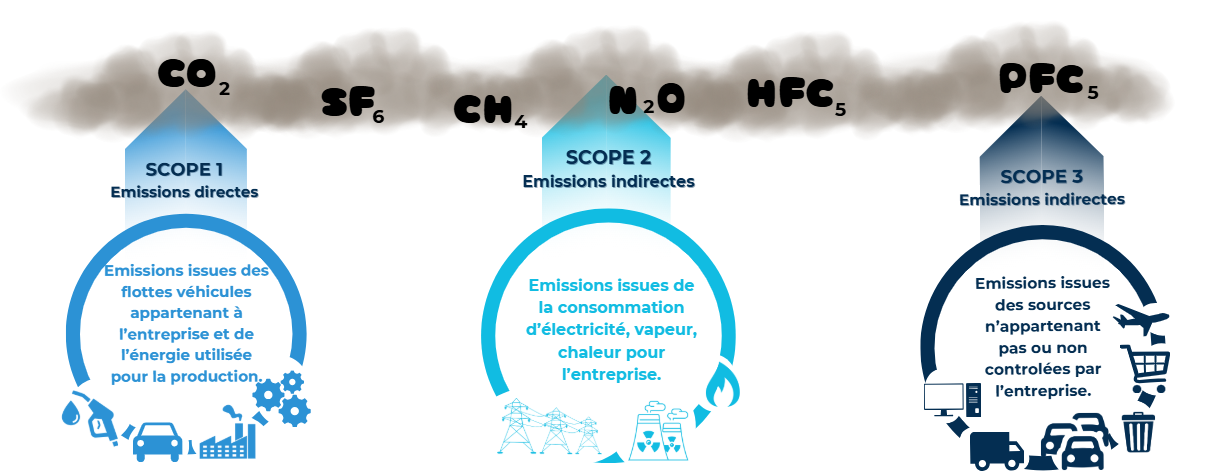
The first step in developing effective decarbonization strategies is to conduct a GHG inventory to identify the company’s sources of greenhouse gas (GHG) emissions. These emissions are classified into three categories:
- Scope 1: These are direct emissions produced by the company, such as fuel combustion in company vehicles or emissions from industrial processes.
- Scope 2: This scope covers indirect emissions related to energy, particularly those resulting from the production of electricity, heat, or steam purchased and consumed by the company.
- Scope 3: This includes other indirect emissions, such as those associated with the supply chain, business travel, the use of products sold, or waste management.
To conduct this assessment, it is recommended to follow the Bilan Carbone® method developed by ADEME, which provides a structured approach for quantifying GHG emissions.
🎯 Raise awareness and engage your team
La réussite d’une stratégie bas-carbone repose sur l’implication de l’ensemble des collaborateurs. Il est essentiel de les sensibiliser aux enjeux climatiques et de les informer sur l’empreinte carbone de l’entreprise. Des actions telles que des ateliers de formation, des séminaires ou des campagnes de communication internes peuvent être mises en place pour mobiliser les équipes.
📊 Set concrete goals and an action plan
After identifying emission sources and mobilizing teams, it is crucial to set clear and ambitious reduction targets. These commitments must be aligned with international commitments, such as the Paris Agreement, and tailored to the company’s specific context. For example, a company might aim to reduce its emissions by 50% by 2030.(source)
To achieve these goals, a detailed strategy must be developed, including specific measures such as:
⚡ Improving energy efficiency: optimizing processes to consume less energy.
🌞 Transition to renewable energy sources: adopting clean energy to reduce our carbon footprint.
🔄 Supply ChainOptimization: Selecting suppliers committed to sustainable practices.
🚲 Promoting sustainable mobility: encouraging the use of eco-friendly modes of transportation for business travel.
It is important that this approach be integrated into the company's overall strategy and that it have the support of senior management.
📈 Define a carbon trajectory (performance tracking and reporting)
Once the strategy is in place, it is essential to regularly monitor performance to ensure that reduction targets are met. This involves establishing a reporting system to measure progress and identify areas for improvement. For example, some companies adopt low-carbon pathways aligned with the recommendations of the Science Based Targets initiative (SBTi).(source)
This monitoring must be transparent and communicated to stakeholders—particularly through annual reports or dedicated publications—to demonstrate the company’s commitment to the climate transition.
In conclusion, developing an effective low-carbon strategy requires a structured approach, from identifying emission sources to setting ambitious targets and implementing rigorous monitoring. This approach enables the company to actively contribute to the fight against climate change while strengthening its competitiveness and its image.
How does Decarbo’Solution® (Decarbo’Solution®) support companies in their carbon reduction plans?
Decarbo’Solution® (Decarbo’Solution®) offers a comprehensive range of services to help organizations develop and implement effective strategies to reduce their greenhouse gas (GHG) emissions.🛠️ Tools and Methodologies
Decarbo’Solution® provides flexible and customizable solutions that facilitate the preparation of GHG inventories in compliance with international standards. These tools include questionnaires tailored to different industries and company sizes, ensuring accurate and relevant data collection. The platform is designed to be user-friendly, allowing even beginners to quickly get the hang of its features thanks to two-hour video training sessions. Additionally, it supports multiple users, fostering collaboration within teams.

📌 Case Studies and Testimonials
Many companies have benefited from Decarbo’Solution®’s expertise in their transition to a low-carbon economy. For example, Amaury Sport Organisation (A.S.O) collaborated with Decarbo’Solution® to assess the carbon footprint of its events, thereby demonstrating its commitment to sustainability. Similarly, the Schmidt Group has successfully engaged 80% of its suppliers in its efforts to reduce emissions, illustrating the effectiveness of the solutions offered by Decarbo’Solution®.

Schmidt Group
Christophe CHRISTEN
Purchasing Methods Manager
The Schmidt Group is France's leading manufacturer of custom-made kitchens, storage furniture, and bathrooms.
To fulfill its commitments, the group has chosen an innovative partner specializing in decarbonizing procurement, offering a collaborative solution: Decarbo’Solution®.

French Badminton Federation
Benjamin GRIZBEC
Project Manager, Disability and Accessibility / Environmental Sustainability
The French Badminton Federation (FFBaD) has chosen Decarbo’Solution® to assess the carbon footprint of its activities as part of its commitment to social performance.
This dynamic partnership continues with the completion of GHG assessments for 20 affiliated clubs, marking a significant milestone in the federation’s transition toward a sustainable approach.
🌱 Additional information: carbon offsets/contributions
In addition to reducing emissions, Decarbo’Solution® supports companies in their carbon offset efforts. This includes certified projects that enable organizations to offset their residual emissions by investing in environmentally friendly initiatives, thereby contributing to carbon neutrality.
In short, Decarbo’Solution® offers comprehensive support to organizations, from the accurate assessment of emissions to the implementation of reduction and offset strategies, thereby strengthening their competitiveness while meeting regulatory requirements and societal expectations.
Implementing a low-carbon strategy is now essential for all companies that wish to be part of the climate transition and address regulatory, economic, and environmental challenges.
Through a structured approach—from identifying greenhouse gas (GHG) emissions to implementing a clear and measurable strategy—it is possible to significantly reduce one’s carbon footprint while improving competitiveness and brand image.
With tailored tools and personalized support, Decarbo’Solution® (Decarbo’Solution®) helps organizations develop their low-carbon strategies and achieve their reduction goals. From conducting a GHG inventory to implementing carbon offset initiatives, Decarbo’Solution® enables organizations to make effective progress toward carbon neutrality and to anticipate future regulations, particularly those related toADEME, the DPEF, and ISO standards.
Committing to a national low-carbon strategy today is an opportunity for all organizations in France and Europe. It’s time to take action for a more sustainable future!
Our carbon experts are available to provide a free of our platform with no obligation. 🚀
Sources
- https://www.cci.fr/ressources/developpement-durable/la-decarbonation-levier-de-performance-et-de-competitivite
- https://climate.selectra.com/fr/entreprises/bilan-carbone
- https://www.lyon-metropole.cci.fr/notre-blog/bilan-carbone-9-avantages-pour-votre-entreprise
- https://www.agenda-2030.fr/17-objectifs-de-developpement-durable/article/odd13-prendre-d-urgence-des-mesures-pour-lutter-contre-les-changements?#:~:text=Specifically,%20the%20goal%20of%20the,carbon%20neutrality%20by%202050.
- https://www.bl-evolution.com/comment-mettre-en-place-une-trajectoire-de-reduction-compatible-avec-les-objectifs-du-sbti/