









Reducing the carbon footprint and costs of transportation without sacrificing efficiency: a mission that can be accomplished

In France, regulatory and tax pressures (ETS1 and ETS2) are intensifying to decarbonize the transportation sector, which accounts for a significant portion of the country’s carbon footprint. European law and strategy now require clear emissions reporting, a transition from fossil fuels to electricity, hydrogen, or biofuels, and the adoption of sustainable mobility across all regions. For businesses, the mission is clear: reduce greenhouse gas emissions while maintaining efficient and competitive logistics. In a market where climate events, rising fuel prices, new carbon taxes, and infrastructure modernization are accelerating this shift, it is essential—amid economic development, innovation, and a strengthened regulatory framework—to pull the right levers and rely on a committed industry. The goal is also to foster the emergence of innovative energy solutions for the entire national industry.
Contents
Why Was Transportation a Blind Spot in Climate Strategies?
Scope 3: A Vague but Strategic Scope
Transportation services, in France as elsewhere, fall primarily under Scope 3: this is the most complex component of the GHG inventory, as it covers all indirect emissions. This includes service providers’ vehicles, outsourced transportation, the five modes of transport (road, rail, sea, inland waterways, and air), and various energy sources (fossil fuels, electricity, hydrogen, and a mix). The diversity of transportation modes, the lack of standardized data on the fuels used, and the variety of infrastructure complicate monitoring. A recent report estimates that the supply chain accounts for up to 40 % of indirect emissions, representing a major challenge for the logistics sector and the competitiveness of each region. Energy consumption—whether from fossil fuels or renewable sources—is a central focus of this transition plan.
In this context, TK’Blue, Decarbo’Solution®’s “transport and logistics” partner, has established itself as a leading provider of support to companies in assessing the environmental performance of their carriers. Thanks to a reliable set of indicators and powerful traceability tools, TK’Blue facilitates the reporting of greenhouse gas emissions, decision-making regarding vehicle, mode, or energy choices, and the monitoring of climate targets set at the national or European level. This solution promotes transparency within the industry and helps align logistics strategies with each company’s energy and sustainability goals.

Data and Traceability: A Real Challenge for the Industry
Collecting accurate information on emissions from various modes of transportation remains challenging. Most French companies work with numerous service providers across very different regions, using road, rail, and even electric or hydrogen-powered vehicles, which multiplies the sources of greenhouse gas emissions. Data collection on energy, electricity, and alternative fuels remains inconsistent, complicating the management of the SNBC framework and compliance with its targets. The evolution of national fleets and the vehicles used is closely linked to the availability of reliable energy solutions.
A Logistics Sector at the Crossroads of Challenges
The transportation sector—whether air, road, rail, or maritime— drives regional development, yet it is too often overlooked in climate strategies. However, French law and European regulations now require reporting obligations, carbon taxes, the promotion of electric solutions, and the consideration of sustainable infrastructure in investment decisions.
Companies are encouraged to adapt their fleets, invest in electric vehicles, develop hydrogen-powered mobility, or optimize the use of rail transport, while taking advantage of transition grants for local production and the modernization of the sector. The national goal is also to foster the development of energy solutions that address new environmental challenges, in order to align each stakeholder’s strategy with the national climate plan.

How to ensure the long-term viability and growth of your business through a successful low-carbon strategy.
Focusing on the Right Leverage Points: Logistical Efficiency and the Energy Transition
Optimizing traffic flow, vehicles, and infrastructure
Logistical efficiency depends above all on optimizing freight flows. Pooling routes, reducing empty returns, and choosing the right modes of transportation based on the nature of the region—all of these measures help lower energy consumption and greenhouse gas emissions. Using rail for long distances, prioritizing electric and hydrogen vehicles on urban and suburban routes, or utilizing biofuels in rural areas: each region and each sector must find its own balance, taking into account the availability of appropriate infrastructure and vehicles. Energy and energy efficiency are now central to all decisions aimed at ensuring sustainable solutions on a national scale.Bidding Processes and Environmental Criteria: The Framework Is Evolving
Incorporating environmental criteria into transportation bids is becoming essential. This encourages transportation companies to invest in lower-emission vehicles, choose alternative fuels, and turn to renewable energy sources. To meet the requirements of the SNBC framework and European regulations, companies must also accurately track their emissions. Digital tools now make it possible to standardize data collection and compare offerings based on their environmental performance, which supports the development of a competitive industry that complies with the law. The development of domestic logistics solutions is accompanied by increased use of clean energy and vehicles optimized for each type of road use.Measure, Monitor, and Reduce: Tools for Effective Action
To move forward, it is crucial to have tools that enable us to manage emissions across the entire scope of operations—from production to logistics, including the purchase of electric vehicles or alternative fuels. The use of platforms dedicated to decarbonization—such as those that offer customized action plans—facilitates emissions analysis, investment prioritization, and the simulation of reduction trajectories over several years. These tools provide a clear overview for each report, supporting decision-making and the pursuit of investment incentives at both the national and European levels.
As part of this initiative, the implementation of a structured logistics decarbonization plan is based on three complementary pillars—the Decarbo’Solution®:
- Decarbo’Target®: enables users to simulate various reduction scenarios, project the impact of investments on the GHG balance sheet, and continuously adjust their strategy.
- Decarbo’Tender ®: incorporates carbon performance into RFPs, standardizes data collection, and facilitates the selection of suppliers with the best greenhouse gas performance.
- Decarbo’Supply ®: transforms procurement into a strategic lever by engaging suppliers in the collection of reliable data and optimizing carbon competitiveness across the entire supply chain. The goal is to provide companies with innovative energy solutions tailored to each type of vehicle and aligned with the national energy transition framework.
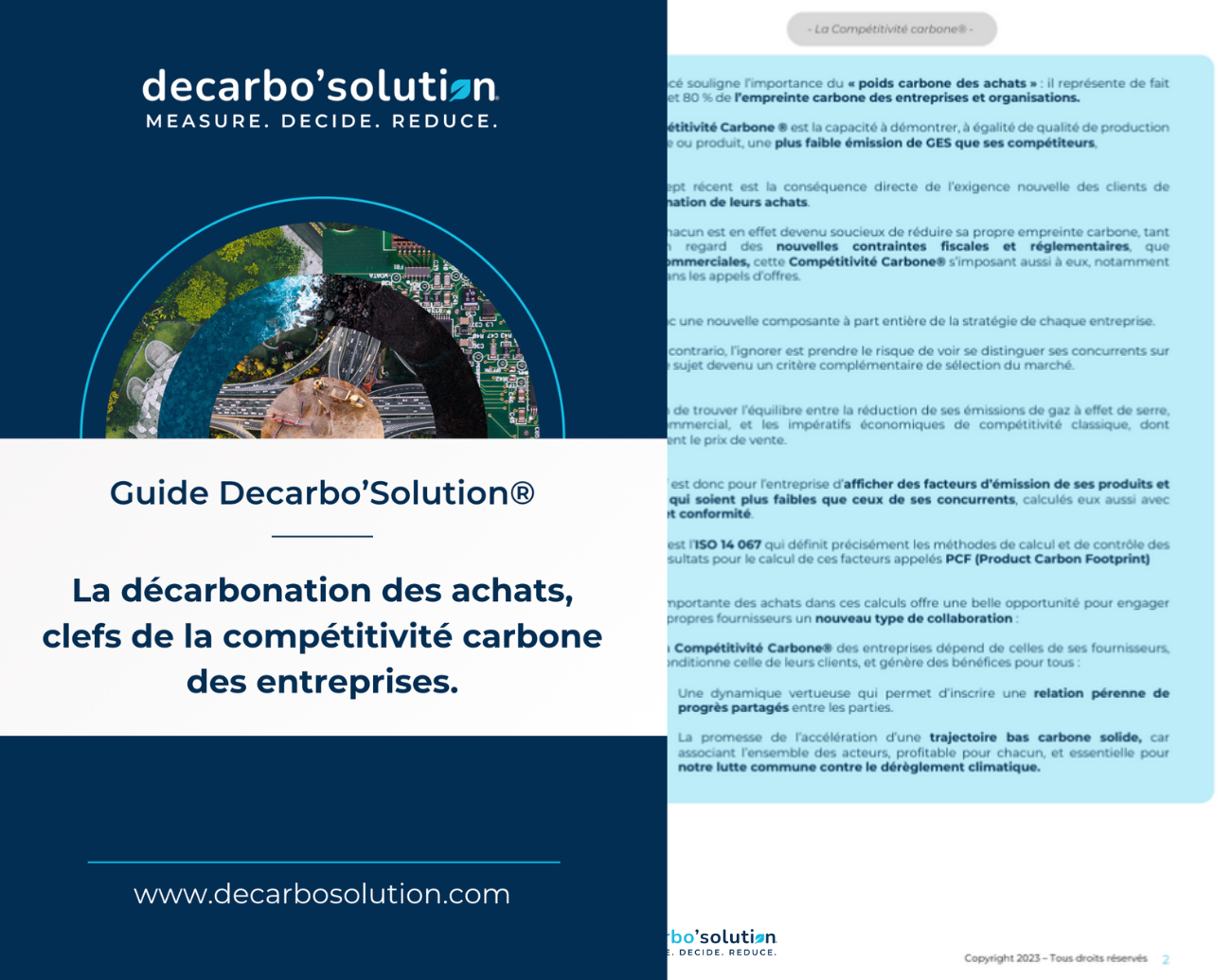
Decarbonizing procurement: the key to companies' carbon competitiveness.
Involve suppliers and service providers in a shared effort
Mobilizing the value chain around decarbonization
The success of the low-carbon transition depends on the commitment of the entire value chain: suppliers, subcontractors, and logistics providers. Incorporating emissions reduction targets into contracts, requesting reliable carbon metrics during major events in the supply chain, and sharing this vision across all regions helps align production and mobility with the framework established by the National Low-Carbon Strategy (SNBC) and the law. Each action plan must take into account the specific energy characteristics of different regions, the types of vehicles used, and the challenges unique to each national sector.
Map and analyze to prioritize actions
Mapping the supply chain is a key step. It helps identify the suppliers with the highest emissions, analyze the maturity of each sector in terms of low-carbon mobility, and target investments for each region. This analysis facilitates the prioritization of public funding, the adaptation of infrastructure, and the recognition of the efforts made by each partner. The use of electricity, rail, hydrogen, or alternative fuels must be adapted to local conditions and market realities. Solutions are thus deployed to meet a wide range of needs, particularly in road transportation and the national sector’s energy management.
Building a Cohesive and Valuable Green Supply Chain
Deploying an effective green supply chain requires the implementation of tools to track progress: regular reports, dynamic metrics, and ongoing dialogue with suppliers regarding energy, vehicles, infrastructure, and mobility. Decarbo’Supply®, for example, makes it possible to collect suppliers’ emission factors, prioritize offers aligned with objectives, and optimize environmental taxation at the regional level. This engages the industry in a process of continuous improvement, while ensuring access to grants and financing to support production and innovation over the long term.
Reducing the carbon footprint of transportation while maintaining efficiency is now a realistic goal. Legislation, the regulatory framework, industry-wide efforts, and the growing use of clean energy are paving the way for a sustainable transformation. Through the integration of carbon management tools, the adoption of electric or hydrogen-powered vehicles, the optimization of mobility in each region, and the promotion of investments in rail and electricity, France is taking a leading role in the decarbonization of its logistics sector.
Companies that commit to this approach benefit from enhanced competitiveness, easier access to public funding, and the ability to anticipate changes in the European regulatory framework. By leveraging the synergy between production, mobility, and sustainable infrastructure, it is possible to align climate goals, economic development, and logistics performance across the entire country. The national strategy is based on innovation in energy and mobility solutions, as well as on the use of vehicles optimized for each transition plan.