









CO₂e Calculation: A Strategic Tool for a Successful Environmental Transition
Le saviez vous, les émissions de gaz à effet de serre (GES) en France ont atteint 373 millions de tonnes de CO₂e en 2023. Limiter le réchauffement climatique passe par la réduction de la consommation de ressources fossiles. La Net Zero Initiative, fixe un objectif clair : inciter les entreprises à adopter des stratégies alignées avec la transition énergétique.
Dans cette dynamique, les organisations se tournent de plus en plus vers le calcul CO₂e pour mesurer et réduire leur empreinte carbone. Cette démarche, bien au-delà d’une simple obligation réglementaire, s’inscrit comme un véritable levier stratégique pour minimiser l’impact environnemental tout en renforçant la compétitivité. L’outil de calculateur CO₂ permet d’évaluer les émissions de GES liées aux activités de production, de transport et d’exploitation. Il fonctionne également comme un comparateur entre différents modes de fonctionnement et exprime les résultats dans une unité commune : la tonne de CO₂ équivalent.
As a result, CO₂ calculation has become an essential pillar of any sustainability strategy, enabling organizations not only to better understand their environmental impact but also to identify opportunities for improvement. In this context, an expert partner like Decarbo’Solution® (Decarbo’Solution®) plays a key role in guiding organizations toward a successful, optimized environmental transition that is in line with international standards.
Contents
Why Calculate Your Carbon Footprint?
⚖️Environmental and Regulatory Challenges
La diminution des émissions de GES est un enjeu central des stratégies de développement durable. Les réglementations nationales et européennes se renforcent chaque année pour inciter les entreprises à réduire leur empreinte carbone et à adopter des pratiques plus respectueuses de l’environnement. Ces GES comprennent notamment le dioxyde de carbone (CO₂) et le méthane (CH₄), dont l’impact est converti en une quantité globale exprimée en CO₂e.
🟢CSRD (Corporate Sustainability Reporting Directive)
Adopted in 2022 by the European Union, the CSRD requires organizations to publish detailed reports on their environmental, social, and governance (ESG) performance. This directive replaces the NFRD and expands its scope to include a greater number of companies, now including publicly traded SMEs.
À partir de 2024, les organisations de plus de 250 employés devront déclarer leurs émissions de CO₂, leurs objectifs de réduction et les risques liés au changement climatique, en respectant les standards de l’ESRS (European Sustainability Reporting Standards). Cette obligation s’inscrit dans une démarche RSE globale.
🟢 The carbon tax
La taxe carbone est un mécanisme fiscal visant à pénaliser les émissions de CO₂ en augmentant le coût des ressources fossiles. En France, cette taxe, appelée Contribution Climat Énergie (CCE), s’applique sur les carburants et le gaz naturel. Chaque pays applique ses propres barèmes.
In August 2024, the price per metric ton of CO₂ stood at 70€, with a projected trajectory to reach €100 by 2030. This measure encourages companies to reduce their energy consumption and invest in low-carbon solutions.
🟢The Carbon Market (EU ETS)
Launched in 2005, the European Union Emissions Trading System (EU ETS) is the world’s largest carbon market. It is based on a “cap-and-trade” principle: an overall cap is set, and the most polluting companies must purchase allowances to offset their emissions.
This mechanism encourages organizations to innovate in order to reduce their carbon footprints and gradually limit the number of available allowances, thereby tightening the regulatory noose.
💯A Strategic Tool for Businesses
Beyond the regulatory framework, measuring a carbon footprint is a powerful driver of performance and competitiveness for organizations. Indeed, organizations can identify significant sources of energy waste, overconsumption, or inefficiency in their internal processes.
✅ Reduction in operating costs
L’optimisation énergétique est souvent synonyme d’économies financières. L’analyse des postes émetteurs – comme les déplacements, le chauffage, ou les procédés industriels – permet de rationaliser les consommations et de faire des choix plus sobres. La consommation d’eau constitue également un poste à surveiller.
For example, according toADEME, turning off standby modes can save up to 15% on your electricity bill (excluding heating and hot water), or more than €100 per year.
De plus, selon le Ministère de la Transition Écologique, une utilisation modérée de la climatisation dans les voitures peut diminuer la consommation de carburant de 1 à 7 % et réduire les émissions de CO₂ de 15 % sur 100 km. Ces exemples illustrent l’intérêt d’agir sur la mobilité.
✅ Enhanced brand image and competitive advantage
Les consommateurs, les investisseurs et les partenaires commerciaux accordent une importance croissante à l’engagement environnemental des entreprises. Afficher une trajectoire bas carbone claire et transparente permet de renforcer la crédibilité d’une entreprise, de répondre aux exigences RSE des clients grands comptes, et de mieux se positionner dans les appels d’offres. Une bonne note extra-financière devient un atout commercial.

✅ Easier access to responsible financing
Financial institutions are increasingly favoring organizations committed to the environmental transition. Having reliable data on a company’s CO₂ emissions—using a calculator—and, above all, using that data to develop a concrete action plan, helps demonstrate the company’s commitment to investors.
It is also a key factor in organizations’ ESG ratings, which have become a major evaluation criterion in the markets.

Controlling our carbon footprint enables us toanticipate changes in the regulatory framework, limit the risk of carbon tax penalties, and gradually adapt our business model to a low-carbon economy. This constitutes a sustainable competitive advantage in a context of accelerated transition.

❗The Importance of Accurate Data in CO₂ Calculations
Measuring a carbon footprint hinges on one fundamental requirement: the reliability of the metrics. Without accurate and well-structured information, any strategy is based on biased assumptions, rendering the action ineffective or even counterproductive.
✅ Accurate data collection and a comprehensive approach
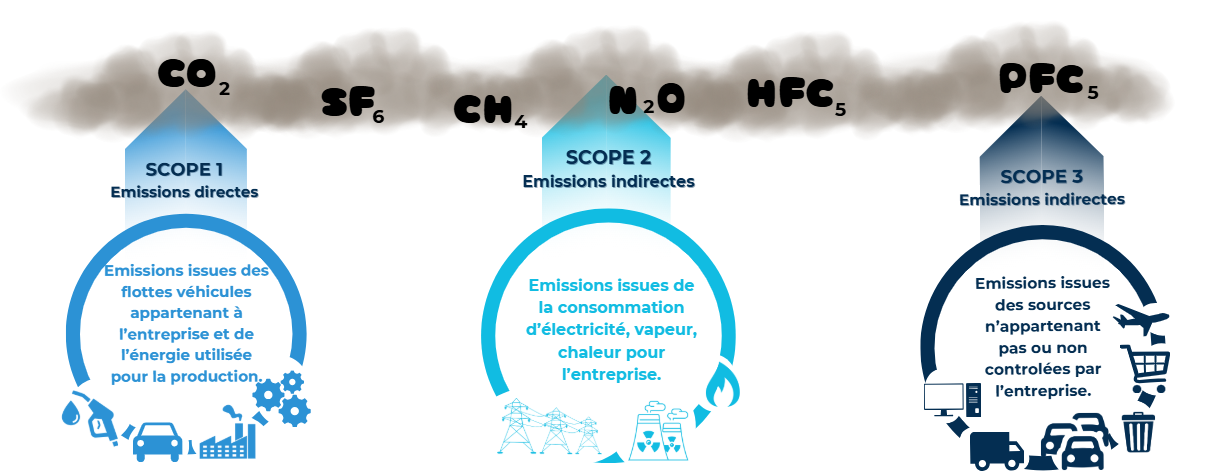
To obtain an accurate picture of its carbon footprint, a company must account for all of its CO₂ sources, covering all three scopes:
- Scope 1: Direct emissions (on-site combustion, vehicle fleet).
- Scope 2: Indirect emissions related to energy (electricity, heating, cooling).
- Scope 3: Other indirect emissions (supply chain, waste, upstream/downstream transportation, product use, business travel, etc.)
To learn more, check out our guide to indirect emissions.
✅ Des données granulaires et actualisées
Les résultats sont d’autant plus pertinents que les métriques sont détaillées : consommation énergétique par site, kilomètres parcourus par type de véhicule, nature des matières premières utilisées, fréquence des livraisons, etc. L’utilisation de facteurs d’émission fiables et actualisés, comme ceux de l’ADEME, est également indispensable. Chaque facteur est rapporté à une unité de référence (kg, km, kWh).
✅ Digitization and Automation
Aujourd’hui, de nombreux outils numériques permettent de faciliter la collecte et l’analyse des données. Ces plateformes automatisent la réalisation des bilans GES, assurent la traçabilité des informations et permettent un suivi régulier des indicateurs. Elles offrent aussi une simulation d’actions d’atténuation pour orienter les décisions stratégiques. Un tableau de bord synthétique facilite la lecture des résultats.
✅ Management and Continuous Improvement
Des données de qualité permettent d’identifier les leviers d’action concrets et de prioriser les efforts. Elles servent aussi à fixer des objectifs réalistes, mesurables, et à communiquer efficacement les progrès réalisés, tant en interne qu’à l’externe. Un reporting fiable est la base d’un pilotage bas-carbone efficace et pérenne. Un test régulier des hypothèses permet d’affiner la démarche.

How to ensure the long-term viability and growth of your business through a successful low-carbon strategy.
CO₂ Calculations: Methods, Challenges, and Applications for Businesses
💡The Different Methods: Bilan Carbone® and the GHG Protocol
There are several recognized methodologies for measuring an organization’s carbon footprint. The two main ones, widely used both nationally and internationally, are Bilan Carbone® and the GHG Protocol. Although they share similar objectives, they differ in their origins, structure, and level of detail.
👉The Bilan Carbone®: A Structured and Educational French Method
Developed bythe Agency for Ecological Transition, this method is specifically tailored to the French context. It offers a comprehensive approach based on accounting for all greenhouse gas emissions associated with an entity’s (company, local government, etc.) activities.
The Bilan Carbone® takes into account the three scopes (Scope 1, 2, and 3)
Its main advantage: it provides a broad and practical overview of carbon impact, while helping to develop a concrete low-carbon strategy.
👉 The GHG Protocol: The International Benchmark Standard
The Greenhouse Gas Protocol, developed by the World Resources Institute (WRI) and the World Business Council for Sustainable Development (WBCSD), is the most widely used method for emissions reporting worldwide. It serves as the basis for international standards, such as ISO 14064, and has been adopted by many multinational companies.
The GHG Protocol is also based on a three-scope classification.
Its advantage lies in its compatibility with international reporting requirements, particularly those related to the CSRD, ESG obligations, and financial markets.
Au-delà de ces méthodes, il est important de noter l’existence de normes internationales complémentaires, telles que l’ISO 14064, qui encadre la quantification et la vérification des émissions à l’échelle d’une organisation, et l’ISO 14067, dédiée à l’empreinte carbone des produits sur l’ensemble de leur cycle de vie. Celui-ci couvre chaque étape, de la fabrication à la fin de vie.
This means that mastering calculation methods is no longer enough: integrating solid standards is becoming a strategic lever for reinforcing the credibility of structural climatic approaches.
💨High-emission sectors
Certain sectors or areas are particularly responsible for global greenhouse gas (GHG) emissions. Understanding their impact is essential for guiding decarbonization efforts.
🚛 Transportation: A Sector in Constant Growth
Le secteur des transports est l’un des principaux contributeurs aux émissions de CO₂. En 2022, les émissions mondiales de CO₂ provenant de ce secteur ont atteint près de 8 gigatonnes (Gt). Cette augmentation de 3 % par rapport à 2021 est principalement due à la reprise du trafic aérien post-pandémie. Comparer les différents modes de mobilité (avion, train, voiture) est donc essentiel.
source: IAE
💻 Digital Technology: A Carbon Footprint That Is Often Underestimated
The digital sector, although less visible, has a significant carbon footprint and already accounts for nearly 4% of global CO₂e emissions. Furthermore, emerging technologies such as artificial intelligence and blockchain are contributing to this increase due to their high energy consumption.
Cette proportion est en constante augmentation en raison de la croissance des usages numériques, des data centers et du streaming. En moyenne, chaque habitant génère plusieurs dizaines de kilos de CO₂e par an via ses usages numériques.
source: ACERP
🏭 Industry: A Major Contributor to the Global Carbon Footprint
The industrial sector is responsible for a significant portion of the world’s carbon footprint. In 2019, emissions from the combustion of energy resources and industrial processes accounted for 19% of the global carbon footprint.
source: BPI France
📊Using Data to Guide the Low-Carbon Transition
Once the carbon assessment is complete, the data collected becomes a valuable management tool for implementing the ecological transition in a structured and effective manner.
1️⃣Target the positions with the highest emissions
The assessment helpsidentify the activities with the highest carbon footprint: production, transportation, procurement, etc. This ranking helps prioritize actions where the impact will be greatest.
2️⃣ Develop concrete action plans
Based on this, the company can develop a customized plan: energy efficiency, logistics optimization, responsible procurement, etc.
3️⃣ Track progress using metrics
Des KPI carbone permettent de mesurer l’efficacité des actions : émissions totales, ainsi que celles par produit ou par salarié (soit par personne), part de chaque scope couvert. L’utilisation d’un outil performant est donc indispensable, tel que celui développé par Decarbo’Solution® qui facilite le suivi dans le temps et la prise de décision.
4️⃣Implement the strategy over the long term
This data feeds into regulatory reports (CSRD, ESG) and reinforces the company's environmental credibility. It also serves as a basis for adjusting strategy and involving all stakeholders.

Decarbo’Solution®: Your Partner for a Successful Environmental Transition
At Decarbo’Solution®, we firmly believe that no action plan can be implemented without a deep understanding of stakeholders. Decarbo’Solution® offers customized training and support to help organizations make sustainability a core part of their strategy.
To that end, we support you at every stage of your environmental transition through:
👩🎓Training on Climate Issues
A program structured into 4 modules:
- Climate and Energy Fundamentals
- Methodological Approach to the GHG Assessment
- Prepare Your Assessment with Decarbo’Solution®
- Assess Your Situation and Reduce Your Emissions
🤝“Climate Mural” workshops by Decarbo’Solution®
Our carbon engineers, who are trained and experienced in facilitating “La Fresque du Climat,” are available to organize these workshops directly at your company, thereby helping to engage your teams in a concrete climate strategy.
Beyond raising awareness, Decarbo’Solution® helps you achieve CSRD compliance and reduce your carbon footprint over the long term, thanks to the various tools available on our platform.
🎦 The Decarbo’Solution® Academy
A learning environment to build skills:
– Tutorial videos, technical documentation
– Detailed FAQs by topic
– Practical simulations on the Decarbo’Solution® platform
✨ Personalized strategic guidance
- Comprehensive GHG Assessment, Including Scope Definition, Data Collection, and Reporting
- Our Decarbo’Solutions®, the winning trio for an effective and sustainable environmental transition:
🛠️ Decarbo’Supply®: Decarbonize your purchases across your entire supply chain. Reduce the carbon footprint of your products by working with your suppliers.
🤝 Decarbo’Tender®: Incorporate carbon criteria into your requests for proposals. Select your service providers based on their environmental performance to ensure truly responsible procurement.
🎯 Decarbo’Target®: Project your GHG emissions over time. Define your reduction trajectories and precisely manage your climate goals.

Mesurer son empreinte carbone n’est plus une option, mais une nécessité pour toutes les organisations désireuses de s’inscrire dans une démarche durable. Réaliser un bilan carbone permet de mesurer l’empreinte carbone de chaque activité et de mettre en lumière les postes les plus émetteurs de gaz à effet de serre. Cette prise de conscience permet d’agir concrètement pour réduire l’impact carbone et environnemental dans une logique de développement durable.
With the support of Decarbo’Solution®, this transition becomes achievable, measurable, and optimized. Together, let’s turn our environmental commitment into a true strategic lever for a greener and more responsible future.
Sources
- https://www.info-compensation-carbone.com/wp-content/uploads/2023/10/Etat-des-lieux-InfoCC-2023.pdf
- https://decarbosolution.ai/contribuer-en-sengageant/
- https://decarbosolution.ai/bilan-carbone/definition-et-bonne-utilisation-du-credit-carbone/
- https://decarbosolution.ai/les-acteurs-de-la-compensation-carbone-perspectives-et-critiques/
- https://decarbosolution.ai/comment-est-calcule-le-prix-de-la-compensation-carbone/
- Glossary – Carbon Neutrality Initiative
- https://decarbosolution.ai/e-brochures-connaissances/les-marches-du-carbone/
- https://www.europarl.europa.eu/workingpapers/agri/s5-14-3_fr.htm
- https://infos.ademe.fr/magazine-fevrier-2022/faits-et-chiffres/les-chiffres-cles-de-la-methanisation/
- Carbon Capture, Utilization, and Storage
- https://www.courrierinternational.com/article/reportage-avec-les-pousses-d-espoir-ces-volontaires-qui-restaurent-les-mangroves-en-indonesie_223009
- The UN-REDD Program | Reducing Emissions from Deforestation and Forest Degradation (REDD+) | Food and Agriculture Organization of the United Nations
- https://decarbosolution.ai/la-certification-des-projets-de-compensation-carbone/
- Voluntary Carbon Offsetting: Get Involved Through Our Projects