









Email pollution is underestimated

Today, every company and every employee relies heavily on email as a communication tool. Fast, accessible, and universal, email seems like a harmless part of daily life. Yet this practice is far from neutral in environmental terms.
Because behind every email sent—whether it’s empty or contains multiple attachments, whether it’s a simple internal message or a mass mailing to dozens of recipients —lies a real consumption of energy resources: server operation, data storage, and device power consumption.
Digital technology already accounts for nearly 4.4% global greenhouse gas (GHG) emissions.The stakes are high for these organizations. Controlling this digital pollution helps reduce theenvironmental impact on the environment. All of this is achieved by improving the energy efficiency of infrastructure and strengthening the consistency of CSR policies. Ultimately, managing this pollution means meeting the growing expectations of stakeholders—employees, customers, and investors.
Contents
Massive digital pollution that remains indecipherable
Worldwide, more than 306 billion emails were sent every day in 2021, a figure that is expected to reach 376 billion by 2025, according to the Carbon Literacy Project.
These staggering figures illustrate just how much the digital pollution generated by emails continues to be underestimated in organizations' climate strategies.
The Carbon Footprint of Emails
The environmental impact of sending emails is significant and accounted for no less than 150 million metric tons of CO2e in 2019, representing 0.3% of the global carbon footprint.
In practice:
- A simple email with no attachments emits an average of 4 g of CO₂e;
- Adding a 1 MB attachment increases this carbon footprint to 11 g of CO₂e;
- A large email with multiple attachments or videos can easily exceed 50 g of CO₂e.
These figures quickly become significant when you look at usage patterns within an organization:
- In 2019, there were more than 4 billion email users worldwide;
- On average, an employee receives 141 emails per day, an executive three times that many, and a manager handles about 200 per week.
Thus, thecarbon footprint of email communication within an organization becomes a key consideration to be incorporated into a low-carbon strategy.
The Hidden Cost of Energy Storage and Consumption
Email pollution stems largely from the permanent storage of data on servers, which themselves consume energy.
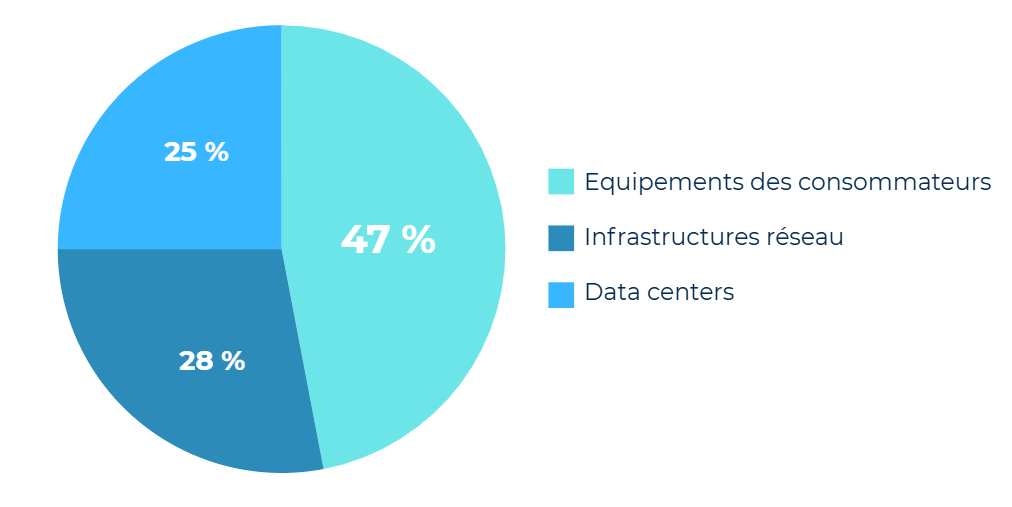
Breakdown of Greenhouse Gas Emissions from the Digital Sector

How to ensure the long-term viability and growth of your business through a successful low-carbon strategy.
Les centres de données (data centers), piliers de l’hébergement des sites web, sont de véritables consommateurs d’énergie, souvent alimentés par des sources non renouvelables.
This high energy consumption stems from several sources:
- Data centers account for 1.5% of global energy consumption. Butthe International Energy Agency (IEA) warns that this share could rise to 10% by 2030 if no significant action is taken.
- The networks required for data transfer, powered by energy-intensive infrastructure.
- User devices, such as smartphones and computers, also use electricity.
This is an alarming finding, given that the production of devices alone accounts for between 65 and 90 percent of the digital sector’s carbon footprint in France. These are the findings of a joint report byArcep andADEME, commissioned by the Ministry of Ecological Transition and the Ministry of the Economy, Finance, and Recovery.
Therefore, reducing the energy impact of digital technology requires taking action as early as the design and manufacturing phases and rethinking our everyday habits.
Where does the digital carbon footprint come from?
While using our digital devices consumesenergy, it is their manufacturing that accounts for the largest portion of their overall carbon footprint:
- About 60% of CO₂ emissions come from manufacturing, compared with 40% from use
The production of a single device requires considerable resources, particularly rare metals. Every year, millions of metric tons of natural resources are extracted to produce smartphones, computers, and tablets, using industrial processes that consume a great deal of energy.
A striking example:
- It takes 800 kg of raw materials and 1.5 metric tons of water to manufacture a 2-kg computer.
- It generates 183 kg of CO₂e, whereas using this computer accounts for only 7.6 kg of CO₂e.
Source: ADEME
Therefore, it is necessary to extend the lifespan of equipment to contribute to a sustainable economy.
To help you take concrete action, we have developed Decarbo’Target®. This service, part of Decarbo’Solution®, analyzes the areas with the highest emissions. It identifies the emission-intensive processes, proposes targeted reduction plans, and measures the environmental performance of the actions taken.
Challenges for Organizations: Reducing Impact, Improving CSR Coherence
Giventhe growing impact of digital technology on the environment, companies can no longer ignore the effects of their digital practices. While the areas with the highest emissions are generally well known (transportation, energy, procurement), digital practices—which are often invisible—account for a significant portion. In this context, organizations must assess the consistency of their CSR approach and take concrete action to reduce their environmental footprint.
Why do organizations need to take action?
“Email is the primary communication tool in business,” according to * Le Monde Informatique*. It forms the backbone of most communications with customers, partners, and suppliers.
However, this practice is still too rarely taken into account in GHG assessments. Yet, by factoring in this impact:
✅ Improve transparency
Including the pollution generated by emails and data in the carbon footprint calculation provides a more accurate and comprehensive view ofthe organization'scarbon footprint.
✅ Meet the growing expectations of stakeholders
Today, customers, employees, and investors increasingly expect consistency between organizations’ environmental commitments and the reality of their digital practices.
✅ Build credibility with investors
Non-financial analysts and investment funds are paying increasing attention to ESG criteria. Proficiency in the use of digital tools has become a true indicator of CSR maturity.
✅ Effectively reduce an organization's carbon footprint
Taking action on digital habits—such as reducing email volume, optimizing storage practices, and limiting the sending of large attachments —provides a quick and effective way to reduceour environmental impact.
Digital technology is now at the heart of CSR strategies, and proficiency in this area has become a key evaluation criterion.
With this in mind, Decarbo’Supply®, one of the pillars of Decarbo’Solution®, helps organizations accurately incorporatethe carbon impact of their digital usage—email, data, servers—into their CSR strategy. The tool makes it possible to prioritize the most energy-efficient infrastructure, engage IT suppliers and service providers, and drive the effective reduction of associated emissions.
Measurable gains
Sending and managing our emails has a significant environmental impact. Fortunately, adopting best practices can significantly reduce this footprint.
Here are some concrete steps you can take to make your digital communications more sustainable:
1. Optimize your email campaigns
- Use links for large files
- Reduce the size of attachments
- Simplify Your Automatic Signatures
Specifically, according toADEME, increasing the number of email recipients by 10 multiplies the email’s impact by 4.
2. Manage your Inbox and Outbox
- Target Your Audience
- Regularly delete old emails and attachments
In addition, the use of file-sharing services (local servers, the cloud, or dedicated file-sharing folders) significantly reduces the distance data must travel and the amount of storage required. This data can travel approximately 15,000 km before reaching its recipients.
By adopting these habits, you are actively helping to reduce the digital sector’s carbon footprint.
Train and raise awareness among teams
Employees need to understand that every email they send or keep, and every attachment they store unnecessarily, has a carbon footprint.
It is essential to implement training programs focused on digital moderation, raise awareness of best practices, and incorporate these issues into CSR training.
However, employees themselves are willing to get more involved. According to ADEME, 68% of employees want to go further and receive training on sustainability issues.
Training thus becomes a strategic tool for:
- Giving Meaning to New Sustainable Practices
- Create a shared culture centered on ethical and responsible communication
- Empower all departments: HR, marketing, digital, procurement, events, etc.
- Facilitate the implementation of a low-carbon approach at all levels of the company
Every email sent and every file stored unnecessarily consumesenergy and contributes to global warming. As customers, investors, and employees have increasingly high expectations regarding CSR consistency, it has become essential for organizations to manage this invisible environmental impact.

Thanks to Decarbo’Solution® —and in particular its Decarbo’Target® and Decarbo’Supply® modules—organizations have an operational framework to:
- Measuring the actual impact of their digital usage,
- Involve teams and suppliers in digital sustainability,
- Optimize email and data management practices,
- Effectively steering the path toward decarbonization.
Every email counts. Every well-executed digital action becomes a powerful tool for accelerating the company’s environmental transition.
Sources
- Digital – Calculate the carbon footprint of your digital activities | Individuals | Taking Action for the Ecological Transition | ADEME
- Why Calculate Your Carbon Footprint?
- The Carbon Cost of an Email: Update! – The Carbon Literacy Project
- The Carbon Footprint of an Email: 7 Ways to Reduce It | Big Media | Get Inspired, Stay Informed, Get Involved
- The staggering number of emails you receive every day at work – Capital.fr
- Why Calculate Your Carbon Footprint?
- Taking Action Every Day: Reducing Your Digital Footprint | WWF France
- Data Centers & Networks – IEA
- Environment | Arcep
- Digital – Calculate the carbon footprint of your digital activities | Individuals | Taking Action for the Ecological Transition | ADEME
- Email: The Top Communication Tool in Business – Le Monde Informatique
- Digital – 10 Best Digital Practices for Remote Work | Individuals | Taking Action for the Ecological Transition | ADEME