







Carry out your GHG assessment with a Scope 3 specialist
- Your complete, compliant GHG assessment (Scopes 1, 2 and 3). Solution tailored to the size of your company, with personalized support
- Bilan GES Scope 3: collect primary data from your suppliers, who calculate the "Carbon Weight" of their products and services free of charge.
- Select products and services with the lowest emissions, and significantly reduce your own emissions
Book a free strategy call and start your carbon transition today!
Companies that are already working alongside us to achieve the global goal of carbon neutrality together.















Carry out a complete GHG assessment in compliance with current standards and regulations

Let our carbon experts guide you
Define your reduction actions, plan your low-carbon strategy
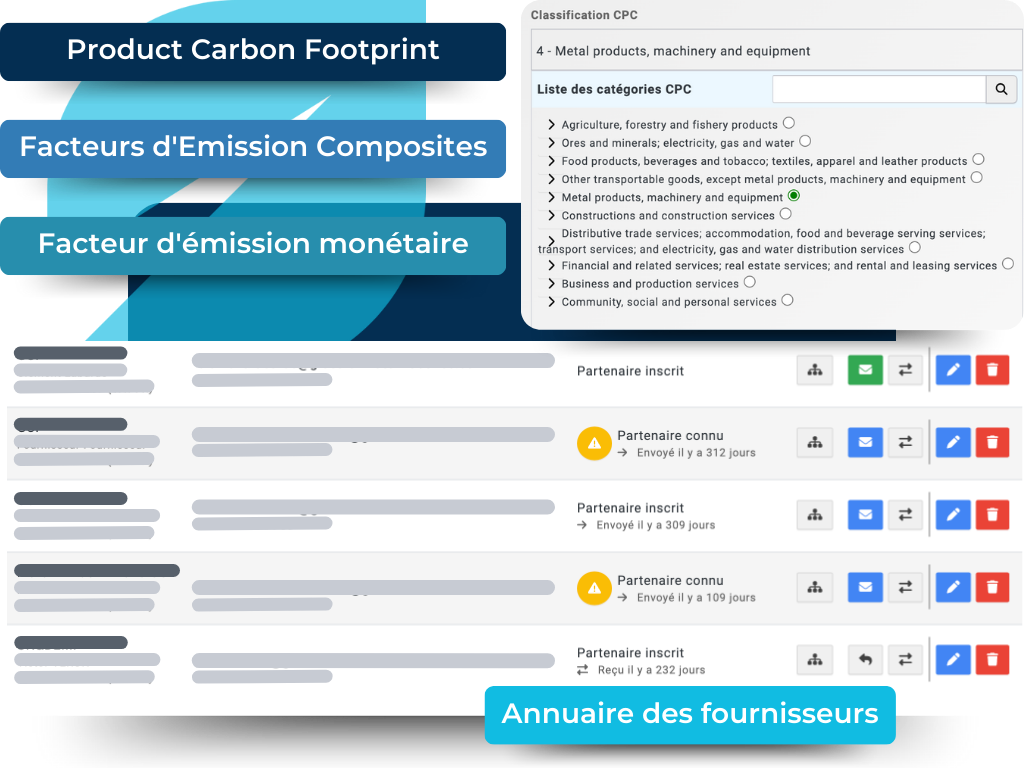
Engage your suppliers free of charge to optimize the calculation of your Scope 3 emissions

An approved and compliant GHG inventory
Supported protocols:




Your GHG Assessment: Stress-Free and Effective
You don't have to be an expert to get started.
- A straightforward path adapted to your business, however complex it may be.
- Scopes 1, 2 and 3? Taken care of automatically, no headaches.
- Reliable data from the best databases: Base Carbone®, EcoInvent, Inies, BEIS... or directly transmitted by your suppliers.
- A balance sheet 100% compliant with the most demanding standards: ISO 14064, ISO 14067, GHG Protocol.
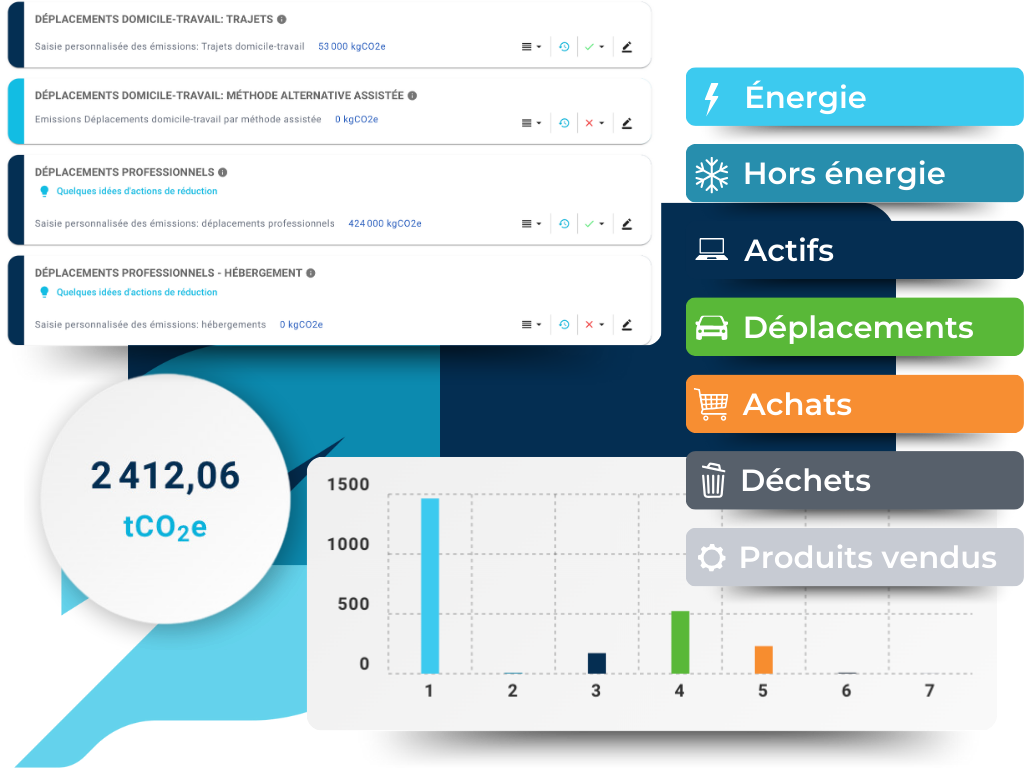
A structured, coordinated, and visual transition plan
Whether or not you have already conducted your GHG assessment with us
- Design and management of comprehensive action plans (ADEME Act method).
- Quantifying and projecting GHG impact using simulation tools.
- Definition of low-carbon trajectory with commitment from partners.
- Comparison of actual trajectory with reduction targets (SBTi).

Get your suppliers on board with your climate initiative
A simple, free platform for decarbonizing together.
- Automatically integrate your suppliers' carbon data into your scope 3.
- Track and visualize the low-carbon trajectory of your purchases in real time.
- Ensure regulatory compliance (CSRD, SBTi and CBAM) based on reliable, auditable supplier data.
- Give your suppliers access to the GHG and LCA assessments of their products and services.
Insist on climate performance right from the request for proposals stage
A simple, free platform for decarbonizing together.
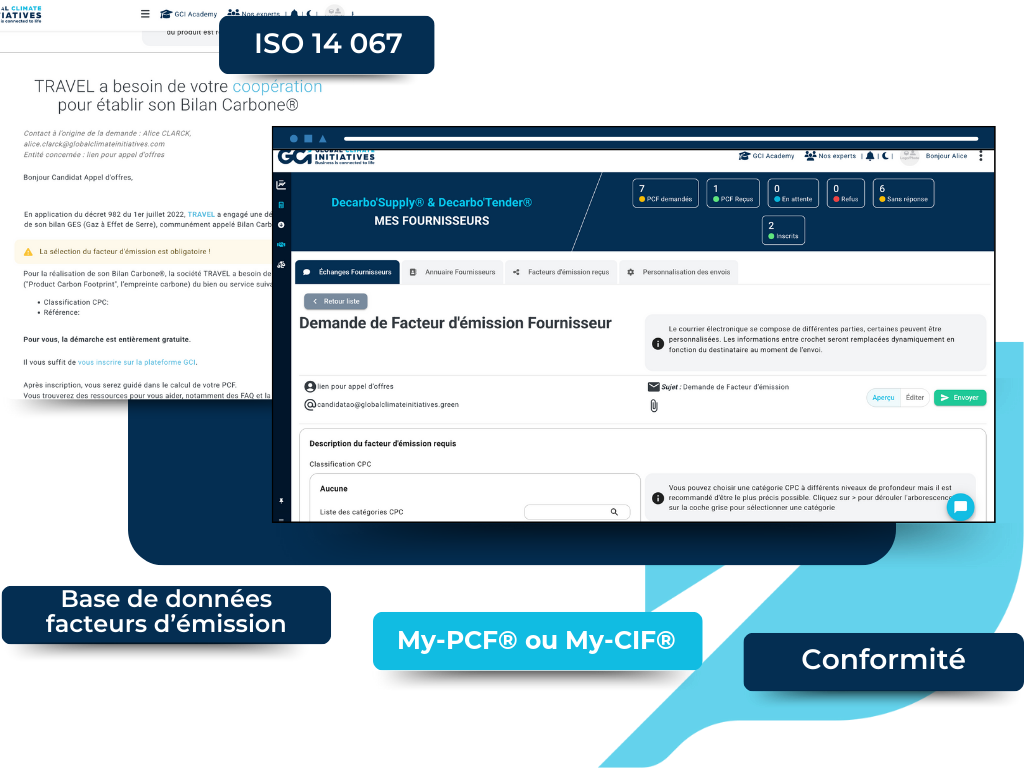
- Specify requests for PCF or My-CIF® carbon intensity factors in requests for proposals.
- Link to the Decarbo’Solution® platform for a calculation by property or service requested (with a description).
- Compliance with the public procurement code: free of charge and focused on an environmental characteristic.
- Compliance with ISO 14 067 standard.
Turn your carbon footprint into a driver of economic performance.
Les entreprises les plus engagées dans leur stratégie
de décarbonation comptent sur notre expertise.
Check out our client case studies and testimonials.

Gaëtan COUREUL | Amaury Sport Organisation

Benjamin GRIZBEC | French Badminton Federation

Christophe CHRISTEN | SCHMIDT Group
Marlène PIVARD | Natural Grass

Catherine ROYER | INDIES

Amélie BERNARD | KELLER Special Foundations
We're here to answer your questions!
How do I calculate my company's GHG footprint?
First of all, carrying out a greenhouse gas assessment (BEGES) enables a company to precisely evaluate its carbon footprint and understand the main source of each of its greenhouse gas emissions.
The main difference between the Bilan Carbone® and the GHG Inventory lies in the definition of the scope of emissions accounting.
In the Ademe methodology, the GHG inventory® calculation takes into account the entire life cycle of a company's products or services. This enables a global assessment of the company's GHG emissions, and the identification of any sources of savings.
Greenhouse gas (GHG) emissions are assessed on the basis of consumption, using conversion factors specific to each energy source. This makes it possible to standardize measurements and obtain a quantity of emissions expressed in carbon dioxide equivalent (CO2e).
In other words, it's a simple matter of multiplying your activity data (in kWh, units, liters, €) by an emission factor (average quantity of greenhouse gas emissions for 1 unit of your activity data).
To calculate your GHG footprint, you need to collect data on activities that directly and indirectly emit greenhouse gases, and convert them using an emission factor.
Why should I carry out a GHG assessment for my company?
Over and above regulatory obligations (in particular since decree no. 2022-982), carrying out a GHG assessment is an essential step for a company, as it enables it to identify and list the greenhouse gas emissions directly or indirectly linked to its activity.
Carrying out your company's first GHG assessment will enable you to make an initial measurement and identify the main emission sources. This will make it all the easier to identify potential areas for reduction and define a low-carbon strategy for your company.
Carrying out GHG Assessments on a regular basis over time will provide an opportunity to adjust your action plan and ensure that you are meeting your objectives for reducing your company's environmental impact.
What data do I need to provide?
To accurately measure greenhouse gas emissions, you need to identify all your company's emission sources. It is therefore necessary to collect activity data:
- Energy consumption (gas, oil, diesel, petrol, electricity, etc. .....)
- Depreciating assets (real estate, fleet of vehicles, computer equipment, furniture, etc.)
- Purchases of goods (raw materials, materials, food, etc.)
- Purchases of services (internet contract, maintenance and installation of equipment, supplies of services, fees, etc....)
- Movement of people: employee commuting, business travel, visitors and customers, etc. .....
- Haulage
- Disposal
- Use and end of life of products sold.
Although it is recommended to be as exhaustive as possible in identifying emission headings, it is possible to start with financial data and to refine the accuracy of the data over time. We recommend that you carry out your inventory in stages, starting with your largest expenditure items first.
How can I reduce my company's carbon footprint?
Reducing the carbon footprint of your company is a multi-step process:
- Carry out an initial assessment of your carbon footprint.
- Identify the most important emission headings, and find ways to reduce them by improving the accuracy of the data used for measurement.
- Involve your suppliers by asking them to calculate the carbon footprint of the goods and services they supply. The measurement will be all the more accurate and you will then be able to implement a responsible purchasing strategy.
- Set up an action plan and a measurement strategy over time to ensure that it is implemented and effective.
We are a member of:
Association for the Low-Carbon Transition

Association of Climate Consulting Professionals

National Procurement Council
Responsible Purchasing Observatory
My-PCF® · Decarbo'Supply® · Decarbo'Tender®
Calculez, partagez, décarbonez avec vos fournisseurs.
Vos clients vous demandent vos PCF ? Vos fournisseurs ne suivent pas ?
Activez les modules adaptés en quelques clics, abonnement mensuel ou annuel.