









ADEME Construction Grant: The Complete Guide to Financing Your Decarbonization Efforts

Key points to learn in this article
- ADEME (the French Agency for Ecological Transition) offers more than 70 financial support programs to assist the construction industry in its ecological transition, with grants covering up to 70% of consulting costs and 50% of equipment investments.
- The building and public works sector accounts for approximately 25% of CO₂ emissions and waste in France: public funding is primarily aimed at reducing the environmental footprint of materials, structures, and transportation.
- Starting August 21, 2026, all public procurement contracts must include a measurable environmental criterion: companies that have structured their CSR initiatives using this funding will have a decisive competitive advantage.
- The Decarbonization Fund, the Heating Fund, the Tremplin program, and the subsidized assessments (Diag Décarbon’Action, Diag Perf’Immo) are the main tools that should be utilized immediately.
- These forms of support can be combined with one another and with other programs (CEE, regional grants, BPI France), making it possible to develop ambitious financing plans.
Contents
What is an ADEME grant for the construction industry?
These grants for the construction industry refer to all financial assistance offered by the Ecological Transition Agency to stakeholders in the construction sector. They are intended to help fund studies, assessments, equipment, and support services related to reducing greenhouse gas emissions and improving energy efficiency.
Concrètement, ces mécanismes permettent de prendre en charge une partie significative du coût total et du coût de mise en œuvre des projets de verdissement et des initiatives vertes. Que vous soyez une PME qui souhaite réaliser son premier bilan GES ou une ETI qui cherche à électrifier ses équipements et installations de chantier, il existe un dispositif adapté à votre situation. Pour cibler les bons leviers, le bilan carbone de vos chantiers reste le point de départ.
Definition
ADEME is France’s leading public agency for sustainable development. Designated by the government as one of the pillars of the France 2030 plan, it manages a catalog of more than 71 support programs for businesses of all sizes—from very small businesses to large corporations.
The catalog covers a very broad range of services: energy audits, feasibility studies, impact analyses, equipment that uses renewable energy, strategic low-carbon support, research, development, and professional training. For the construction sector, the stakes are considerable, as it alone accounts for a massive share of national CO₂ emissions.
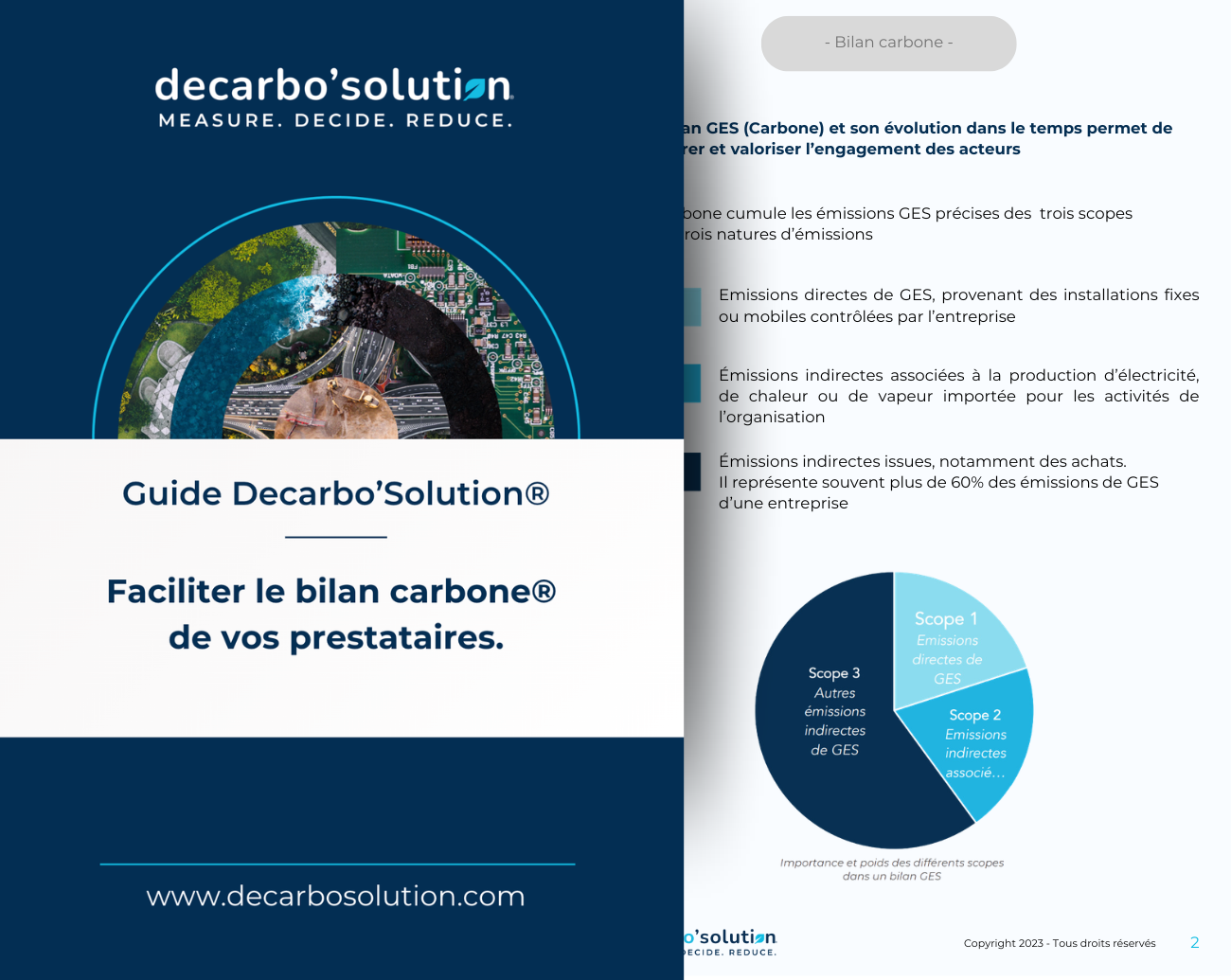
Simplify the GHG assessment for your service providers
Why Construction Is a Priority Sector
The construction industry accounts for approximately 25% of CO₂ emissions in France. It is one of the sectors with the greatest climate impact, with three main sources: materials (steel, cement, aluminum), logistics and transportation, and the use of buildings.
This significance explains why the government focuses a significant portion of its grants and budgets on new and existing buildings in this sector. Construction professionals can find grants tailored to their projects here. The challenge goes beyond mere regulatory compliance: it involves a fundamental transformation of the practices of an entire profession.
Did you know?
In the construction industry, Scope 3 emissions (indirect emissions related to suppliers, materials, and subcontractors) account for 60 to 90 percent of a company’s total carbon footprint. That is why support measures are not limited to work on construction projects; they also focus on organizing environmental data across the entire supply chain.
The three major areas targeted by the funding
– Construction materials — Steel, cement, and aluminum are among the most polluting products. Under the Carbon Border Adjustment Mechanism (CBAM) and the carbon market, these imported materials will be subject to a tax starting in 2026. The organization co-funds studies to identify lower-emission alternatives, optimize technical choices, and reduce construction waste.
– Transportation and Logistics — Transporting materials to construction sites has a significant environmental impact. Support measures include logistics optimization, investment in low-carbon vehicle fleets, the installation of charging stations, and the accurate measurement of the freight footprint.
– Building Performance — The Heat Fund and electrification programs for commercial buildings help reduce energy consumption in both existing and new facilities.
The main resources available to professionals
The “Springboard for the Ecological Transition of SMEs” Help Desk
This is the most accessible program for small and medium-sized organizations in the sector. It allows for the co-financing, through a single application, of multiple assessments and equipment related to the green transition. The amount of funding can reach €200,000 for the most ambitious projects and renovation projects.
This service covers, among other things, assessments, feasibility studies for machine replacement, and low-carbon solutions. Its main advantage is administrative simplicity, with a single application covering multiple initiatives.
The Decarbonization Fund
This fund is intended for organizations of all sizes and offers grants ranging from €30,000 to €500,000 for industrial projects aimed at reducing CO₂ emissions. The amount of funding for these projects can cover up to 50% of the total cost, particularly for initiatives focused on improving the efficiency of industrial processes.
For a construction company looking to electrify its equipment or install heat recovery systems, this financial incentive is particularly attractive.
The Heat Fund
This program supports renewable heat and energy recovery initiatives, covering up to 40% of eligible expenses. It applies primarily to commercial buildings, permanent construction site facilities, and fixed installation sites.
Eligible technologies include high-temperature heat pumps, renewable thermal networks, and waste heat recovery systems. This incentive is relevant for professionals who own sites used for industrial or commercial purposes.
Please note: Financial assistance can only be granted if the project has not yet begun at the time the application is submitted. You must submit your application before incurring any expenses. Failure to meet this requirement will automatically result in the rejection of your application.
Collective Actions to Reduce GHG Emissions
Launched in 2026, this program brings together at least 10 organizations in a collaborative initiative. It offers three levels:
– ACT Step-by-Step — Developing a concrete and ambitious roadmap, including a roadmap for reducing waste.
– Investment Roadmap — Defining a transformation strategy and prioritizing actions to be taken, with a specific timeline.
– Personalized financial coaching — Risk analysis, profitability calculations, and putting together a proposal to help you take the plunge.
This group formatreduces per-person costs and allows participants to share their experiences and concrete results —a valuable asset for small and medium-sized businesses and their employees (including those in training) who are just beginning their CSR journey.
Supported Diagnostics and Analyses: The Starting Point
Before making any major investment, it is essential to assess the situation. Every project must be based on reliable data. The Agency co-funds several types of assessments that form the foundation of any strategy to reduce GHG emissions in the construction sector.
Decarbon’Action Assessment
Designed for companies and SMEs with fewer than 500 employees — including employees undergoing retraining —(or 250 employees for certain programs) that have never conducted a greenhouse gas (GHG) assessment, this assessment lays the groundwork for a structured approach. It includes the completion of a simplified GHG inventory, the identification of initial areas for action, an employee training program, and introductory training on carbon management tools.
Definition
The greenhouse gas (GHG) emissions inventory measures an organization’s total direct and indirect emissions. It is broken down into three scopes: Scope 1 (direct emissions), Scope 2 (purchased energy), and Scope 3 (value chain). In the construction industry, Scope 3 accounts for the majority of the carbon footprint and is the primary area for improvement.
Diag Perf’Immo
This program is aimed at commercial or mixed-use buildings. A specialized consulting firm works with the company for six to eight months to help it reduce its energy consumption and put it on a path that complies with the commercial building decree. It also serves as a tool to accelerate the development of expertise in building performance.
Energy Audits
Energy audits for facilities may be subsidized up to 50% of the amount excluding tax— up to a maximum of 8,500 euros per facility. For a construction company that operates multiple facilities (offices, workshops, warehouses), this subsidy can amount to total funding of several tens of thousands of euros.
Feasibility Studies
For more advanced initiatives, the program co-funds feasibility studies at 70 percent of the cost, with caps that vary depending on the nature of the project and the total cost. These preliminary studies help validate the technical and economic feasibility of an equipment estimate before committing to the project.
Did you know?
The cost of a subsidized assessment is often lower than the cost of a poorly structured environmental management program. Companies such as Schmidt Groupe have reduced the uncertainty in their Scope 3 metrics from 50% to 5% after streamlining their supplier data collection process, while identifying 242 metric tons of CO₂ that could be reduced in just a few weeks.
How to Put Together a Job Application in the Construction Industry
Applications must be submitted exclusively through the AGIR platform (agirpourlatransition.ademe.fr). Here are the key steps to maximize your chances of success.
Step 1: Identify the correct mechanism
Start by browsing the catalog on the AGIR platform. Filter by industry (construction, civil engineering) and by program type (expertise, equipment, support). Each entry details the eligibility criteria, funding amounts, funding caps, and deadlines.
Step 2: Prepare the documents for the file
A high-quality proposal typically includes a detailed description of the initiative and preliminary analyses, a precise breakdown of investment costs—including a projected budget—an implementation schedule and expected results, as well as projected outcomes and measurable goals in terms of GHG reduction. The more structured and well-quantified your proposal is, the better your chances will be. Also, be sure to include a detailed quote from the proposed service provider and any additional quotes.
Step 3: Contact the regional office
The disbursement of grants often depends on each region’s guidelines and budget. Discussing the matter in advance with your local contact will help confirm eligibility and anticipate any necessary adjustments.
Step 4: Submit the request before incurring the expenses
This is the golden rule. Do not begin any project or place any orders until you have received confirmation of funding. Any expenses incurred before the application is submitted will render the initiative ineligible.
Please note: Deadlines vary by program. For 2026, some calls for proposals close as early as April, while others close in June or October. Be sure to check the deadlines in the catalog. For example, the submission deadline for group projects is June 12, 2026.
Regulations: What's Changing in 2026
The year 2026 marks a major turning point for construction professionals. Government assistance takes on its full significance within this new regulatory framework, as it enables the industry to prepare for compliance with requirements that are becoming mandatory.
The Climate and Resilience Act: Environmental Criteria in Public Procurement
Effective August 21, 2026, all public procurement contracts must include at least one criterion measuring the impact on the carbon footprint. This criterion will account for between 10 and 30 percent of the final score. Merely declarative approaches will no longer suffice: quantified, standardized, and auditable indicators will be required.
For professionals, this means that it is becoming essential to have a structured GHG inventory and product carbon footprints (PCF) that comply with the ISO 14067 standard. Public funding for assessments and expert analyses is the first step toward achieving this structure.
The MACF: Taxation on Imported Materials
The Carbon Border Adjustment Mechanism will become operational in 2026 for raw materials (steel, cement, aluminum, fertilizer, hydrogen). Without evidence of the actual carbon footprint of these materials, the European Union applies default values—which are often the most punitive on the market.
For a construction company that imports steel or cement, the difference between the default tax rate and the tax rate based on actual emissions can amount to a significant sum. Platforms such as Decarbo’Solution® make it possible to calculate and certify PCFs in accordance with the ISO 14067 standard, turning a tax burden into a competitive advantage.
CSRD: Enhanced Non-Financial Reporting
The CSRD requires large companies and mid-sized enterprises to provide detailed reporting on their greenhouse gas emissions, including Scope 3 emissions. Supplier data must be reliable, comparable, and auditable. Public subsidy programs designed to support the development of these indicators serve as a valuable tool for meeting this CSR requirement and enhancing CSR credibility.
Combining Sources of Support: CEE, Regional Grants, and BPI
One of the most strategic aspects of financing the transition to sustainable construction is the ability to combine multiple funding mechanisms. An optimized approach to financial assistance can significantly reduce the remaining cost and the out-of-pocket expense.
Energy Savings Certificates (CEE)
The EE Credits encourage energy suppliers to co-finance renovation projects for businesses in all sectors, particularly those in the construction industry. In 2026, microbusinesses and small-to-medium-sized enterprises will be eligible for additional incentives. EE Credits can be combined with public grants for the same project.
Regional Support
Each region offers additional support programs. The Climaxion program, for example, brings together the public agency and local governments to co-fund energy transition initiatives. The amount of regional grants ranges from €10,000 to €150,000, depending on the project and the size of the organization.
BPI France — Green Guarantees
As part of the Green Industry Act, BPI France offers three guarantees (green startup, green growth, and green business transfer) covering up to 80% of programs related to eco-responsible transformation. These guarantees facilitate access to bank loans, green loans, and subsidized loans for heavy equipment.
Did you know?
By combining public funding (up to 50%), subsidized energy efficiency credits (CEE), regional support, and a BPI France guarantee, some players in the construction industry are able to cover up to 80% of the costs of their greening initiatives. The remaining costs are then offset by the savings achieved and the competitive advantage gained in competitive bidding and public procurement.
Structuring Your Strategy to Maximize Funding
Securing a government grant is a first step. But to get the most out of it, this funding must be integrated into a coherent and sustainable strategy. The initial step only makes sense if it leads to an operational action plan.
Moving from a GHG Assessment to an Action Plan
A GHG inventory is a snapshot. It measures the footprint at a specific point in time, but says nothing about the actions to be taken, the priorities, or the path forward. To turn this snapshot into a concrete roadmap, a costed reduction plan must be developed.
That’s what solutions like Decarbo’Target® and Decarbo’Inventory® offer: transforming a static assessment into a dynamic roadmap, complete with prioritized levers, estimated Capex and Opex costs, and a trajectory aligned with SBTi goals.
Engaging Suppliers in the Process
In the construction industry, 60 to 90 percent of the environmental footprint comes from the supply chain. No strategy can succeed without the active commitment of suppliers. However, collecting environmental data from suppliers remains one of the most complex challenges facing the industry.
Data is often anecdotal, inconsistent, and impossible to compare. To organize this data collection, platforms such as Decarbo’Supply® offer a free portal for suppliers, featuring standardized data entry forms and dedicated support. It also serves as a tool to raise awareness among your partners about the challenges of climate change and the energy transition.
Preparing Responses to Construction Bids
With environmental criteria set to account for up to 30% of the score in public tenders starting in August 2026, the ability to provide auditable metrics is becoming a key differentiator. Solutions such as Decarbo’Tender® make it possible to incorporate product carbon footprints (PCF) directly into bids, with objective scoring that complies with the Climate Law.
Managing the Tax Base
With the MACF and the ETS, carbon and CO₂ become a direct cost item. Construction industry players who import steel, cement, or aluminum face increasing tax pressure. An ISO 14067-certified PCF allows companies to pay taxes calculated based on actual emissions rather than on punitive default values. The impact on profit margins can be significant.
Please note: It takes an average of 12 to 18 months to establish these indicators. Starting the administrative process in 2027 to be ready by 2028 is already too late. The support programs available today are designed to assist with this phase. Don’t let them expire.
Conclusion
These support programs for the construction industry represent an exceptional opportunity for professionals in the sector who wish to accelerate their green transition while maintaining their competitiveness. With more than 70 support mechanisms, funding rates of up to 70% for consulting services and 50% for equipment, and the ability to combine multiple funding sources, financing for GHG reduction has never been more accessible. Environmental challenges make this investment essential.
But beyond the financial aspect, the issue is strategic and relates to corporate social responsibility (CSR). Investing in CSR pays off. Organizations that begin developing their carbon strategies now are positioning themselves favorably ahead of the 2026 regulatory deadlines—and gaining a competitive edge in bidding processes.
Impact criteria in public procurement, the MACF for imported materials, and the CSRD for reporting: these requirements are coming. Organizations that have robust, auditable, and actionable metrics will protect their margins and turn this constraint into a competitive advantage.
Solutions such as Decarbo’Solution® support construction companies through this transition, from initial assessment to operational reduction, including supplier engagement and the management of their low-carbon and climate-neutral trajectory.
Don't let these funding opportunities expire. Start planning your application now.
👉 Find out how Decarbo’Solution® can accelerate your transformation