









Avoiding Greenwashing: Setting and Managing Credible Climate Goals in Business

These days, simply listing “lofty” climate goals on a company’s website homepage or in its annual report no longer convinces anyone. Customers, partners, investors, employees—everyone is now scrutinizing the actions that back up the words. When it comes to climate issues, trust can no longer be simply decreed: It proves itself, backed by figures. Each report must demonstrate a genuine commitment and a measurable impact, in line with ADEME’s expectations and France’s official environmental framework.
But how can we turn the desire to “do our part” into a corporate climate strategy that stands up to scrutiny? How can a company stand out when even the slightest miscalculation in its GHG inventory (Greenhouse Gas Emissions Inventory) or the slightest inaccuracy in its greenhouse gas (GHG) emissions figures can undermine years of communication efforts? For companies, it has become essential to take concrete action and demonstrate their commitment.
In a world where carbon neutrality is no longer achieved through marketing campaigns, but through measurable commitments, precise assessments, and verifiable actions, the time has come to do away with greenwashing at all costs. We must clearly commit to prioritizing energy, transparency, and the zero-emissions goal.
Contents
Between Posture and Strategy: Laying the Right Foundation
Talking about carbon neutrality or achieving net-zero emissions without taking concrete action means running the risk of being accused of greenwashing.
For every company, the credibility of its climate goals depends on the implementation of a rigorous methodology that is science-based and tailored to the sector. Frameworks such as the GHG Protocol, the Science Based Targets initiative (SBTi), the National Low-Carbon Strategy (SNBC), and the Climate Resilience Act have become essential for structuring a company’s climate strategy and transition plan in full compliance with regulations, serving as the sole tangible reference in France.
An environmental goal always begins with:
-
- Defining a clear scope of analysis: Scopes 1, 2, and 3 (direct emissions, significant indirect emissions, and value chain emissions). Understanding each scope is essential to placing environmental action at the center of our efforts,
- An initial GHG inventory that complies with standards (ISO 14064, ISO 14067, ISO 14083) and covers all sources of GHG emissions in order to provide a clear picture of the organization’s carbon footprint and energy demand
- The integration of sector-specific issues—such as mobility, energy, procurement, logistics, raw materials—as well as all activities related to business development, …
Collecting accurate and detailed data on the carbon footprint and all of the company’s activities is essential, as is taking into account the requirements of the National Low-Carbon Strategy. A commitment to environmental sustainability also requires greater transparency. The expectations of financial institutions, customers, and stakeholders make it necessary to ensure full transparency regarding balance sheets, emissions, and low-carbon transition plans.
This is what Decarbo’Solution® (Decarbo’Solution®) offers: an internationally recognized platform that enables all organizations—from microbusinesses, small and medium-sized enterprises, and mid-sized companies to large private and public enterprises—to independently conduct their GHG inventories and to secure and manage their transition plans, which reflect their low-carbon strategies.
Set a trajectory aligned with actual emissions
Conducting a GHG assessment is only valuable if it serves as the first step in a concrete corporate transition plan, with clear and measurable emissions reduction targets.
For companies, analyzing the main sources of emissions (Scope 1, 2, and 3) and identifying opportunities for reduction measures makes it possible to develop a credible transition plan
Key points of the approach:
- Prioritize actions based on their reduction potential
- Set climate goals aligned with a recognized pathway (SBTi, SNBC)
- Prioritize the decarbonization of its procurement, its energy transition, and eco-design,
- IncorporatingClimate Change Adaptation and Resilience into Your Strategic Roadmap
To set and achieve ambitious goals, companies must also engage their value chain: suppliers, subcontractors, partners, etc.
Getting all stakeholders on board to reduce GHG emissions is essential to achieving the established goals.
This collective effort brings people together: it is an asset in addressing climate challenges and ensuring the long-term sustainability of its operations.
The Decarbo’Solution® platform includes a“Decarbo’Target®”module—a turnkey solution for organizing and managing an ambitious and credible low-carbon transition plan: prioritizing actions targeting the main sources of emissions, ensuring precise management of its climate strategy, and committing to reduction targets in line with the requirements of the SBTi (Science Based Targets initiative) and the SNBC.
This three-dimensional approach (involving both internal resources and partners and suppliers) enables a credible, data-driven transition supported by a clear vision of action plans with well-defined impacts.
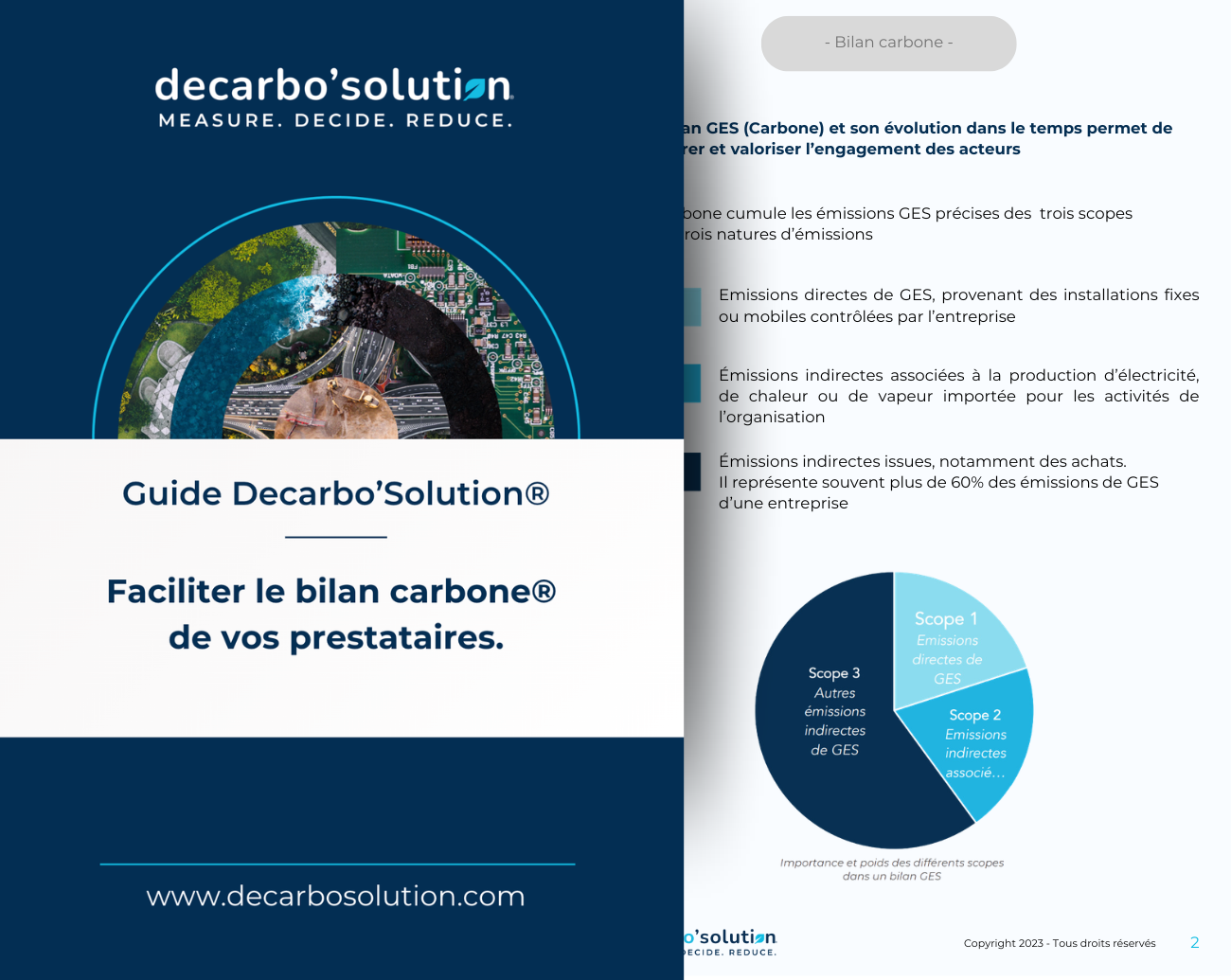
Simplify the GHG assessment for your service providers
Managing and Communicating Commitments Over the Long Term
Meeting climate commitments and demonstrating actual reductions in emissions requires regularly monitoring, adjusting, and reporting on performance. Long-term commitment, year after year, is a key factor in success.
Dashboards and dynamic indicators are essential for assessing and improving the impact of an organization’s actions and for monitoring progress toward its climate goal, with the aim of moving as close as possible to carbon neutrality over the long term. Incorporating energy-related issues into these analyses enhances the relevance of the monitoring process.
Key Success Factors:
- Dynamic monitoring of indicators (reduction of greenhouse gas emissions, stakeholder engagement, emissions avoided, ongoing progress toward carbon neutrality), with a stronger link to decarbonization principles)
- Reporting that complies with regulatory, industry, and financial institution requirements, often based on ADEME guidelines,
- Training and engaging teams on issues related to sustainable development and climate change adaptation, as part of a comprehensive transition initiative,
- Transparent communication about its strategy, changes in its GHG footprint, and progress toward its climate goals.
Action on significant indirect emissions, the accounting of avoided emissions, the potential inclusion of carbon sinks, and the consideration of long-term adaptation scenarios demonstrate the level of maturity and sincerity of an ambitious climate strategy.
Decarbo’Solution® offers a comprehensive suite of tools (Decarbo’Solution®), support and awareness-raising modules (training sessions, webinars), interactive management solutions, and detailed, automated reports.
The deliverables can be immediately incorporated into transition plans and CSR reports. They provide robust documentation of the company’s commitments and trajectory, thereby reassuring financial institutions and stakeholders that a sustainable low-carbon trajectory—rooted in a structured and sustainable development approach—is indeed being implemented.

The 7 Benefits of Conducting a GHG Assessment for Your Company.
Avoiding greenwashing and embedding genuine climate goals at the heart of corporate strategy is no longer an option but a necessity for contributing to the fight against climate change, while strengthening resilience and credibility among all stakeholders—a key factor in ensuring the long-term economic viability of companies affected by their GHG emissions.
The era of excessive ambitions and broken promises is over : Today, success depends on transparency, alignment with science, continuous measurement of greenhouse gases, and collective action.
In this challenging environment, relying on solutions capable of organizing, securing, and managing every step of the process independently has become a key factor for success in achieving the goal of net-zero emissions.
That is the strength and uniqueness of Decarbo’Solution®: A comprehensive, three-module approach that is 100% compliant and designed to support every business – regardless of its industry, size, or level of maturity – in the reasonable determination and practical implementation of its climate commitments in relation to its carbon footprint.
From the development of the initial BEGES to the definition of the transition plan, the monitoring of reduction targets, and the engagement of teams and stakeholders, Decarbo’Solution® offers a suite of reliable, scalable online services that comply with the highest international standards and commitments.
Each action is evaluated with the goal of ensuring an effective and sustainable climate strategy, which is necessary to gradually move toward and achieve carbon neutrality.