









SBTi (Science-Based Targets Initiative): Key Takeaways
Climate change is now one of the most urgent and complex challenges facing humanity. The most recent scientific studies indicate that to limit global warming to 1.5°C, it is imperative to drastically reduce greenhouse gas (GHG) emissions worldwide. In this context, businesses play a crucial role. Not only do they contribute to global emissions, but they also possess the resources, innovation, and influence necessary to transform their business models.
The Science Based Targets Initiative (SBTi) provides a robust, recognized, and transparent framework that enables companies to set emissions reduction targets aligned with scientific evidence. This approach ensures that decarbonization pathways are consistent with the goals of the Paris Agreement and, beyond that, strengthens organizations’ economic and environmental resilience.
Contents
Understanding the SBTi: A Scientific Framework for Climate Action
🤔 What is the Science Based Targets initiative?
The Science Based Targets initiative is the result of a collaboration between the Carbon Disclosure Project (CDP), the United Nations Global Compact, the World Resources Institute (WRI), and the World Wildlife Fund (WWF). Its primary objective is to provide companies with a framework for setting emissions reduction targets based on climate science. Unlike traditional voluntary commitments, SBTs are verified by experts and must meet strict criteria for consistency with climate models.
The SBTi distinguishes between two levels of ambition:
- The “Well below 2°C” level, consistent with limiting global warming to well below 2°C.
- The “1.5°C” target, which is now the recommended standard for ambitious and responsible companies.
🔦 Emission sources: A comprehensive approach
To ensure comprehensive coverage, the SBTi requires the inclusion of emissions in accordance with the GHG Protocol classification:
- Scope 1: Direct emissions from the company’s own facilities and operations (e.g., fuel combustion).
- Scope 2: Indirect emissions associated with the production of purchased energy (e.g., electricity, heat, steam).
- Scope 3: all other indirect emissions upstream and downstream of the value chain (transportation, purchase of raw materials, product use, etc.).
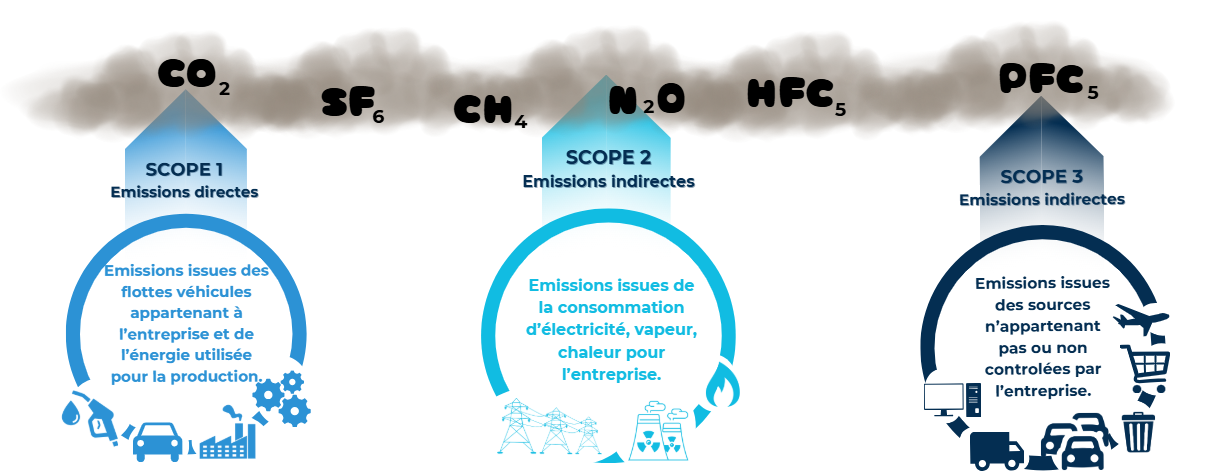
It is worth noting that Scope 1 and 2 cover 10 to 20% of total GHG emissions. As for Scope 3 emissions, managing them is often the most complex but also the most impactful: they can account for up to 90% of a company’s total emissions.
🌍 A global momentum driven by Europe
According to the latest report from the Science Based Targets initiative, corporate commitment to science-based climate targets has grown significantly.
The number of organizations with validated targets increased by 102% between 2022 and 2023. By the end of 2023, 4,205 companies worldwide had set emissions reduction pathways in line with scientific recommendations for limiting global warming.
Europe stands out as the main driver of this momentum: 53% of the companies and institutions that have received SBTi validation are based on the continent. This European leadership reflects a growing awareness and a strong commitment to aligning corporate strategies with planetary boundaries.
Breakdown of Financial Companies and Institutions That Have Validated Their Growth Trajectories by Region (2023)

This growth is taking place against the backdrop of a global climate emergency, in which businesses play a key role in the low-carbon economy.
Implementing the SBTi Initiative: From Commitment to Action

How to ensure the long-term viability and growth of your business through a successful low-carbon strategy.
👌Set ambitious and measurable goals
Implementing an SBTi pathway is not merely a matter of making a statement; it is based on a rigorous methodology for assessing emissions and making medium- and long-term projections.
The objectives set must be:
- Based on a clearly defined base year.
- Consistent with the IPCC climate scenarios.
- Auditable by third parties.
In France, this trend is particularly strong: 88% of CAC 40 companies are engaged in such an initiative. This phenomenon reflects a growing awareness of the need for strategic alignment with planetary boundaries.
✅ Examples of sector-specific commitments
Climate commitments validated by the SBTi reveal widely varying trends across different industries. In 2023, the service and manufacturing sectors accounted for the largest number of companies aligned with science-based climate trajectories, with 741 and 568 companies, respectively. Together, these two sectors represent 58% of organizations that have set validated targets, illustrating their leading role in the low-carbon transition.
Some sectors are also showing spectacular growth. This is true ofthe healthcare, biotechnology, and pharmaceutical industries, which posted the strongest proportional growth. The number of participating companies rose from 23 to 74 in one year, representing a 222% increase .
Conversely, sectors that have traditionally been highly exposed, such as the materials sector, are showing signs of a slowdown. After a significant increase of +160% between 2021 and 2022, this sector slipped to 11th place in terms of growth, with only a +41% increase between 2022 and 2023 (rising from 109 to 154 companies).
Breakdown by Industry Sector of Companies That Have Set Goals

Beyond the overall figures, several economic sectors are translating their climate commitments into concrete actions that have been validated by the SBTi initiative. These companies demonstrate that, regardless of the industry, it is possible to define a credible, measurable, and ambitious carbon reduction pathway.
Inspiring sector-specific commitments:
💻 Econocom – Digital Services
Econocom is committed to an ambitious low-carbon trajectory, validated by the SBTi:
- A 61.4%reduction in absolute Scope 1 and 2 emissions by 2028, compared to 2018.
- Renewable electricity: share rose from 5% to 92% over the same period.
- Committed value chain: 100% of product and service suppliers must have adopted SBTi targets by 2028.
source: Econom.com
🏗️ Bouygues Construction – Building & Civil Engineering
A pioneer in the construction industry, Bouygues Construction has integrated its climate strategy into a comprehensive transformation plan.
Targets validated by the SBTi:
- Scopes 1 & 2: – 40% reduction in direct emissions by 2030 (based on 2021 levels).
- Scope 3 – Construction: 30% of indirect emissions across the entire life cycle of buildings.
- Scope 3 – Public Works: 20% of upstream emissions.
source: Bouygues-construction.com
💊 Pharmaceutical Industry – Collective Commitment Through LEEM
As part of its environmental roadmap, Leem (Les Entreprises du Médicament) is engaging the entire French pharmaceutical industry in the SBTi initiative. Two key areas of focus:
- Reduction in Scope 1 & 2 emissions: 50% by 2030 (based on 2021 levels), including production and consumption.
- Reduction in Scope 3 emissions: 25% reduction in indirect emissions.
- A strategy integrated into the 3R (Reduce, Reuse, Recycle) roadmap, aligned with the goals of phasing out single-use plastics by 2040.
source: leem.com
These examples demonstrate that the SBTi initiative can be adapted to all sectors, and that each sector can identify its own levers for action. Aligning corporate strategies with low-carbon goals is no longer an option, but a key factor in sustainability, resilience, and competitiveness.
💚Strategic and systemic benefits
Adopting a low-carbon strategy aligned with Science Based Targets is not merely an ethical or environmental imperative. It is also a strategic initiative that creates value for both the company and its ecosystem. The benefits are evident on several levels: reputation, compliance, economic performance, and innovation.
✅Strengthen its reputation among customers, investors, and top talent.
⚖️Anticipate and manage regulatory risks in the context of increasingly stringent climate laws (CSRD, green taxonomy, etc.).
💡Optimize costs through improved energy efficiency.
🔄 Accelerate innovation by rethinking business models to promote greater circularity and sustainability.
Decarbo’Solution®: Your Partner for a Successful Low-Carbon Strategy
At Decarbo’Solution®, we firmly believe that no action plan can be implemented without a deep understanding of stakeholders. Decarbo’Solution® offers customized training and support to help organizations make sustainability a core part of their strategy.
To that end, we support you at every stage of your environmental transition through:
👩🎓Training on Climate Issues
A program structured into 4 modules:
- Climate and Energy Fundamentals
- Methodological Approach to the GHG Assessment
- Prepare Your Assessment with Decarbo’Solution®
- Assess Your Situation and Reduce Your Emissions
🤝“Climate Mural” workshops by Decarbo’Solution®
Our carbon engineers, who are trained and experienced in facilitating *La Fresque du Climat* workshops, are available to organize these sessions directly at your company, thereby helping to engage your teams in a concrete climate strategy.
Beyond raising awareness, Decarbo’Solution® supports you in reducing your carbon footprint over the long term, thanks to the various tools available on our platform.
🎦The Decarbo’Solution® Academy
A learning environment to build skills:
- Tutorial videos, technical documentation
- Detailed FAQs by Topic
- Real-world simulations on the Decarbo’Solution® platform
✨ Personalized strategic guidance
- Comprehensive GHG Assessment, Including Scope Definition, Data Collection, and Reporting
- Our Decarbo’Solutions®, the winning trio for an effective and sustainable environmental transition:
🛠️Decarbo’Supply®: Decarbonize your purchases across your entire supply chain. Reduce the carbon footprint of your products through your suppliers.
🎯Decarbo’Target®: Project your GHG emissions over time.
⚡Decarbo’Tender®: Incorporate carbon performance into your requests for proposals
To support you, Decarbo’Solution®’s carbon engineers—experts in the Bilan Carbone® method (Level 2, ABC) and methodologies such as ADEME’s “Act Pas à Pas”—put their expertise at your organization’s service to guide you step by step toward a sustainable environmental transition.
Committing to the SBTi pathway isn’t just about meeting a climate requirement—it’s about choosing a more sustainable, resilient, and forward-looking business model. Amid increasing regulation, high societal expectations, and new economic pressures, companies that align their strategy with science are gaining a competitive edge. They are turning constraints into drivers of competitiveness, innovation, and attractiveness.
Decarbonization is now a strategic imperative.
And every organization has a role to play.
With the right tools and committed partners like Decarbo’Solution®, it is possible to set your company on an ambitious, credible, and sustainable path.
Now is the time to act.

Sources
- Publication of the SBTI Guide: Strengthening Companies’ Climate Ambition
- SBTiMonitoringReport2023.pdf
- Climate Strategy: Bouygues Construction’s CSR Commitments
- The Science Based Targets initiative (SBTi) approves Econocom’s decarbonization goals | Econocom
- Green Transition: The Pharmaceutical Industry Commits to Decarbonization and Phasing Out Single-Use Plastic Packaging | Leem