









IPCC Report: Challenges, Findings, and Actions for Businesses

In the face of growing climate challenges, the Intergovernmental Panel on Climate Change (IPCC) plays a central role in the scientific assessment of climate change and in helping societies adapt to these upheavals. Established in 1988 by the United Nations Environment Programme (UNEP) and the World Meteorological Organization (WMO), the IPCC provides policymakers with a solid scientific foundation for understanding the impact of greenhouse gas (GHG) emissions on the environment and for guiding climate policy.
Its reports, published every 5 to 7 years, are essential references for governments, businesses, and citizens around the world. The IPCC’s latest assessment report (AR6), published in 2023, highlights the accelerating pace of global warming and the major risks it poses to our planet. It also underscores the urgency of immediate action, requiring a fundamental transformation of business practices and economic strategies to limit these impacts.
This article provides a summary of the key findings of the IPCC report, analyzes the implications for businesses, and identifies concrete solutions to reduce their carbon footprint and greenhouse gas emissions
1. Key Findings from the IPCC Report
1.2 Overall and Sector-Specific Impacts
1.3 The Connection to International Goals
2. Concrete Actions for Businesses
2.1 Summary: Assessing Your Carbon Footprint
2.2 Reducing Greenhouse Gas Emissions
2.3 Commit to a low-carbon approach
3. Concrete Solutions for Taking Action
3.1 Achieving Carbon Neutrality
Key Findings from the IPCC Report
🌍 Scientific Findings
The latest IPCC report, published in 2023, confirms that global warming is accelerating at an unprecedented rate. The global average temperature has already risen by 1.2°C compared to pre-industrial levels, and this rise continues. Human activities are the primary cause of this increase, due to massive emissions of greenhouse gases (GHGs).
Emissions of carbon dioxide (CO₂), methane (CH₄), and nitrous oxide (N₂O) have reached record levels. In 2023, the concentration of CO₂ in the atmosphere exceeded 420 parts per million (ppm), a level not seen in 800,000 years (source).
Sectors with the highest emissions:
- The energy sector accounts for approximately 73% of global GHG emissions(source).
- The transportation sector accounts for 16% of emissions.
- Industry accounts for 21% of emissions, particularly from cement and steel production.
Scientists at the IPCC warn that without a drastic reduction in emissions, global warming could exceed 2 °C by 2100, leading to irreversible consequences for ecosystems and human societies. This situation requires an effective combination of mitigation and adaptation strategies.
⚠️ Global and Sectoral Impacts
Climate change is already having visible effects around the world. The IPCC report highlights several major impacts:
🌪️ Extreme weather events :
-
-
- Hurricanes, droughts, and floods are becoming more frequent and more intense.
- In 2021, floods in Germany caused economic losses estimated at 40 billion euros.
- In 2024, the Valencia region in Spain suffered devastating floods, resulting in more than 200 deaths and damage estimated at 30 billion euros. (source)
-
🌊 Rising sea levels:
-
-
- The average sea level has risen by 20 cm since 1900, and the rate of rise is accelerating. (source)
-

Source: U.S. Copernicus Marine Service Information, Time series of mean sea level, data extracted in September 2022. Processing: SDES, 2022
-
-
- Coastal areas and small islands are particularly at risk.
-
🏞️ Ecosystem disruption:
-
-
- Coral reefs are experiencing widespread bleaching due to ocean warming.
- Tropical forests are experiencing a rapid loss of biodiversity.
-
In the face of these upheavals, economic sectors must adapt to limit risks and reduce their impact:
-
- Energy: The transition to renewable energy is becoming essential to reducing emissions.
- Transportation: This sector accounts for more than one-third of CO₂ emissions from end-use sectors and must transition toward electrification and hydrogen.
- Industry: Cement and steel production are highly polluting and require technological innovations.
🎯 The connection to international goals
Le rapport du GIEC rappelle l’urgence de respecter l’Accord de Paris, qui visent à limiter le réchauffement à 1,5 °C. Pour y parvenir, les émissions mondiales doivent diminuer de 45 % d’ici 2030 et viser un bilan net zéro en réduisant et compensant ses émissions d’ici 2050.
Example of a climate policy:
-
- The European Union has adopted the European Green Deal, which aims to reduce emissions by 55 percent by 2030 and achieve carbon neutrality by 2050.
Meeting these commitments requires a profound transformation of all economic sectors, involving ambitious policies and massive investments in low-carbon solutions. This transition also requires in-depth work on developing realistic and effective scenarios for achieving these goals.
A clear summary of these actions helps steer political and economic decisions toward a sustainable path.
Your content goes here. Edit or remove this text inline or in the module's Content settings. You can also style every aspect of this content in the module's Design settings and even apply custom CSS to this text in the module's Advanced settings.

Concrete Actions for Businesses
📊 Summary: Assessing Your Carbon Footprint
Measuring your carbon footprint is a key step in identifying the main sources of emissions and implementing an effective reduction strategy. A GHG inventory allows you to analyze emissions according to three categories:
- Scope 1️⃣: Direct emissions related to the company's operations (fuel consumption, industrial processes).
- Scope 2️⃣: Indirect emissions related to energy consumption (electricity, heat).
- Scope 3️⃣: Other indirect emissions (supply chain, transportation, use of products sold).
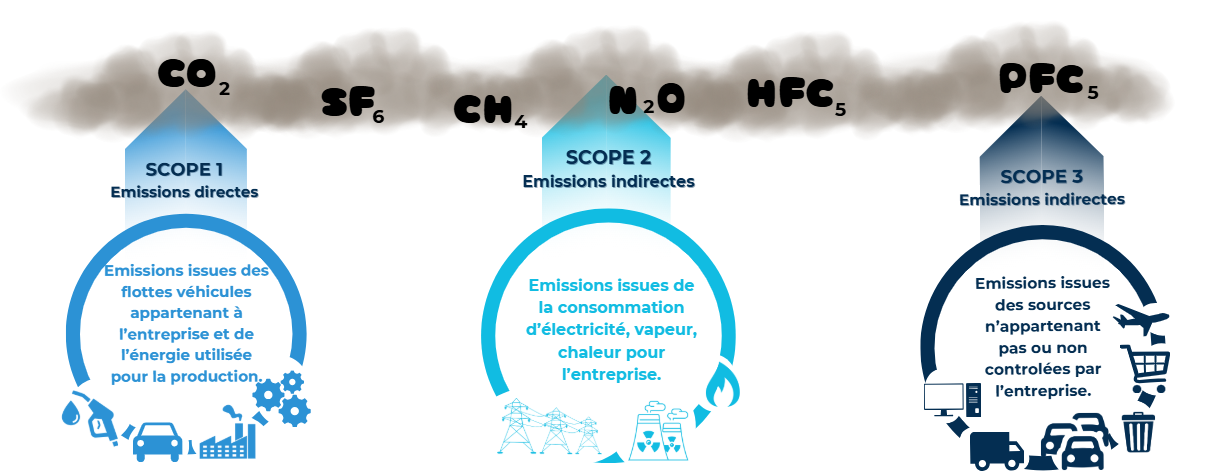
Including Scope 3 emissions is essential, as they often account for the majority of a company’s emissions. Conducting a GHG inventory not only helpsidentify the main sources of emissions but alsoenables the development of a targeted action plan to reduce them effectively.
♻️ Reduce greenhouse gas emissions
Companies must take a proactive approach to minimizing their environmental impact by implementing effective strategies:
⚡️ Energy optimization: investing in more efficient technologies, using renewable energy, and improving the energy efficiency of buildings.
🚌 Sustainable transportation: reduce business travel, promote remote work, and invest in low-carbon vehicle fleets.
💶 Circular economy: rethinking manufacturing processes, prioritizing recycling, and reducing industrial waste.
The increase in initiatives promoting sustainable development is a key driver in addressing the climate and economic challenges of the coming years. Numerous scientific reports highlight the importance of a rapid transition to reduce environmental risks and limit the impact of businesses on the planet.
🌱 Commit to a low-carbon approach
Adopting this approach requires a company-wide commitment:
- Eco-design of products: minimizing environmental impact starting in the design phase.
- Stakeholder Engagement: Raising awareness among employees and suppliers about best practices.
- Participation in carbon offset projects: supporting reforestation and CO₂ capture initiatives.
The fight against climate change is a global priority, and every country has a role to play in ensuring resilience in the face of environmental challenges. Reducing greenhouse gas emissions is essential to avoiding the worst-case scenarios of global warming.
Business adaptation is crucial to preserving the health of populations and ecosystems. Furthermore, incorporating climate issues into business strategies requires constant monitoring of international reports and best practices, which are often published in English to reach a global audience.
Practical Solutions for Taking Action
Faced with the challenges posed by climate change, companies must adopt ambitious strategies to reduce their greenhouse gas emissions and contribute to the transition to a low-carbon economy. Inspired by the IPCC’s recommendations and the United Nations’ goals, these solutions enable concrete action to limit the environmental impact of economic activities.
Carbon footprint assessments have shown us that the greatest environmental impacts of our events are related to travel by spectators and participants, since we organize “off-stadium” and community-based competitions.
☁️ Achieving carbon neutrality
Achieving carbon neutrality means reducing greenhouse gas emissions as much as possible and offsetting those that cannot be avoided. This approach is in line with the goals set by the Paris Agreement and the IPCC’s recommendations.
To achieve this, companies must follow several steps:
- Identify their emission sources through a comprehensive GHG inventory, including Scopes 1, 2, and 3.
- Implement an emissions reduction plan by investing in sustainable approaches and optimizing their processes.
- Support carbon offset projects such as reforestation, CO₂ capture, or the development of renewable energy.
Major companies have already taken steps in this direction. For example, IKEA aims to be carbon neutral by 2050 by reducing its emissions and funding environmental projects.
Reports published regularly by international organizations show that the success of these commitments depends largely on large-scale emissions reductions and the implementation of strategies tailored to different global warming scenarios.
🚀 Implement a decarbonization strategy
La décarbonation est essentielle pour réduire l’empreinte carbone des entreprises. Elle passe par plusieurs actions clés, et c’est précisément ce que propose Decarbo’Solution® (Decarbo’Solution®) à travers ses solutions dédiées :
- Calculating Your Carbon Footprint: Decarbo’Solution® helps companies accurately assess their emissions through a certified GHG inventory. This analysis is essential for identifying the main sources of emissions and developing an effective action plan.
- Optimizing Emissions Reduction Strategies: Decarbo’Solution® offers tools to help companies identify priority actions and best practices for reducing their emissions, while taking European and international regulations into account.
- Reducing Indirect Emissions (Scope 3): A significant portion of emissions comes from the supply chain. Decarbo’Solution® helps companies integrate their suppliers and partners into their climate strategy by conducting comprehensive carbon assessments across the entire value chain.
Grâce à ces outils et accompagnements, Decarbo’Solution® permet aux entreprises de structurer une véritable démarche de décarbonation et de conformité aux exigences des réglementations européennes et des attentes des investisseurs et clients.
🤝 Working Together for a Sustainable Future
Combating global warming requires collective action. Businesses must work with government agencies, scientific institutions, and other economic stakeholders to implement sustainable solutions.
- Strengthening public-private partnerships: Cooperation across different sectors is essential to accelerating the green transition. In Europe, initiatives such as RE100 bring together companies committed to using 100% renewable energy.
- Raise awareness and provide training: Climate education is a major issue. Encouraging decision-makers and employees to adopt sustainable practices helps ensure the effectiveness of the measures put in place.
- Relying on scientific research: This is essential for successfully transitioning to a more climate-friendly economy. Organizations such as the CNRS play a key role in developing innovative technologies. For example, in November 2022, the CNRS launched an ambitious plan to reduce its own emissions by 40% by 2030, focusing on energy, digital technology, mobility, and procurement.
By taking a proactive approach and collaborating with all stakeholders driving change, companies can not only reduce their impact on the climate but also strengthen their resilience and competitiveness in a rapidly changing world.
Le dernier rapport du GIEC souligne l’urgence d’une transition vers des pratiques durables et rappelle que chaque action compte pour limiter les changements mondiaux. Les entreprises ont un rôle clé à jouer en anticipant les réglementations, en engageant leurs partenaires et en s’appuyant sur des experts tels que Decarbo’Solution® pour structurer leur démarche.
L’élévation des températures moyennes a des conséquences directes sur les écosystèmes, les océans et la fréquence des événements extrêmes. Prendre des mesures adaptées est indispensable pour réduire la hausse des températures et atténuer ses effets sur les sociétés et l’environnement.
In a changing world, adopting a low-carbon strategy is no longer an option, but a necessity to ensure the sustainability of economic activities and build a resilient future. Decision-makers, businesses and citizens must act together to make this transition a reality and meet the global challenges of our time. Each group of players has a role to play in accelerating this transformation and ensuring a sustainable future by preserving the state of our planet and the health of future generations.
Our carbon experts are available to provide a free of our platform with no obligation. 🚀
For more information:
