









What is the Product Environmental Footprint (PEF)?

In light of climate challenges and evolving consumer expectations, companies are increasingly being called upon to demonstrate the sustainability of their products. But how can they accurately measure their environmental footprint and present a clear assessment?
It is in this context that the Product Environmental Footprint (PEF) comes into play—a European methodology developed by the European Commission that relies ondata analysis to provide a harmonizedassessment framework. Unlike limited approaches, such as the carbon footprint, the PEF takes into account all stages of a product’s life cycle, from manufacturing to recycling.
By providing an objective environmental score that complies with ISO standards, it becomes an essential tool for meeting regulatory requirements, strengthening companies’ CSR strategies, and providing consumers with reliable and comparable information.
En bref : Le Product Environmental Footprint (PEF) est une méthodologie européenne (Commission européenne) qui évalue l’impact environnemental d’un produit sur l’ensemble de son cycle de vie — de la fabrication au recyclage — au-delà du seul carbone. Elle s’appuie sur les normes ISO 14040 et 14067 pour produire un score environnemental comparable. (Mis à jour le 5 août 2026)
Contents
Understanding the environmental footprint of products
A clear and accessible definition
The EFP is a standardized methodology that enables an accurate assessment of a product’s environmental impacts throughout its entire life cycle. It is based on a scientific, transparent, and Europe-wide approach.
The Origins of the European Methodology
Developed by the European Commission, this method addresses the need to standardize calculation and assessment approaches. Until then,LCA studies varied depending on the methods used, making the results difficult to compare.
By establishing a common framework and building on ISO standards (14040 and 14067), the PEF has set an international benchmark for ecological footprints .

How to sustain and strengthen your business through a successful low-carbon trajectory.
Why this approach has become essential
Addressing climate and regulatory challenges
As environmental regulations become increasingly stringent, the PEF helps companies meet their obligations and prepare for non-financial audits, particularly the CSRD.
It also enables companies to anticipate market changes and comply with an increasingly demanding regulatory framework.
A transparency tool for consumers
Thanks to the PEF, the information provided to consumers is clear, reliable, and comparable.The score-basedenvironmental labeling allows them to make informed choices about products with the lowestenvironmentalimpact.
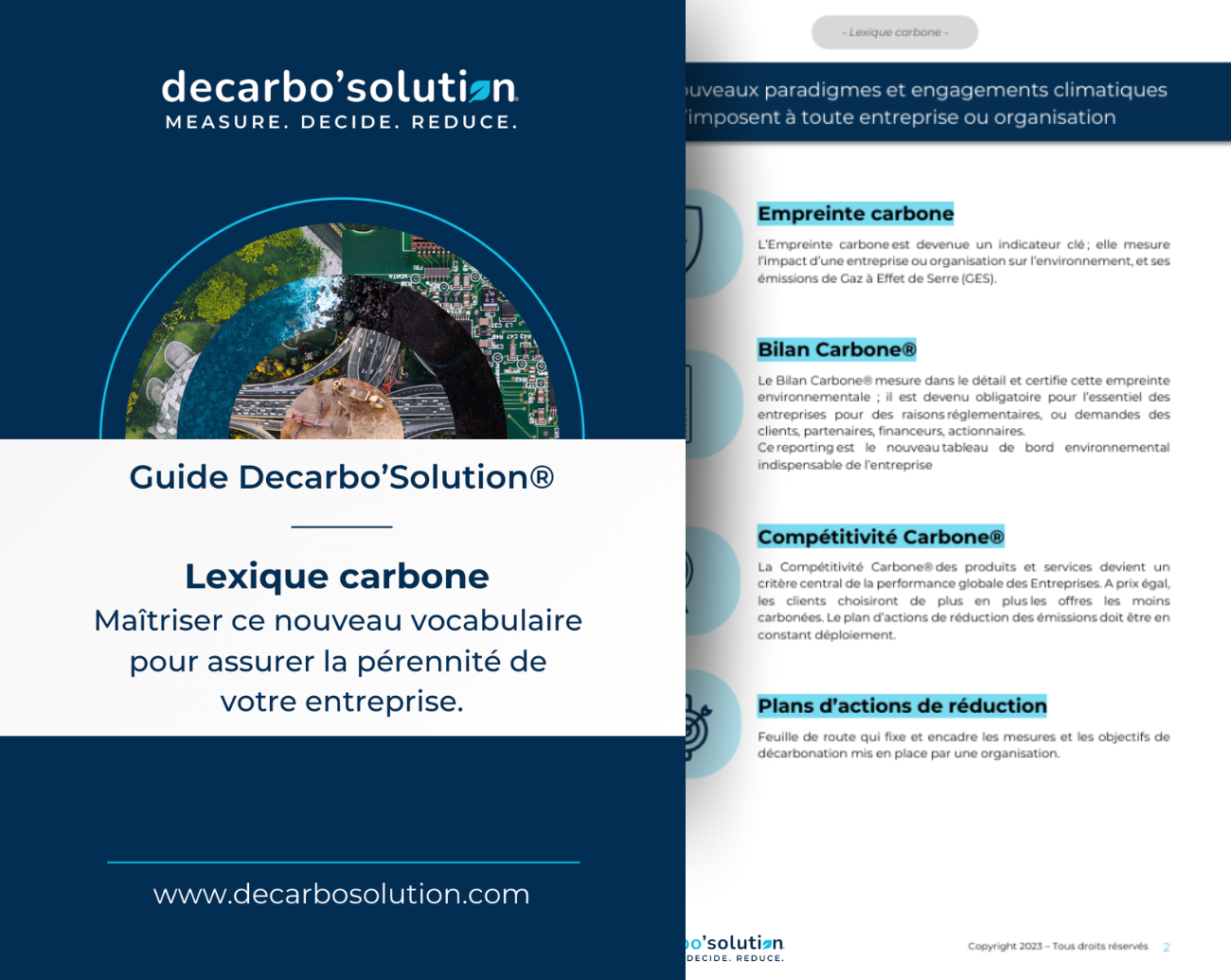
Master a new vocabulary to ensure the long-term future of your company.
How does the evaluation methodology work?
Environmental impacts taken into account
The PEF assesses greenhouse gas emissions (including carbon), as well as other categories: water consumption, air pollution, use of natural resources, and impact on biodiversity.
Steps for assessing a product’s environmental footprint
- Define the product and its functional unit.
- Collect data throughout the entire lifecycle.
- Calculate emissions and impacts.
- Convert the results into an environmental score that complies with ISO standards and is recognized throughout Europe.
Differences from the traditional LCA
The PEF is based onLife Cycle Assessment (LCA), but goes a step further by requiring a standardized methodology. Whereas LCA could yield differing results depending on the method chosen, the PEF provides a unified framework that ensures greater comparability among products.
Practical applications in businesses
Environmental Disclosure and CSR Strategy
Many companies are already experimenting withenvironmental labeling based on the PEF. This fits naturally into their CSR strategy, enhancing their credibility and image among stakeholders.
Case studies in Europe and France
Pilot studies conducted in France and elsewhere in Europe have shown thatlabeling based on a single score is well received by consumers. These initiatives are also paving the way for wider adoption across the European market.
The benefits for companies and their stakeholders
Build credibility and trust
Adopting the PEF enables companies to provide verified information and demonstrate their commitment tothe environment. This enhances their market position and builds trust among customers and investors.
Stay Ahead of Regulations and Boost Competitiveness
With the growing importance of the CSRD and related audits, adopting the PEF is becoming a strategic advantage. Companies that commit early demonstrate their ability to meet their obligations while enhancing their competitiveness.
We aim to meet ministerial requirements and guidelines by promoting more responsible sports and raising awareness among our members and the general public.
The Limitations and Challenges of the Product Footprint
Technical complexity and implementation costs
Collecting detailed data for all stages of the product lifecycle is a challenge. Small and medium-sized enterprises may face difficulties due to the costs associated with calculation andevaluation.
Toward international harmonization
Although the methodology is sound, it has yet to gain international acceptance. The lack of a global standard creates discrepancies between markets. Harmonization would enable the PEF to establish itself as a universal benchmark.
The role of Decarbo’Solution® in providing support
Digital tools for measuring and managing impact
Decarbo’Solution® offers digital solutions to help companies collect data, calculate emissions, andassess their product footprint, in accordance with European methodology and ISO standards.
Decarbo’Solution: a 3-in-1 tool to accelerate decarbonization
With its Decarbo’Solution, Decarbo’Solution® goes a step further by helping companies transform their procurement, transition plans, and calls for proposals into drivers of environmental and economic performance:
- Decarbo’Supply®: Reducing Scope 3 emissions by engaging suppliers and collecting reliable data.
- Decarbo’Tender®: to incorporate carbon considerations into requests for proposals, promote low-carbon bids, and meet the requirements of audits and the CSRD.
- Decarbo’Target®: to develop anaction plan, simulate various scenarios, and track results within a framework that complies with ISO standards.

The Product Environmental Footprint is much more than just a technical methodology: it is a strategic tool for assessing environmental impacts, providing a reliable assessment, and anticipating regulatory requirements.
In a challenging climate and a rapidly changing market, it provides companies with a clear framework for improving their CSR strategy and providing consumers with transparent information.
By integrating Decarbo’Solution®’s Decarbo’Solution, they gain access to a comprehensive platform for calculating,analyzing,evaluating, and implementing concreteactions.
In this way, the PEF and its associated tools become the cornerstone of an ecological and competitive transition.