









What is carbon debt?

Every day we delay reducing greenhouse gas emissions adds to an invisible but very real burden: the carbon debt. This concept—still little known to the general public but increasingly referenced by experts and institutions such as ADEME and ABC—allows us to quantify our overshoot of planetary boundaries in concrete terms.
Much like a bank overdraft, it measures the gap between our actual emissions and the trajectories consistent with international climate goals, particularly those of the Paris Agreement. It thus reveals not only how far behind we’ve fallen, but also the level of effort required to get back on track toward a world limited to +1.5 °C.
Against a backdrop of increasing regulatory requirements (CSRD, European Taxonomy), pressure from stakeholders, and economic upheavals linked to the low-carbon transition, carbon debt is becoming a strategic indicator for businesses, local governments, and the federal government. Gaining a better understanding of it means equipping ourselves to take more effective action.
Contents
Defining Carbon Debt
🤔 What is carbon debt?
Carbon debt refers to the accumulation of greenhouse gas (GHG) emissions that exceed the limits set by international climate agreements. It reflects our exceeding of the carbon budget compatible with limited global warming. Every excess metric tonof emissions adds to this environmental deficit that we are passing on to future generations.
For companies, this manifests itself as their own discrepancy between:
- their actual carbon footprint;
- and a trajectory aligned with +1.5 °C or carbon neutrality.
The larger this gap, the greater the carbon deficit becomes, and the more drastic and costly future efforts will have to be.
💥Origins of the Concept
Stemming from discussions about ecological debt, the concept of carbon debt is now being used by many environmental organizations, includingADEME andthe Association Bilan Carbone (ABC).
It is now used for:
- better integrate climate considerations into non-financial reporting,
- assess the risks associated with inaction on climate change,
- raise awareness among executives about a long-term vision.
This concept therefore makes it possible to link the climate crisis to tangible economic concepts, thereby raising awareness among both businesses and public institutions.
Carbon debt thus helps companies shift their perspective: moving from managing their carbon footprint to managing their accumulated climate liabilities.
❓Connection to the carbon budget
The global climate is under strain: according to the IPCC, we have a limited carbon budget to meet the goals of the Paris Agreement. If current trends continue, this budget will be exhausted before 2030.
According to the IPCC, at the current rate, this budget compatible with a 1.5 °C limit could be completely exhausted before 2030.
This means that:
- Every metric ton counts;
- Every delay increases the deficit to be repaid;
- Every company must anticipate this factor and factor it into its operational and strategic decisions.
Every delay in the energy transition increases our carbon footprint and makes future actions more complex, more costly, and more urgent.

How to ensure the long-term viability and growth of your business through a successful low-carbon strategy.
A Strategic Tool for Businesses
✅Bilan Carbone® Approach
The first step in assessing one’s carbon footprint is to conduct a GHG inventory using a recognized method (e.g., the French regulatory method,ABC’s Bilan Carbone®, ISO 14064). This inventory enables companies and organizations to identify the sources of their emissions, broken down into Scopes 1, 2, and 3.
The first step is to conduct a comprehensive GHG inventory, organized by scope:
- Scope 1: direct emissions (processes, vehicles, combustion),
- Scope 2: indirect emissions related to energy (electricity, heat),
- Scope 3: Other indirect emissions (purchases, transportation, product use, waste, etc.).
Mapping of Greenhouse Gas Emissions
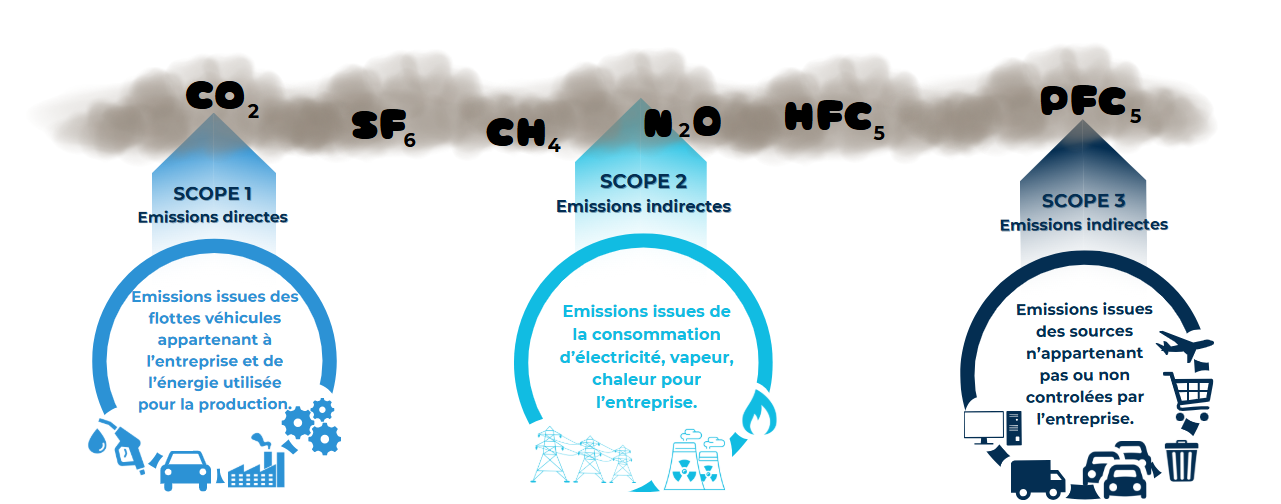
It is important to note that Scopes 1 and 2 generally account for only 10 to 20 percent of a GHG inventory. In contrast, Scope 3 constitutes the largest share, accounting for up to 90 percent of a company’s carbon footprint.
This assessment is essential for:
- identify priority emission sources,
- quantify its position relative to a target trajectory,
- define concrete measures to reduce[emissions].
This is an essential step toward understanding its impact and implementing effective solutions.
❗What are the risks involved?
Carbon debt is no longer merely an environmental concern; it has now taken on a major economic and financial dimension. Affected companies—particularly those in carbon-intensive sectors—must contend with three types of pressure: regulatory, reputational, and financial.
In 2023, the cumulative carbon debt of carbon-intensive sectors in France reached 644 million metric tons of CO₂ equivalent, illustrating the scale of the environmental liability that must be addressed. For economic actors, this debt translates into increased risks of being excluded from financing, stricter regulatory constraints, and heightened investor scrutiny of climate performance.
Nationwide,the average carbon footprint per capita is 9.4 metric tons of CO₂e, 56% of which is attributable to imported emissions. This dependence underscores the critical role of Scope 3 in supply chains. Since 1990, France’s overall carbon footprint has decreased by 13%, primarily due to a reduction in domestic emissions (-33%), while emissions associated with imports have increased by 13%.
For businesses, incorporating climate risk into performance analyses and financial statements is becoming essential. This involves identifying critical sources of emissions, aligning investments with a low-carbon trajectory, and establishing a governance framework capable of anticipating these systemic changes.
💯A driver of transformation and performance
Managing one’s carbon footprint is not merely a matter of complying with regulatory requirements: it is, above all, an opportunity for strategic transformation that drives sustainable value creation.
Companies that proactively commit to measuring, reducing, and managing their greenhouse gas emissions enjoy tangible competitive advantages:
- Enhancing financial attractiveness: Economic actors committed to a low-carbon trajectory are better able to attract responsible investors and sustainable financing. Incorporating climate risk into the overall strategy reassures financial partners and facilitates access to favorable financing terms.
- Brand enhancement and stakeholder loyalty: A credible climate policy builds trust among customers, employees, and partners. It becomes a key differentiator in markets that are increasingly focused on CSR commitments.
- Cost Optimization and Efficiency Gains: Reducing emissions often helps identify opportunities for energy efficiency, resource rationalization, or strategic relocation of procurement. These measures reduce expenses while strengthening resilience in the face of economic fluctuations.
- Regulatory foresight and business resilience: By developing a strategy that anticipates the requirements of the CSRD and other regulatory frameworks, companies can avoid having to make last-minute adjustments. This enhances their stability, credibility, and adaptability.
- Fostering innovation and strategic alignment: Integrating climate considerations into investment, procurement, and production decisions drives the development of innovative, more resource-efficient, and sustainable solutions. This momentum permeates the entire organization and becomes a driver of growth.
👉 That is why organizations such asADEME encourage companies to align their carbon strategy with their corporate governance, by placing these issues at the heart of executive committees, transformation plans, and management tools.
Taking action on your carbon footprint means investing in your long-term sustainability. It means viewing climate change not as a constraint, but as a driver of adaptation, operational excellence, and sustainable performance.
Reducing Carbon Debt: From Strategy to Action
Addressing carbon debt requires a structured, phased approach that is aligned with international climate goals. The most advanced companies base their strategy on three pillars: reducing emissions at the source, regulated carbon offsetting, and strengthened governance. Each of these levers plays a complementary role in implementing a credible and sustainable low-carbon pathway.
📉Reducing emissions at the source
The top priority for any organization is to reduce its greenhouse gas emissions directly at the source. This step requires an operational transformation that involves every function within the company. The main drivers include:
- Energy efficiency: modernizing equipment, optimizing industrial processes, and improving the thermal performance of buildings.
- The transition to low-carbon energy: electrification of end uses, solar self-consumption, utilization of waste heat, and procurement of renewable electricity (PPAs, guarantees of origin).
- Logistics and Sustainable Mobility: Making Fleets More Environmentally Friendly, Sharing Transportation, and Relocating Production Sites.
- Simplicity: rethinking needs, extending the lifespan of products, and reducing unnecessary or redundant volumes in the value chain.
These actions must be quantified, scheduled over time, and incorporated into a comprehensive roadmap aligned with a trajectory consistent with the Paris Agreement (e.g., a 50% reduction by 2030). They form the basis of a credible transition plan.
♾️Carbon Offsets and Carbon Sinks
Even with an ambitious reduction strategy, some residual emissions remain unavoidable, particularly in complex sectors such as air travel, agriculture, and heavy industry. Carbon offsetting then makes it possible to neutralize these emissions through positive climate actions:
- Natural carbon sinks: reforestation projects, agroforestry, wetland restoration, and the preservation of existing forests.
- Carbon capture technologies: geological CO₂ storage, direct air carbon capture (DACCS), and bioenergy with carbon capture and storage (BECCS).
- Certified projects with significant co-benefits: those that incorporate social, economic, or biodiversity aspects.
However, offsetting never replaces the obligation to reduce emissions. It is part of a climate responsibility approach once all internal measures have been implemented. Best practices recommend relying on recognized certification programs (Gold Standard, Verra, Low-Carbon Label) and ensuring that offset projects operate within a transparent, auditable framework that is monitored over time.
💚Governance, Innovation, and Support
For a climate strategy to yield sustainable results, it must be managed at the right level. This requires strong governance, an aligned corporate culture, and appropriate monitoring tools. The key drivers are:
- Establish cross-functional carbon governance: appoint a dedicated manager or team, align the carbon strategy with senior management, and incorporate climate metrics into executive committees.
- Train and engage employees: raise teams' awareness of carbon-related issues, offer targeted training, and foster a culture of collective responsibility.
- Investing in low-carbon innovation: eco-design, circularity, alternative materials, and artificial intelligence for energy optimization.
- Leveraging external expertise: Support from specialized partners such asADEME,the Association Bilan Carbone (ABC), or expert platforms (such as Decarbo’Solution®) facilitates skill development and operational efficiency.
Finally, the climate strategy cannot stand alone. It must be integrated into the company’s overall strategy, its procurement processes, its investment decisions, its risk management, and its supplier relationships.
Carbon debt is not merely an environmental abstraction. But far from being a pessimistic assessment, this concept primarily offers a strategic framework for steering the low-carbon transition. By measuring it accurately, addressing emissions at the source, incorporating robust offsetting solutions, and strengthening their climate governance, organizations can transform a risk into a driver of performance.
👉 Decarbo’Solution® is fully aligned with this approach. As an expert platform, Decarbo’Solution® supports businesses, local governments, and institutions at every stage of their low-carbon transition:
- Rigorous measurement of emissions (GHG inventory, Scopes 1, 2, and 3),
- Defining pathways aligned with climate goals,
- Coordinating concrete reduction and offset measures,
- Reporting in accordance with regulatory standards (CSRD, SBTi, European Taxonomy).
With climate challenges intensifying, we can no longer afford to wait. We must act today to preserve tomorrow. It is through this process of positive transformation that Decarbo’Solution® stands alongside all ambitious organizations.
