









What is the carbon price?
Yes, carbon has a price, and that's important!
It is an economic tool designed to internalize the hidden costs of damage caused by greenhouse gas (GHG) emissions into market prices. Its goal is to encourage economic actors to adopt a low-carbon trajectory.
The Recent Consolidation of Carbon Pricing
The carbon marketwas established in 1997 following the Kyoto Protocol, which took CO2 emissions into account when setting the price of carbon, as they accounted for more than three-quarters of measured global GHG emissions.
The idea was to regulate the right to buy and sell GHG emission permits based on supply and demand.
In2015, theCoalition for a Carbon Price(CPLC) was officially launched at the opening of COP21. This voluntary initiative brings together heads of state from 74 countries, as well as leaders from more than 1,000 companies. Its goal is to foster a productive dialogue between public and private decision-makers on opportunities to expand carbon pricing policies. By promoting carbon pricing as an effective tool for reducing emissions, the participating stakeholders aimed to have it cover at least 50% of global emissions by 2030.
There are two main forms of carbon pricing that coexist.
The carbon tax and carbon allowances are the two main tools currently in place to set the price of carbon.
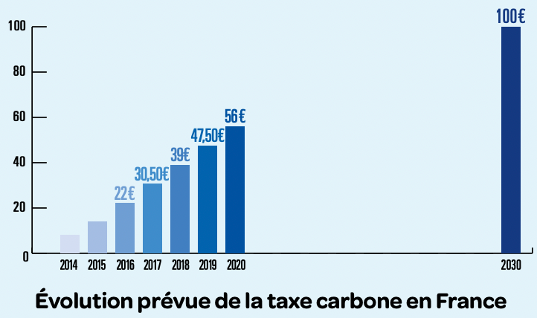
The simplest form is the carbon tax. Rising steadily since 2014, the carbon tax has gone from €7 per metric ton to €56 in 2020, “reaching over €90 in early 2022,” according to the Bank of France. On June 22, 2022, the European Parliament approved the Commission’s proposal to introduce a carbon border tax at the EU’s borders starting in 2023.
The sources primarily affected by the carbon tax are “small emitters” (small businesses) and diffuse sources (vehicles, heating and domestic hot water in buildings, agriculture, etc.).
The establishment of a carbon market is a more complex form of carbon pricing. This trading system imposes carbon quotas, meaning it limits carbon emission rights in a market.
The latter focuses in particular on high-emission sources. The industrial sector (electricity generation from fossil fuels, large-scale industries) actually favors the imposition of quotas over a carbon tax.
Since the Kyoto Protocol, numerous initiatives aimed at establishingcarbon marketshave emerged around the world, foremost among them the European carbon market.Since 2005, the share of global emissions covered by an emissions trading system has increased by 73 percent. These various systems draw inspiration from one another in terms of their operational details, which must, however, be adapted to local conditions.
The European Commission intends to expand the carbon market. Last June, the European Parliament adopted its position, supporting the proposal to phase out free allowances in certain industrial sectors. In addition, airlines—starting in 2027—and the maritime sector, road transport, and building heating—starting in 2026—will in turn be required to adapt their strategies to these new allowances.
In addition to these regulatory tools, many companies are developing their own voluntary climate and CSR initiatives related to carbon pricing, including the implementation of internal carbon prices.
Progress and a Turning Point in the European Carbon Market
Regardless of the pricing mechanism used, the goal of raising the price of carbon is to reduce carbon emissions in the future. On a global scale, this strategy aims to combat environmental dumping by the rest of the world through the European Union’s “carbon border adjustments.”
The carbon price reflects the EU’s ambition to transition to a low-carbon society. In 2019,“GHG emissions from industrial sitessaw theirsharpest decline,falling by 9.1 percent—or some 152 million metric tons of carbon dioxide equivalent less than in 2018,” according to the European Commission.
Today, the carbon market is at a turning point, as the European Commission plans to expand and strengthen it to make it truly effective.
On July 14, 2021, the Commission presented aseries of measures, whose 2030 target entails a significant increase in carbon prices. This target is part of the European Green Deal, which aims to reduce the EU’s carbon emissions by 55% by 2030.
Finally, at a meeting on June 28, 2022, European environment ministers adopted a100% reduction in CO2 emissions from light-duty vehicles by 2035. This decision reaffirms the European Commission’s ambition to achieve the goal of a 55% reduction in CO2 emissions by 2035, while also forming part of a broader effort to steer market dynamics toward a low-carbon trajectory and, ultimately, achieve carbon neutrality.
For more information on indirect emissions, we offer a guide to Scopes 1, 2, and 3 of the carbon footprint assessment.