









Why aren't companies' GHG reports comparable?

1.1. A Strategic Tool for Companies to Manage Emissions Reduction
1.2. Addressing Regulatory and Societal Challenges
2. Why is a comparison of GHG inventories inadequate?2.1. The Environmental Impact of Sector-Specific Characteristics
2.2. Diverse Methodologies and Scopes
2.3. The Risks Associated with a Simplistic Comparison
3. Alternatives and Prospects for Harmonization3.1. The Product Carbon Footprint (PCF): A More Relevant Measure
Understanding the Role of the GHG Inventory
The BEGES helps companies understand their environmental footprint by identifying their main sources of emissions. It is a key tool for implementing a low-carbon strategy and achieving the goal of net-zero emissions by 2050. However, it is not limited to simply measuring emissions: it embodies a genuine transformation process, encouraging every organization to rethink its activities in order to sustainably reduce its footprint and contribute to the environmental transition.

The 7 Benefits of Conducting a GHG Assessment for Your Company.
📊A strategic tool to help companies manage emissions reductions
This tool, which is central to the CSR strategy and ESG commitments, makes it possible to accurately identify the main sources of greenhouse gas emissions based on a structured analysis of the three scopes:
- Scope 1: Direct Emissions
Scope 1 includes emissions from all activities directly generated by the company, arising from sources it owns or controls. These emissions represent the primary area for action to reduce the impact of internal operations.
- Scope 2: Indirect emissions related to energy
Scope 2 includes emissions resulting from energy purchased and consumed by the organization, such as electricity or heat. Optimizing energy consumption and using renewable energy sources are therefore priorities for reducing this category of emissions.
- Scope 3: Indirect emissions related to the value chain
Le scope 3, souvent le plus conséquent, inclut les émissions associées à l’ensemble de la chaîne de valeur : fournisseurs, transport, usage des produits, gestion de fin de vie, etc. C’est dans ce champ que réside le plus grand potentiel d’innovation et de collaboration avec les parties prenantes pour transformer durablement les écosystèmes économiques. Dans les très grandes entreprises, il représente souvent l’essentiel de l’empreinte carbone de l’entreprise.
Adopting a strategic and sustainable management approach fosters a culture of continuous improvement that highlights the unique characteristics of each business unit and ensures tangible results. This allows companies to focus on relevant and impactful solutions.
⚖️ Addressing Regulatory and Societal Challenges
Redefining these priorities is therefore essential and necessary for companies, as procurement management, the circular economy, and relationships with carriers are becoming crucial. The GHG inventory provides a structured framework for collecting and analyzing this information. By identifying emission sources and targeting reduction measures, it enables organizations to adopt a proactive and responsible approach while meeting the growing demands of their stakeholders.
Beyond its operational role, the report addresses growing expectations:
- Regulatory: Companies must comply with standards and guidelines, such as the Corporate Sustainability Reporting Directive (CSRD) in Europe.
- Strategic: Anticipating market trends and the expectations of investors, who are increasingly sensitive to environmental performance.
“96% of investors surveyed say that CSR issues play a key role in investment decision-making. Companies with strong ESG (Environmental, Social, and Governance) performance are particularly valued, according to BNP Paribas.
- Societal: Build stakeholder trust by demonstrating a transparent and proactive approach.
According to Consumer Science & Analytic: “Employees are on the front lines of driving the environmental transition within their companies. As many as 71% of employees say they are taking action to support the environmental transition within their companies, reflecting a growing interest in green initiatives.”
Why is a comparison of GHG inventories inadequate?
🤔 Diverse methodologies and scopes
Although BEGES are based on recognized methodologies such as the GHG Protocol and the ISO 14064-1 standard, they vary widely in their application, which makes it difficult to compare them across companies. This heterogeneity stems from differences in scopes, methodological approaches, and geographic contexts, which directly influence the data collected and the calculations of greenhouse gas emissions.
- Areas analyzed: When it comes to accounting, some companies focus solely on certain line items that are immaterial or offer little potential for action.
- Methodological Choices:
The calculation of GHG emissions is based on methodological choices that significantly influence the results obtained:
- Emission factors: These carbon weights, used to convert energy consumption or the mass of materials into GHG emissions, vary depending on the database and the country.
- Assumptions and Tools: It is important to note that the assumptions used to compile operational data vary from one assessment to another, which can affect the calculation of a company’s carbon footprint.
- Geographic location:
A company’s location directly influences its greenhouse gas emissions, particularly due to the energy mix and available infrastructure:
- In countries where the energy mix relies on fossil fuels (coal, oil), electricity consumption generates significantly higher emissions than in regions where renewable energy sources predominate.
- Local infrastructure, such as transportation networks and district heating systems, also affects emissions from business activities.
🚀The Environmental Impact of Sector-Specific Characteristics
Carbon emissions differ structurally across different industries. For example, an industrial manufacturer will naturally have higher emissions than a digital services company. These differences reflect the operational, technological, and economic realities specific to each sector and do not necessarily indicate a lack of environmental efficiency.
Sectoral Breakdown of Global GHG Emissions from Energy Combustion in 2021
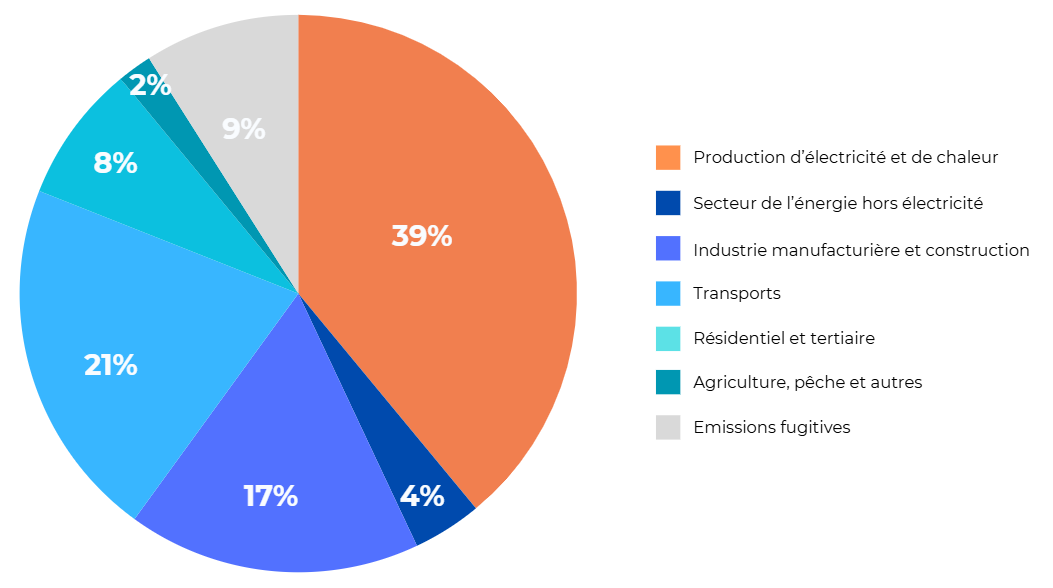
Ministry of Ecological Transition
🟥 The Risks of a Simplistic Comparison
Comparing GHG inventories across companies without taking these differences into account can lead to biased interpretations. This can:
- Discourage certain organizations, particularly those in sectors with high, unavoidable emissions.
- Encouraging opportunistic practices, where form takes precedence over substance, at the expense of truly effective actions.
This comparative approach can also distract companies from their true goal: reducing their carbon footprint to help combat climate change. In seeking to rank highly in rankings or benchmarks, some organizations risk prioritizing short-term measures that enhance their image, rather than implementing ambitious and sustainable strategies to protect the environment. A thoughtful assessment tailored to each company’s specific circumstances is essential to maximize their positive impact and fully embrace the environmental transition.
Alternatives and Prospects for Harmonization
🟩The Product Carbon Footprint (PCF): A More Relevant Measure
To address the limitations of broad comparisons, the Product Carbon Footprint (PCF) offers a targeted alternative. It assesses the carbon impact of a product or service throughout its life cycle, providing a perspective that is better suited to certain comparisons:
- Compare Similar Products: The PCF makes it possible to analyze the carbon footprint of equivalent products, which helps both consumers and businesses make more informed choices in favor of solutions with a lower environmental impact.
- Identify opportunities for improvement: This approach highlights the key stages of the value chain where initiatives can be implemented to reduce emissions, thereby enhancing the effectiveness of reduction efforts.
By incorporating the PCF into their analyses, companies can refine their BEGES by focusing on concrete, measurable achievements. This approach helps transform a simple assessment into a strategic tool capable of guiding operational and innovation decisions. Furthermore, it fosters collaboration with value chain partners to collectively reduce the carbon footprint of the products and services they offer.
💚Ongoing harmonization thanks to European frameworks
With the entry into force of the CSRD, companies will be required to comply with common standards for non-financial reporting, including carbon emissions. This directive aims to reduce methodological disparities and enhance data comparability. Combined with tools such as the PCF, this harmonization will increase the reliability of information while maintaining a focus on sector-specific improvement.
According to BPI France: “It is important to note that companies subject to the GHG Inventory must comply with the requirements of the law. Any failure to meet this obligation to prepare a Carbon FootprintⓇ may result in a fine of 10,000 euros.”
The diversity of methodologies and sector-specific realities underscores the importance of treating GHG inventories as a tool for internal progress rather than an instrument for external comparison. Each company must focus on its own emissions reduction trajectory, tailored to its specific circumstances.
At Decarbo’Solution® (Decarbo’Solution®), we support organizations through our SaaS platform, designed to provide accurate, reliable ESG data that complies with current standards, such as the CSRD. Our solution helps you:
- Identify your key emission sources using proven methodologies.
- Compare your results over time to track your progress.
- Adopt an appropriate sector-specific approach and implement concrete reduction strategies.
We aim to meet ministerial requirements and guidelines by promoting a more responsible approach to sports and raising awareness among our members and the general public.
Our carbon experts are available to provide a free of our platform with no obligation. 🚀