









Why do regulations highlight the importance of carbon footprint assessments?

With the rise of regulatory frameworks such as the CSRD, carbon accounting is emerging as a key management tool for businesses. Regardless of theirindustry, organizations must now accurately quantify their emissions, including indirect emissions (Scope 3). In France,the average carbon footprint per capita stands at 9.4 metric tons of CO₂ equivalent, 56% of which comes from imported emissions.
The cost of inaction is rising: in 2023, the price per metric ton of carbon on the European market exceeded €100, underscoring the importance of a planned and measured energy transition. Furthermore, the cumulative carbon debt of emission-intensive sectors amounts to 644 MtCO₂e in France, highlighting the scale of the environmental liability that must be addressed.
In this context, a GHG assessment—conducted using a rigorous methodology (Bilan Carbone®, ISO 14064)—enables organizations to leverage internal data, raise employee awareness, develop a credible transition plan, and align their climate strategy with European goals. Rather than being a constraint, regulation becomes a catalyst for sustainable performance.
Contents
An increasingly demanding regulatory framework for organizations
⚖️ The Rise of Legal Requirements
In recent years, European and French legislation has significantly strengthened requirements for climate reporting and environmental transparency:
- The Corporate Sustainability Reporting Directive (CSRD) will be phased in starting in 2024. It replaces the NFRD and significantly broadens the scope of companies subject to it: nearly 50,000 companies in Europe will now be required to publish structured non-financial reports in accordance with the European Sustainability Reporting Standards ( ESRS ).
This includes the requirement to conduct a comprehensive GHG inventory covering Scopes 1, 2, and 3, accompanied by a transition plan toward a low-carbon trajectory.
- In France, the Decree No. 2022-982 dated July 1, 2022, makes the Regulatory GHG inventory required every 4 years for companies with more than 500 employees. This report must include:
- A quantification of emissions using the regulatory methodology,
- A justification of the mitigation measures already implemented,
- And, since 2023, it has been available online on ADEME’s dedicated platform.
These documents reflect a clear commitment: to make carbon a strategic indicator and manage it with the same rigor as a financial statement.
🔦 An expansion of the scope of reporting
Historically, regulatory GHG inventories have focused on direct emissions (Scope 1) and emissions associated with energy consumption (Scope 2).
Mapping of Greenhouse Gas Emissions
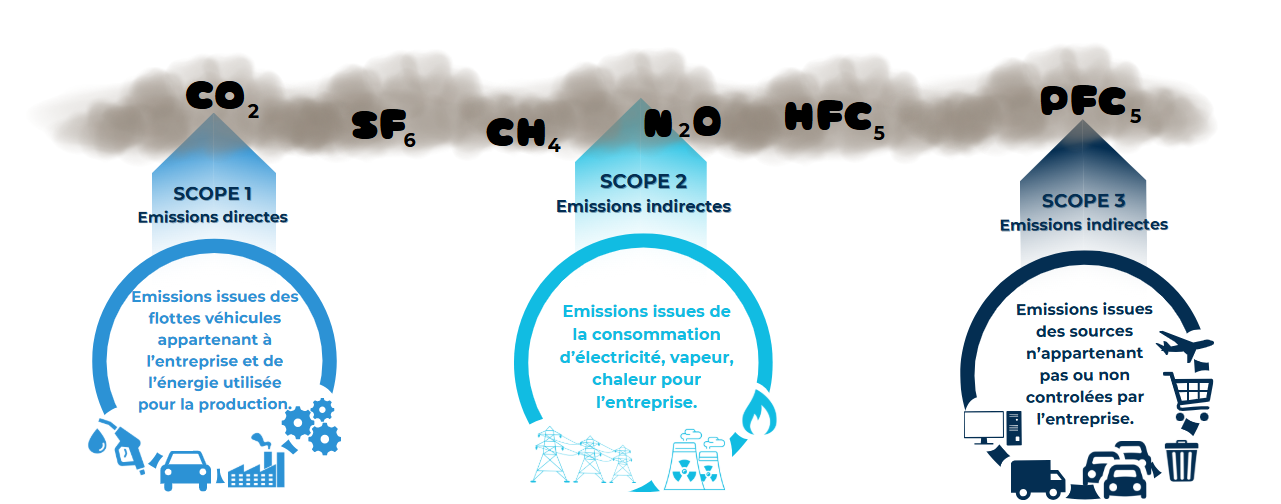
- Scope 1: direct emissions (processes, vehicles, combustion),
- Scope 2: indirect emissions related to energy (electricity, heat),
- Scope 3: Other indirect emissions (purchases, transportation, product use, waste, etc.).
It is important to note that Scopes 1 and 2 generally account for only 10 to 20 percent of a GHG inventory. In contrast, Scope 3 constitutes the largest share, accounting for up to 90 percent of a company’s carbon footprint.
The CSRD therefore requires comprehensive accounting for Scope 3 emissions, which have become an integral part of a company’s climate performance. This involves engaging suppliers, tracking indirect emissions, and relying on reliable and verifiable data.
💡The Shift Toward Standardized Carbon Accounting
The increase in regulatory requirements is accompanied by a drive toward methodological standardization, in order to ensure the comparability, traceability, and quality of the climate data used.
Three standards have emerged as the cornerstones of this structured carbon accounting:
- The GHG Protocol, which is used internationally, with its 15 Scope 3 categories;
- The ISO 14064 standard, which provides a framework for the measurement, verification, and reporting of GHG emissions;
- The Bilan Carbone® method, developed bythe Association Bilan Carbone (ABC), is widely used in France and aligned with ADEME’s requirements.
These frameworks enable companies to integrate their carbon data into their management tools, modelemissions reduction plans, and ensure that their climate transition meets the expectations of regulators, customers, investors, and employees.
Eventually, carbon accounting will become just as fundamental as financial accounting. Companies will no longer be able to discuss performance without including their GHG footprint.

How to ensure the long-term viability and growth of your business through a successful low-carbon strategy.
Increased pressure from customers, investors, and partners
Beyond regulatory requirements, companies today face growing pressure from their ecosystem: customers, clients, investors, business partners, employees, and even job candidates. In this context, carbon footprint assessment is becoming a strategic tool for management, communication, and competitiveness.
✅Transparency requirements in requests for proposals
An increasing number of public and private buyers are incorporating environmental criteria into their selection processes. Responding to a request for proposals now requires providing concrete and verifiable information:
- An up-to-date GHG inventory, including Scopes 1, 2, and 3,
- Quantified emission reduction targets,
- Evidence of concrete actions implemented as part of the transition plan.
En France, la loi Climat et Résilience (2021) incite fortement les acheteurs publics à privilégier les prestataires engagés dans la réduction de leur empreinte carbone. Cela implique pour les entreprises de professionnaliser leur reporting GES et d’intégrer l’enjeu carbone dans leur stratégie commerciale.
💡 Tools such as Decarbo’Tender®, developed by Decarbo’Solution®, enable organizations to highlight their environmental performance in their bid responses by incorporating carbon data as early as the cost estimation and proposal drafting phases.
❗Carbon Footprint as an Investment Criterion
ESG funds, banks, and investors are demanding quantifiable evidence of companies’ low-carbon trajectories: reliable reporting, an emissions inventory, and a clear strategy for reducing emissions.
According to BNP Paribas: “96% of investors surveyed say that CSR issues play a key role in their investment decisions.” Companies with strong ESG (Environmental, Social, and Governance) performance are particularly highly valued. Thus, without reliable data, it is impossible to demonstrate a business’s resilience in the face of climate challenges.
Incorporating carbon footprint assessments into investment criteria thus becomes a strategic tool: it allows a company to demonstrate that it has climate risks under control and that its growth is aligned with a sustainable, low-carbon model.
💯 A stronger brand image
Today, expectations regarding CSR and the energy transition do not come solely from regulators or shareholders. They are also strongly driven by consumers, employees, and even future talent.
- Consumers are becoming increasingly mindful ofthe carbon footprint of the products and services they purchase.
- Employees want to work for organizations that align with their environmental values.
- Young professionals, particularly those from prestigious universities, base their career choices on the actual impact a company has onthe environment.
In this context, conducting a comprehensive GHG inventory, accompanied by an ambitious action plan, has become a key differentiator. It is no longer merely a requirement, but a tool for enhancing attractiveness, fostering loyalty, and engaging stakeholders, including employees.
Decarbo’Solution®: Your Partner for a Successful Low-Carbon Strategy
At Decarbo’Solution®, we firmly believe that no action plan can be implemented without a deep understanding of stakeholders. Decarbo’Solution® offers customized training and support to help organizations make sustainability a core part of their strategy.
To that end, we support you at every stage of your environmental transition through:
👩🎓Training on Climate Issues
A program structured into 4 modules:
- Climate and Energy Fundamentals
- Methodological Approach to the GHG Assessment
- Prepare Your Assessment with Decarbo’Solution®
- Assess Your Situation and Reduce Your Emissions
🤝“Climate Mural” workshops by Decarbo’Solution®
Our carbon engineers, who are trained and experienced in facilitating “La Fresque du Climat,” are available to organize these workshops directly at your company, thereby helping to engage your teams in a concrete climate strategy.
Beyond raising awareness, Decarbo’Solution® helps you reduce your carbon footprint over the long term, thanks to the various tools available on our platform.
🎦The Decarbo’Solution® Academy
A learning environment to build skills:
- Tutorial videos, technical documentation
- Detailed FAQs by Topic
- Real-world simulations on the Decarbo’Solution® platform
✨ Personalized strategic guidance
- Comprehensive GHG Assessment, Including Scope Definition, Data Collection, and Reporting
- Our Decarbo’Solutions®, the winning trio for an effective and sustainable environmental transition:
🛠️Decarbo’Supply®: Decarbonize your purchases across your entire supply chain. Reduce the carbon footprint of your products through your suppliers.
🎯Decarbo’Target®: Project your GHG emissions over time.
⚡Decarbo’Tender®: Incorporate carbon performance into your requests for proposals
To assist you with your Bilan Carbone assessment—whether for CSRD compliance or other purposes —the carbon engineers at Decarbo’Solution®, who are experts in the Bilan Carbone® method and methodologies such as ADEME’s “Act Pas à Pas,” put their expertise at your organization’s service to guide you step by step toward a sustainable environmental transition.
The growing body of regulations surrounding carbon accounting reflects the urgent need for companies to manage their carbon footprint and commit to a planned and transparent transition to a low-carbon economy. Beyond mere compliance, rigorously addressing these issues enables organizations to meet the expectations of customers, investors, and partners, while strengthening their competitiveness, innovation, and reputation.
With support from specialized organizations such as Decarbo’Solution®, companies now have the methodological, educational, and strategic tools to fully integrate their carbon footprint into their governance. This transition to standardized carbon accounting paves the way for sustainable, responsible performance that is aligned with international goals to combat climate change.
