









How do you rate a product’s environmental performance?

Rating a product’s environmental performance involves translating its impacts into a single score, calculated across its entire life cycle: raw materials, manufacturing, transportation, use, and end of life. In France, the term now encompasses two distinct concepts: the rating that determines the eco-bonus for electric cars, and the environmental cost of consumer products, starting with textiles.
The logic is the same in both cases: an official method, defined by ADEME, aggregates emissions and impacts to produce a clear result. For a car, this rating determines eligibility for subsidies. For a piece of clothing, it is displayed as an impact score.
Key Takeaways
- The score is calculated based on the product’s entire life cycle (LCA).
- For electric cars, a score above the minimum threshold of 60 out of 80 has been required to qualify for the eco-bonus since January 1, 2026.
- ADEME updates the list of eligible models every month.
- For consumer products, the rating is expressed as the environmental cost, in impact points, calculated using the Ecobalyse tool.
- Greenhouse gas emissions form the foundation of this, as defined by the ISO 14067 standard.
- A good result depends first and foremost on the quality of the manufacturing data.
Contents
What is an environmental score?
It is a summary score that encapsulates, in a single value, a product’s environmental impact. It eliminates the need to compare dozens of separate criteria (climate, energy, water) by converting them to a common scale that is easy to understand for consumers, public procurers, and fleet managers.
This assessment, often referred to as an “eco-score,” is based on a life-cycle analysis: consumption and emissions are quantified at each stage and then converted into a single indicator. This principle is enshrined in the Environmental Code.
The Case for Electric Cars
Since 2024, the eco-bonus is no longer based solely on price; it depends on an environmental rating calculated by ADEME. This rating measures the car’s carbon footprint, from the extraction of raw materials to battery production, through assembly and transportation. Since January 1, 2026, the calculation has covered the entire life cycle.
The 2026 Eligibility Criteria
To be eligible for the assistance, all three of the following conditions must be met:
- a purchase price of less than 47,000 euros;
- a mass of less than 2,400 kg;
- a score of 60 out of 80 or higher.
The official list of eligible models is updated every month. Models such as the Renault 5 E-Tech, the Peugeot e-208, and the Citroën ë-C3 are included, while others—manufactured outside of Europe—are excluded. Since two trim levels of the same new car may qualify differently, you should verify the exact version before purchasing.
Who is eligible?
The program is aimed at individuals, businesses, and fleet managers. It is now funded through the Energy Savings Certificates (CEE) mechanism, in the form of a purchase incentive similar to the “coup de pouce” incentives. The amounts vary based on income:
| Beneficiary | Amount for 2026 |
|---|---|
| Households in Precarious Circumstances | up to 5,700 € |
| Low-income households | up to 4,700 € |
| Other households | up to 3,500 € |
| Surbonus battery made in Europe | €1,200 to €2,000 |
Beyond financial incentives, a high-rated model facilitates access to low-emission zones (LEZs) and retains a higher resale value. For a corporate fleet, this criterion becomes a key purchasing factor in its own right.
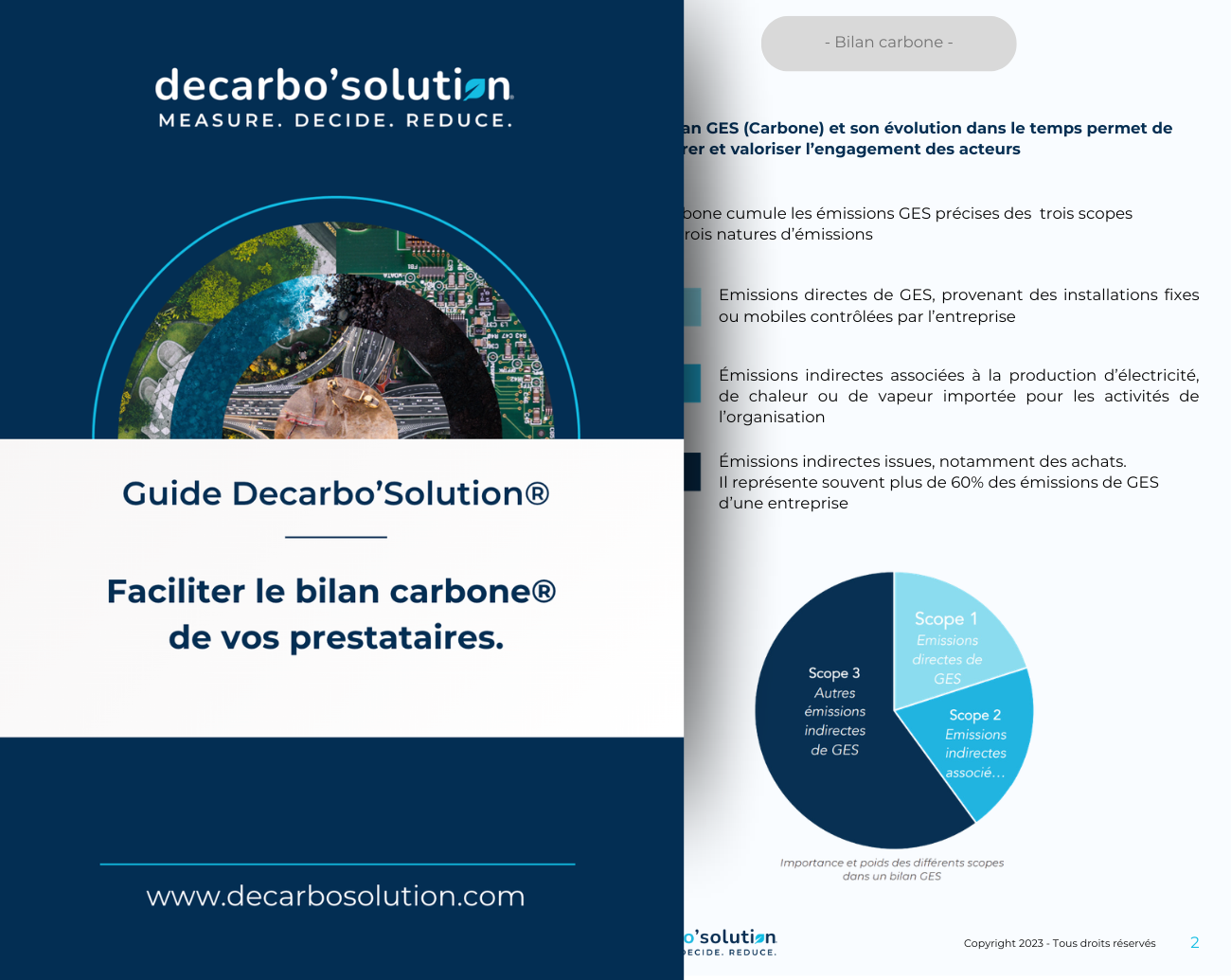
Simplify the GHG assessment for your service providers
The Environmental Cost of Consumer Products
The same logic applies to everyday products. The Climate and Resilience Act introduced the concept of environmental cost, with the textile industry being the first sector targeted.
A rating based on impact points
It is calculated using Ecobalyse, the official tool of ADEME, and aggregates 16 indicators from the European Environmental Footprint Framework:
- greenhouse gas emissions;
- water and energy consumption;
- pollution from microfibers and chemicals;
- sustainability and recyclability.
The Textile Calendar
- Since October 2025: voluntary display, reserved for brands;
- Starting in October 2026: Mandatory labeling for any brand that already reports another environmental indicator.
The food, furniture, and electronics industries are following the same path, in line with the European Digital Product Passport.
How is the calculation done?
Regardless of the product, the method is based on three pillars:
-
- a life cycle assessment covering all stages, from production to end of life;
- recognized emission factors for converting fluxes into impacts;
- an official weighting to arrive at a single value.
The quality of the result depends directly on the input data. A calculation performed using default values often yields an unfavorable result, whereas actual manufacturing data may reveal much better performance.
Carbon footprint: the basis for the rating
Dans le score des voitures comme dans le coût des produits, les émissions de gaz à effet de serre pèsent lourd. Un chiffre crédible suppose une empreinte carbone calculée selon la norme ISO 14067, à partir de données de fournisseurs plutôt que d’estimations.
Two products that appear identical can have very different environmental impacts depending on the electricity mix in the country of production and the mode of transportation. Without primary data, this difference in impact remains hidden.
This is Decarbo’Solution®’s area of expertise: the My-PCF® module generates ISO 14067-compliant, auditable, and reusable carbon footprints to be used in a report or digital passport. Our methodological framework document is available upon request.
How can I get good results?
Four initiatives can be launched immediately:
-
- Identify the relevant products or models and their characteristics (materials, weight, manufacturing processes, origins).
- Collecting actual supply chain data—the step that takes the longest to implement.
- Calculate emissions in accordance with ISO 14067.
- Simulate results using the official tool to identify areas for improvement.
A company that has a firm grasp of its data turns a constraint into an advantage: remaining eligible for grants, highlighting its highest-rated models, and correcting the others before publication.
FAQ
Is the environmental score required?
For electric cars, it’s already a make-or-break factor: without a sufficient result, there’s no bonus. For textiles, disclosure has been voluntary since October 2025 and will become more stringent starting in October 2026.
Where can I find the list of eligible cars?
On the ADEME website, which updates it monthly. Be sure to check the exact version of the model, as two different versions may yield different results.
How does this differ from a carbon footprint?
The carbon footprint measures only climate impact. The score combines several indicators, but carbon remains its primary basis.
Are companies and fleet managers eligible for financial assistance?
Yes. They are eligible for subsidies for the purchase of qualifying vehicles, funded by energy-saving certificates, and a high score makes it easier to access Low-Emission Zones.
Do we need data from suppliers?
Yes. Otherwise, the calculation uses default values that are often inaccurate. Primary data remains the best way to obtain an accurate figure.
