








Limiting the carbon impact/cost of transportation without sacrificing efficiency: mission possible

In France, regulatory and fiscal pressure (ETS1 and ETS 2) is intensifying to decarbonize the transport sector, which weighs heavily on the national carbon footprint. European law and strategy now require clear emissions reporting, a transition from fossil fuels to electricity, hydrogen, or biofuels, and the adoption of sustainable mobility across all territories. For businesses, the mission is clear: reduce greenhouse gases while maintaining efficient and competitive logistics. In a market where climate events, rising fuel prices, new carbon taxes, and infrastructure modernization are accelerating the movement. Between economic development, innovation, and a strengthened regulatory framework, it is becoming essential to pull the right levers and rely on a committed industry. The goal is also to promote the emergence of innovative energy solutions for the entire national industry.
Contents
Why transportation was a blind spot in climate strategies
Scope 3: a vague but strategic scope
Transport services, in France as elsewhere, mainly fall within Scope 3: this is the most complex part of the GHG balance sheet, as it covers all indirect emissions. This includes service providers' vehicles, outsourced mobility, the five modes of transport (road, rail, sea, river, air), and different energy sources (fossil fuels, electricity, hydrogen, mix). The diversity of mobility options, the lack of consistent data on the fuels used, and the multiplicity of infrastructure complicate monitoring. A recent report estimates that the logistics chain accounts for up to 40% of indirect emissions, which is a major challenge for the logistics sector and the competitiveness of each region. Energy consumption, whether fossil or renewable, is a central focus of this transition plan.
Dans ce contexte, TK’Blue, partenaire « transport et logistique » de Decarbo’Solution® s’impose comme un acteur de référence pour accompagner les entreprises dans l’évaluation des performances environnementales de leurs transporteurs. Grâce à une base d’indicateurs fiable et à des outils de traçabilité performants, TK’Blue facilite la production de rapports sur les émissions de gaz à effet de serre, la prise de décision en matière de choix de véhicules ou de modes ou d’énergie et le suivi des objectifs climatiques fixés dans le cadre national ou européen. Cette solution favorise la transparence au sein de la filière et aide à aligner la stratégie logistique avec les ambitions énergétiques et durables de chaque entreprise.

Data and traceability: a real challenge for the industry
Collecting accurate information on emissions from different modes of transport remains difficult. Most French companies work with numerous service providers in very different regions, using road, rail, and even electric or hydrogen-powered vehicles, which multiplies the sources of greenhouse gas emissions. The production of data on energy, electricity, and alternative fuels remains inconsistent, complicating the management of the SNBC framework and compliance with targets. The evolution of national fleets and the vehicles used is closely linked to the availability of reliable energy solutions.
A logistics sector at the crossroads of challenges
The transport sector, whether air, road, rail, or maritime, fuels regional development, but too often remains on the sidelines of climate strategies. However, French law and European regulations now impose reporting obligations, carbon taxes, the promotion of electric solutions, and the consideration of sustainable infrastructure in investments.
Companies are encouraged to adapt their fleets, invest in electric vehicles, develop hydrogen mobility, or optimize the use of rail transport, while taking advantage of transition subsidies for local production and modernization of the sector. The national objective is also to develop energy solutions that respond to new environmental challenges, in order to align the strategy of each player with the national climate plan.

How to sustain and strengthen your business through a successful low-carbon trajectory.
Acting on the right levers: logistics efficiency and energy transition
Optimizing flows, vehicles, and infrastructure
L’efficacité logistique dépend avant tout de l’optimisation des flux. Mutualiser les trajets, réduire les retours à vide, choisir les bons modes selon la nature du territoire : tout cela permet d’abaisser la consommation d’énergies et les émissions de gaz à effet de serre. Adopter le ferroviaire pour les longues distances, favoriser l’électrique et l’hydrogène sur les axes urbains ou périurbains, ou recourir aux biocarburants sur les zones rurales : chaque territoire et chaque filière doit trouver son équilibre, en lien avec la disponibilité des infrastructures et des véhicules adaptés. L’énergie et la performance énergétique sont désormais au centre de toutes les décisions pour garantir des solutions pérennes à l’échelle nationale.Calls for tenders and environmental criteria: the framework is changing
The integration of environmental criteria into transport tenders is becoming essential. This encourages transport companies to invest in lower-emission vehicles, choose alternative fuels, and turn to renewable energies. To meet the requirements of the SNBC framework and European regulations, companies must also accurately track their emissions. Digital tools now make it possible to standardize data collection and compare offers based on their environmental performance, which supports the development of a competitive sector that is aligned with the law. The development of national logistics solutions goes hand in hand with increased use of clean energy and vehicles optimized for each type of road use.Measure, manage, and reduce: tools for effective action
To move forward, it is crucial to have tools that enable emissions to be managed across the entire scope: from production to logistics flows, including the purchase of electric vehicles or alternative fuels. The use of dedicated decarbonization platforms, such as those offering tailor-made action plans, facilitates emissions analysis, investment prioritization, and the simulation of reduction trajectories over several years. These tools provide a clear overview for each report, supporting decision-making and the search for investment aid at both national and European level.
In this approach, the implementation of a structured logistics decarbonization plan is based on three complementary pillars, the Decarbo'Solution®:
- Decarbo’Target®: allows you to simulate different reduction scenarios, project the impact of investments on your GHG balance sheet, and continuously adjust your strategy.
- Decarbo’Tender®: integrates carbon performance into calls for tenders, standardizes data collection, and facilitates the selection of the most virtuous suppliers in terms of greenhouse gases.
- Decarbo’Supply ®: transforms purchasing into a strategic lever by enabling suppliers to be enlisted in the collection of reliable data and optimizing carbon competitiveness across the entire supply chain. The aim is to provide companies with innovative energy solutions tailored to each type of vehicle and in line with the national energy transition framework.
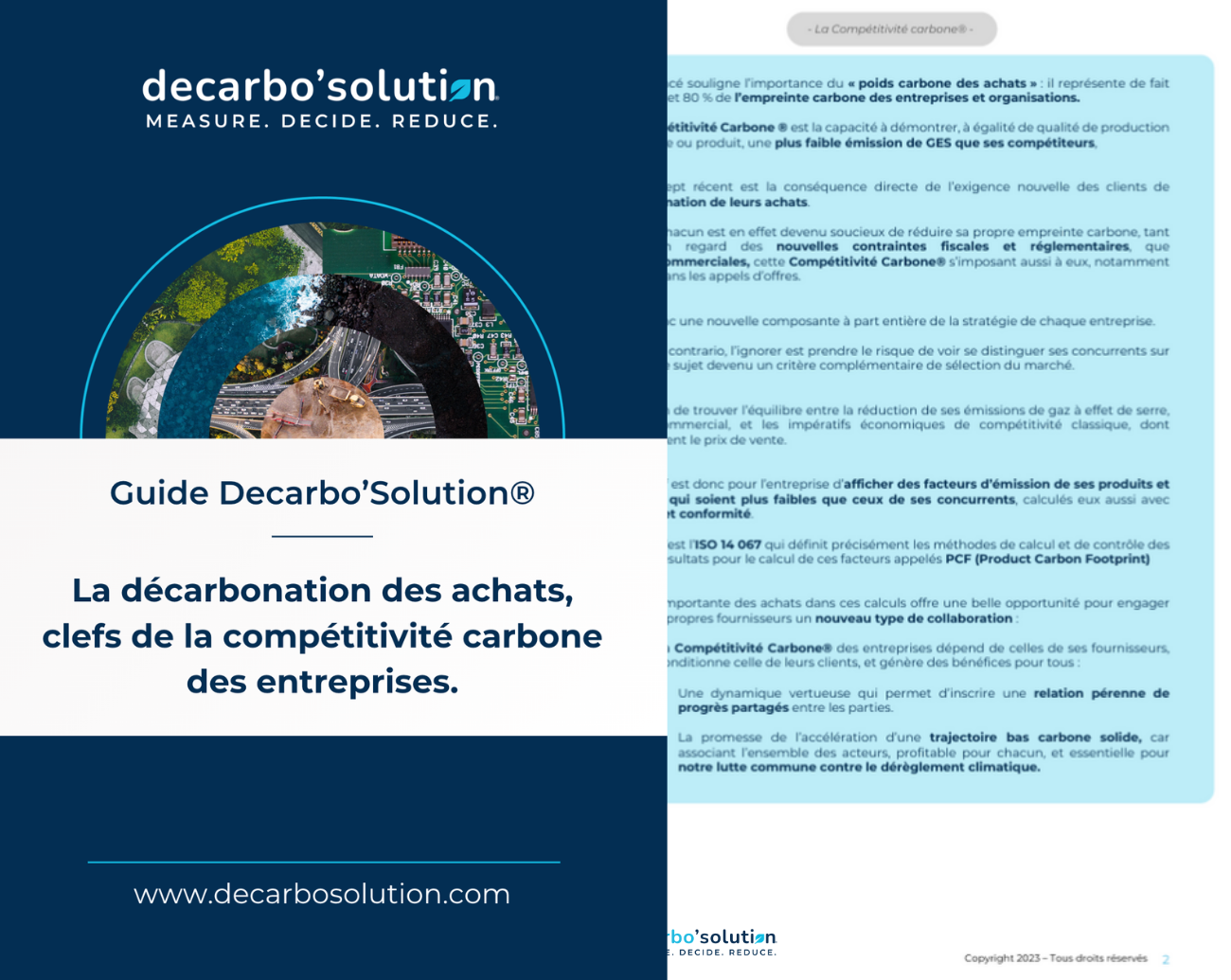
Decarbonization of purchasing, the key to corporate carbon competitiveness.
Involve suppliers and service providers in a shared dynamic
Mobilizing the value chain around decarbonization
The success of the low-carbon transition depends on the commitment of the entire value chain: suppliers, subcontractors, and logistics providers. Integrating emission reduction targets into contracts, requesting reliable carbon indicators during major events in the logistics chain, and sharing the vision across all territories will enable production and mobility to be aligned with the framework set by the SNBC and the law. Each action plan must take into account the specific energy characteristics of different regions, the types of vehicles used, and the challenges specific to each national sector.
Mapping and analyzing to prioritize actions
Mapping the supply chain is a key step. It helps identify the suppliers with the highest emissions, analyze the maturity of each sector in terms of low-carbon mobility, and target investments for each region. This analysis facilitates the prioritization of public aid, the adaptation of infrastructure, and the promotion of the efforts made by each partner. The use of electricity, rail, hydrogen, or alternative fuels must be adapted to local specificities and market realities. Solutions are therefore being deployed to meet a variety of needs, particularly in road transport and energy management for the national sector.
Building a coherent and valuable green supply chain
Le déploiement d’une green supply chain efficace suppose la mise en œuvre d’outils pour suivre les progrès : des rapports réguliers, des indicateurs dynamiques, et un dialogue continu avec les fournisseurs sur la place des énergies, des véhicules, des infrastructures et de la mobilité. La Decarbo’Supply® permet, par exemple, de collecter les facteurs d’émission des fournisseurs, de privilégier les offres alignées avec les objectifs, et d’optimiser la fiscalité environnementale à l’échelle de chaque territoire. On engage ainsi la filière dans une dynamique d’amélioration continue, tout en s’assurant d’accéder aux aides et aux financements pour soutenir la production et l’innovation sur le long terme.
Limiting the carbon impact of transportation while maintaining efficiency is now a realistic goal. Legislation, regulatory frameworks, industry mobilization, and the rise of clean energy are paving the way for sustainable transformation. Thanks to the integration of carbon management tools, the adoption of electric or hydrogen vehicles, the optimization of mobility in each region, and the promotion of investment in rail and electricity, France is taking a leading role in the decarbonization of its logistics sector.
Companies that commit to this approach benefit from enhanced competitiveness, easier access to public aid, and the ability to anticipate changes in the European framework. By leveraging the synergy between sustainable production, mobility, and infrastructure, it is possible to combine climate ambition, economic development, and logistics performance across the entire territory. The national strategy is based on innovation in energy and mobility solutions, and on the use of vehicles optimized for each transition plan.