









Key Steps for Developing a Materiality Matrix and Translating Your Challenges into a Climate Strategy

Against a backdrop marked by the ecological transition, growing regulatory and tax pressures (CSRD, European taxonomy, ISO standards, ETS), and changing expectations from stakeholders (customers, employees, investors, suppliers), companies no longer have a choice: they must demonstrate their genuine commitment to sustainability.
La matrice de matérialité est devenue un outil stratégique incontournable. Elle ne se limite pas à un exercice de reporting RSE ou à une cartographie des enjeux environnementaux. Bien construite, elle constitue le socle d’une politique climat ambitieuse, permettant de :
- Set priorities.
- Improve environmental performance.
- Guide the organization's sustainable management.
This article details the three key steps to creating a successful materiality matrix:
- Understanding its strategic value.
- Systematically identify the key issues.
- Translate this analysis into a concrete action plan using innovative solutions such as Decarbo’Solution®.
Contents
Understanding What a Materiality Matrix (Really) Is
Definition and Strategic Role
A materiality matrix is a management tool that combines two dimensions:
- What is important to stakeholders (customers, employees, supply chain partners, investors, and local communities).
- Factors that have a real impact on the company's operations (environment, finances, ethics, safety, and workplace practices).
It provides a diagrammatic overview of the priority issues that should guide climate strategy, CSR policy, and governance practices.
More Than Just CSR Reporting
All too often reduced to a mere compliance exercise, the materiality matrix is in fact a strategic management tool that:
- helps anticipate ESG (environmental, social, and governance) risks.
- is a driver of sustainable competitiveness.
- establishes a commonCSR dialogue among management, employees, and stakeholders.
At Decarbo’Solution®, the materiality matrix is considered a fundamental step before any climate initiative, as it provides direction for the action plan and aligns the company’s values with its commitments.

How to ensure the long-term viability and growth of your business through a successful low-carbon strategy.
Systematically Identify Priority Issues
A rigorous evaluation phase
The success of a matrix depends on structured and inclusive work. The most effective methods include:
- Internal consultations: workshops, employee surveys.
- External dialogue: meetings with customers, investors, strategic suppliers, and NGOs.
- Literature and Regulatory Review: ESG compliance, ISO 26000 standards, CSRD.
- Risk Mapping: Environmental, Social, Ethical, and Financial Impacts.
Identify what is essential and avoid what is unnecessary
This phase helps distinguish the truly fundamental issues from secondary topics:
- Examples of key topics: climate, emissions, security, diversity, energy transition, and accountability.
Each identified issue is evaluated based on:
- Its importance to stakeholders.
- Its potential impact on the company’s operations, financial results, and governance.
Expert support from Decarbo’Solution®
The Decarbo’Solution® teams support corporate groups and companies through:
- Proven research tools.
- An expert interpretation of international standards.
- Participatory methods that foster employee buy-in and stakeholder engagement.
This approach ensures a robust framework that is useful not only for compliance with standards but, above all, for sustainable management and decision-making.
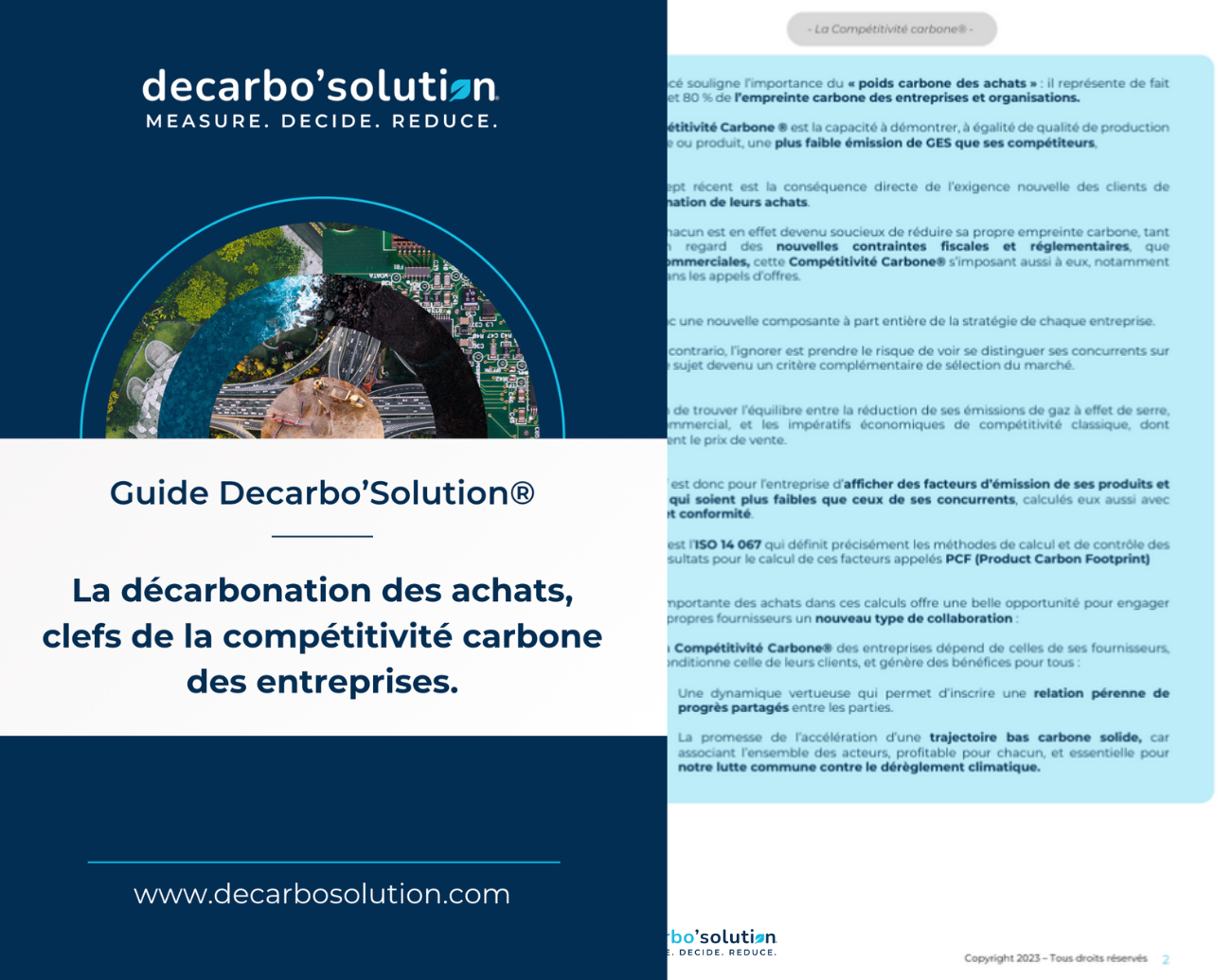
Decarbonizing procurement: the key to companies' carbon competitiveness.
Translate the matrix into a climate action plan
From Analysis to Action
A materiality matrix is only valuable if it leads to concrete actions. Companies must:
- Prioritize the most significant emission sources.
- Implement corrective and innovative measures.
- Engage all stakeholders, including strategic partners.
Decarbo’Solution® Modules: Turning Analysis into Results
To support organizations in taking action, Decarbo’Solution® has developed the Decarbo’Solution® suite:
- Decarbo’Target®: Create, simulate, and manage a multi-year action plan. Visualize the impact of each action and set an ambitious trajectory.
- Decarbo’Supply®: Focus on reducing the carbon footprint of purchases, which can account for up to 80% of a company’s Scope 3 emissions. Promote positive carbon discrimination® and strengthen competitiveness.
Decarbo’Tender®: Incorporate environmental criteria into requests for proposals, in accordance with ISO 14067 and the Public Procurement Code. Select more responsible partners and improve overall results.
Toward a Low-Carbon Pathway
By combining the materiality matrix with the Decarbo’Solution® tools, companies can:
- Comply with reporting and compliance requirements (CSRD, ISO, SBTi).
- Strengthen their competitiveness in the market.
- Engage employees, partners, and customers in a process of creating sustainable value.
The matrix thus becomes the first step in an ambitious climate initiative, integrated into management and aligned with performance goals.

In short, developing a materiality matrix means investing in a more responsible, competitive, and sustainable future.
With the support of Decarbo’Solution® and its Decarbo’Solution® suite, companies move beyond a simple overview of the challenges to an ambitious and manageable low-carbon trajectory that complies with regulations, creates value, and has a positive impact on the environment and society.
In short, developing a materiality matrix means investing in a more responsible, competitive, and sustainable future.