









Mistakes to Avoid for an Accurate Carbon Footprint® Assessment and an Effective Reduction Strategy

It measures all direct and indirect emissions associated with the company’s activities—such as energy consumption, transportation, production, and emissions related to the supply chain, for example.
However, conducting an accurate and effective Bilan Carbone® assessment can present certain challenges. Although many companies are motivated by good intentions, errors can sometimes occur, which may affect the accuracy of the results and limit the impact of their reduction efforts.
These difficulties are often encountered when collecting data, taking into account indirect emissions (Scope 3) or involving stakeholders. An incomplete assessment or the use of imprecise data can lead to an underestimation of the company's actual carbon footprint.
1.1. Engage stakeholders to ensure comprehensive data collection
1.2. Account for all sources of emissions: leave nothing out
1.3. Rely on recent and specific data
2. Develop a long-term vision for a sustainable carbon strategy
2.1. Set clear and measurable goals to ensure true effectiveness

Plan Ahead to Better Optimize Your Bilan Carbone®
🔍 Engage stakeholders to ensure comprehensive data collection
The success of a Carbon Footprint® assessment also depends on the engagement of internal and external stakeholders. Limiting data collection to a single department—such as the CSR department—without involving other departments or key partners can result in significant gaps in the emissions assessment.
Internal departments, such as procurement, logistics, marketing, and production, must be involved in identifying sources of emissions and collecting accurate data. In addition, collaboration with suppliers is essential to obtain accurate information, particularly regarding raw materials, modes of transportation, and waste management.
According to a 2020 study conducted by McKinsey on decarbonization across the entire supply chain,“of the 239 companies that have joined the Science Based Targets initiative, 94% have included commitments to reduce GHG emissions among their customers and suppliers.”
The Science Based Targets initiative (SBTi) helps companies set GHG emission reduction targets aligned with climate science and the goals of the Paris Agreement. It encourages companies to include their supply chains (Scope 3) in their commitments, which maximizes the overall impact of their efforts.
This collaborative approach ensures exhaustive coverage of emissions sources and facilitates the implementation of joint initiatives to reduce emissions along the value chain.
🧩 Account for all emission sources: leave nothing out
One common practice in preparing a Bilan Carbone® assessment is to focus primarily on direct emissions (Scope 1) and energy-related emissions (Scope 2), while neglecting indirect emissions (Scope 3). These include, in particular, emissions generated by suppliers, subcontractors, freight transportation, employee travel, and customer use of products.
Scope 3 emissions are often the hidden part of a company’s emissions, but they are also the most significant. According to a study by the Carbon Disclosure Project (CDP), Scope 3 emissions account for an average of 70 to 90 percent of a company’s total emissions in sectors such as retail, manufacturing, and the technology industry.
Failing to include them amounts to underestimating the organization’s actual carbon footprint, which undermines the effectiveness of efforts to limit its environmental impact.
To provide a clearer framework for this process, the ISO 14064 standard specifies the principles and requirements for quantifying and reporting greenhouse gas (GHG) emissions.
Since the 2018 revision, the ISO 14064-1 standard requires compliant companies to account for Scope 3 emissions. Complying with this standard not only meets legal and regulatory requirements, but also enables a more comprehensive and reliable approach to emissions management.
📊 Rely on recent and specific data
Relying on generic industry averages or outdated energy data significantly reduces the reliability of the results and the credibility of the GHG emissions inventory.
To ensure an accurate Bilan Carbone® assessment, it is essential to rely on specific and up-to-date data that reflects the company’s current operational realities.
- For example, when it comes to energy consumption, carbon emission factors related to electricity vary depending on each country’s energy mix, which changes over the years as renewable energy becomes increasingly integrated into the grid.
- In 2022, the emissions factor for France’s average electricity mix, as reported by ADEME’s Base Empreinte®, was 0.0520 kg CO2e/kWh, compared to 0.0573 in 2016.
By using up-to-date data and ensuring its traceability, companies can not only improve the accuracy of their Bilan Carbone® but also demonstrate their commitment to rigorous and transparent environmental management.

Develop a Long-Term Vision for a Sustainable Carbon Strategy
Developing a Bilan Carbone® goes beyond simply collecting data. It is an ongoing process that must be part of a long-term strategy, incorporating clear objectives, raising awareness among teams, and adopting rigorous methods.
A sustainable approach involves defining a path that not only allows us to measure emissions but, more importantly, to reduce them significantly.

🎯 Set clear and measurable goals for true effectiveness
A Bilan Carbone® assessment without specific goals primarily provides a snapshot of a company’s carbon footprint at a given point in time. To derive actionable results from it, it is essential to set clear and measurable goals.
According to a 2021 study conducted by McKinsey, there is a positive correlation between:“the average percentage reduction in emissions targeted by companies (compared to the base year) and their progress at the time of the report’s publication.”
In other words, companies that have set themselves more ambitious targets seem to have achieved better results on the road to achieving them.
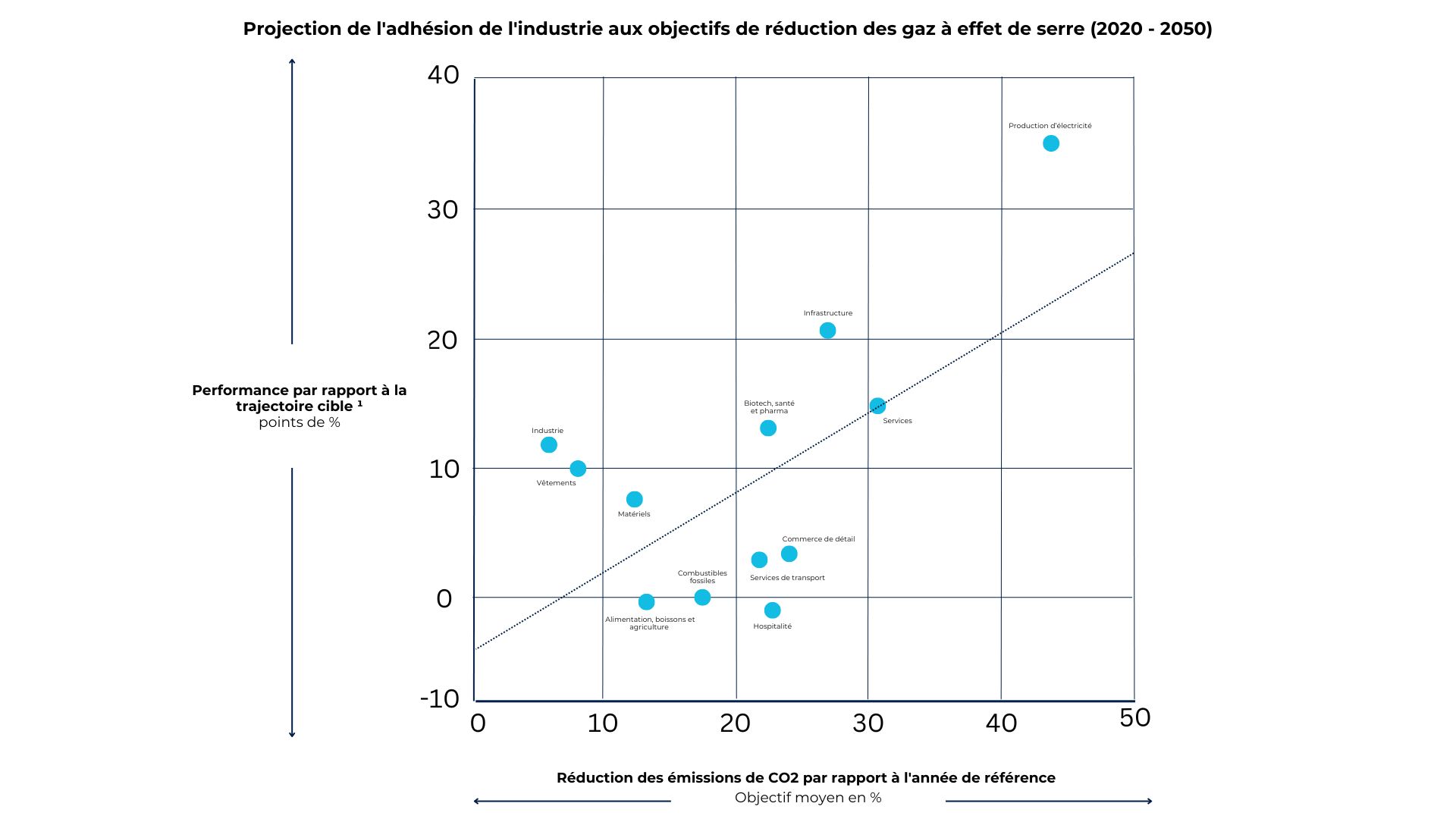
A performance greater than 0% represents one percentage point of the target trajectory exceeded.
A performance below 0% represents one percentage point of the target trajectory not achieved.
Source: CDP Climate Change Questionnaire 2020; McKinsey ESG Insights
🌿 Train and educate your teams to prevent mistakes
When implementing the Bilan Carbone® assessment,it is beneficial to ensure that all stakeholders—both internal and external— receive training and are made aware of the process. A better understanding of climate issues and measurement tools helps enhance the reliability of the data and the effectiveness of your actions.
This awareness-raising effort must include all employees, as well as partners, suppliers, and customers. Innovative methods, such as the “Fresque du Climat,” provide a fun and educational way to explain the mechanisms of climate change and the impacts of human activities.
Our Decarbo’Solution® carbon experts are certified facilitators for La Fresque du Climat and can lead a workshop at your company. This engaging workshop helps participants better understand the causes and consequences of climate change, while exploring concrete actions they can take, both personally and professionally.
We also support companies that want to raise awareness among their teams and begin an environmental transition process through comprehensive training led by our carbon experts.
- Module 1 – Climate and Energy Fundamentals: Understanding the essential elements of climate, the fundamental criteria, and their relationship to the GHG inventory.
- Module 2 – Methodological Approach to GHG Accounting: Learn about the three scopes, emission sources, key methods, regulations and standards, activity data, emission factors, and databases.
- Module 3 – Preparing Your GHG Inventory with Decarbo’Solution®: Organize data collection, understand emission factors and the features of Decarbo’Solution®, and prepare a GHG inventory on the platform.
- Module 4 – Conducting a GHG Inventory and Reducing GHG Emissions: Enter activity data, view results and deliverables, calculate activity units and uncertainties, set SBTi targets, and define reduction actions.
⚖️ Choose the methodology that best suits your needs
The choice of methodology for conducting a Bilan Carbone® assessment plays an important role in the accuracy and comprehensiveness of the results. It is essential that this approach be tailored to the specific characteristics and needs of each company.
Three main standards/methodologies are generally used to guide this process, each offering its own advantages depending on the organization’s objectives:
✅ The Bilan Carbone® method developed by ADEME (the French Agency for Ecological Transition) offers a rigorous French methodology focused on reducing greenhouse gas emissions. The Bilan Carbone® method developed by ADEME is designed for all types of organizations and enables the measurement of direct (Scope 1) and indirect (Scope 2 and 3) emissions, taking local specificities into account.
✅ The GHG Protocol® (Greenhouse Gas Protocol) is an internationally recognized benchmark standard that has been widely adopted by companies. It provides a flexible framework for measuring and managing GHG emissions, notably by distinguishing between different emission sources according to the three scopes. It is suitable for companies that wish to standardize their reporting on an international level.
✅ The ISO 14064 standard, which is also an international standard, provides a structured and verifiable approach to calculating GHG emissions, with specific requirements for quantifying and reducing emissions, while incorporating principles of traceability and auditability. This standard is particularly useful for companies seeking ISO certification, thereby enhancing their credibility and transparency with stakeholders.
The Decarbo’Solution® platform incorporates and complies with all recognized standards, regulations, and methodologies:
- ISO 14064-1: 2018;
- GHG Protocol (Corporate and Corporate Value Chain Standards);
- Regulatory GHG Inventory Methodology, Version 5.
- ISO 14 067 (PCF)
By setting clear and measurable goals, raising awareness and training their teams, and adopting a rigorous methodology, companies can effectively integrate these initiatives into a long-term vision.
Decarbo’Solution® supports companies in this process by offering tailored training and ensuring that your assessment adheres to recognized methodologies. This approach not only ensures compliance with regulations but also strengthens companies’ competitiveness in a context where the environmental transition has become a key factor in long-term success.