









How is carbon calculated?
A carbon footprint assessment measures the number of metric tons of CO₂e emitted by a company, a product, or an individual. It helps identify sources of energy consumption, reduce emissions, and implement reduction strategies, while encouraging environmentally responsible actions.
Why is it important? Beyond the fight against environmental change, good emissions monitoring enables French and international companies to optimize their costs and comply with current regulations. But how do you go about estimating emissions, and which tools should you use? This article provides a step-by-step guide.
1.1 Carbon and Its Role in the Climate
1.2 How are carbon emissions measured?
1.3 Categories of GHG Emissions
1.4 Why is it essential to measure carbon?
2. Why calculate your carbon footprint?
2.1 A Key Challenge for the Low-Carbon Transition
2.2 The Benefits of Carbon Accounting for Businesses
2.3 A Driver of Innovation and Engagement
3. Reducing Your Carbon Footprint After the Calculation
3.1 Develop a Strategy to Reduce Emissions
3.2 Concrete Steps to Reduce Your Carbon Footprint
3.3 Monitoring and Continuous Improvement of Environmental Performance
What is carbon?
Carbon is an element essential to life and is found everywhere on Earth: in the atmosphere, the oceans, the soil, and living organisms. It circulates naturally in the environment through the carbon cycle, but human activities have significantly increased greenhouse gas concentrations, disrupting the climate balance.
🌍 Carbon and Its Role in the Climate
In the form of carbon dioxide (CO₂), methane (CH₄), or nitrous oxide (N₂O), these gases contribute tothe greenhouse effect. This natural phenomenon maintains a temperature suitable for life on Earth. However, the burning of fossil fuels (coal, oil), deforestation, and intensive agriculture have significantly increased GHG emissions.
In France, the main sectors responsible for CO₂e emissions are:
-
- Transportation (34% of GHG emissions)
- Industry and Energy (17%)
- Residential and commercial (11%)
- Agriculture (20%)
Reducing these emissions is a major challenge if we are to limit global warming and get the world moving.
🧮 How are carbon emissions measured?
Calculating emissions involves measuring the amount of CO₂e (CO₂ equivalent) emitted by an activity, a product, or a company. It is based on a basic formula:

- The activity represents a need (for energy, raw materials, etc.).
- The emission factor is a coefficient that indicates the amount of CO₂e emitted per unit of activity.
For example, for a company consuming 1,000 kWh of electricity, with an average emission factor of 0.06 kg CO₂e/kWh in France, the emissions will be:

📊 GHG Emission Categories
The GHG emissions inventory, commonly known as a carbon footprint, classifies emissions into three broad categories, called Scopes:
-
- Scope 1: Direct emissions (e.g., gas combustion in a boiler, fuel used by a fleet of vehicles).
- Scope 2: Indirect emissions related to energy use (e.g., electricity, purchased heat).
- Scope 3: Other indirect emissions (e.g., manufacturing of purchased products, transportation of goods, employee travel).
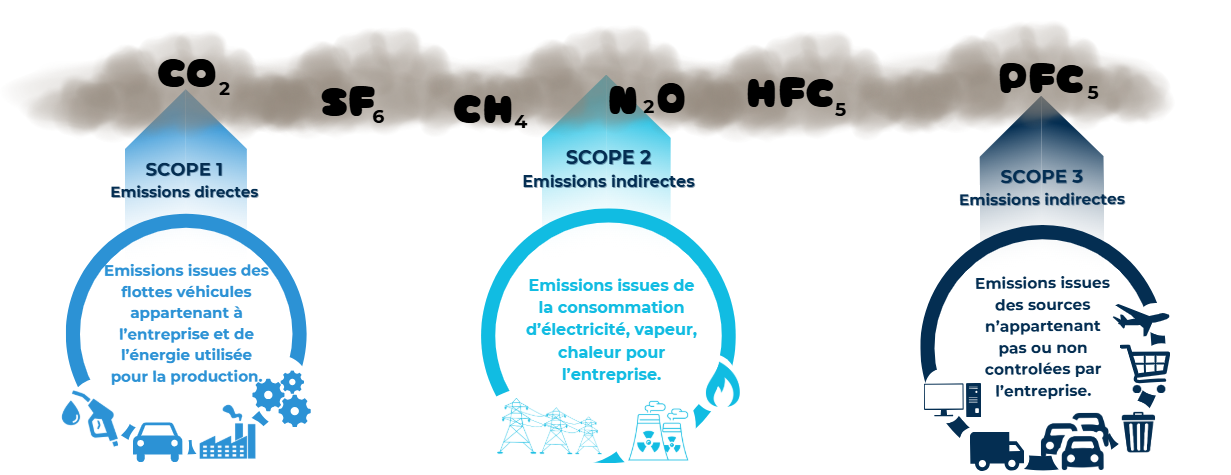
Scope 3 often accounts for the largest portion of a company’s carbon footprint. However, it is also the most complex to measure because it depends on many stakeholders (suppliers, service providers, and customers).
❓Why is it essential to measure carbon?
Carbon accounting makes it possible to assess the environmental impact of human activities and identify ways to reduce that impact. For a company, a carbon analysis offers several benefits:
-
- Reduce costs by optimizing energy consumption.
- Regulatory compliance with environmental requirements in France and Europe.3
- Improved reputation among customers and partners who are concerned about climate issues.
By regularly monitoring its emissions, a company can take concrete action to accelerate its environmental transition and adopt a sustainable approach.

The 7 Benefits of Conducting a GHG Assessment for Your Company.
Why Calculate Your Carbon Footprint?
🌱 A Key Challenge for the Low-Carbon Transition
Global warming is a global challenge, and every metric ton of carbon emitted exacerbates the problem. According to preliminary estimates from the Interprofessional Technical Center for Air Pollution Studies (Citepa), greenhouse gas emissions in France reached 385 million metric tons of CO₂ equivalent (MtCO₂e) in 2023, marking a 4.8% decrease compared to 2022. The goal is to reduce these emissions by 55% by 2030, in line with the commitments made under the Paris Agreement.
In this context, measuring one's carbon footprint makes it possible to:
-
- Identify the main sources of emissions (transportation, energy, production, waste, etc.).
- Implement targeted measures to reduce one's environmental footprint.
- Track the progress of one's efforts over time.
Whether you're a company, a local authority or an individual, this approach is essential if you want to play an active part in the fight against environmental change.
🏢 The Benefits of Carbon Accounting for Businesses
For businesses, conducting a greenhouse gas inventory offers numerous benefits, both economically and from a regulatory standpoint.
Cost Reduction and Resource Optimization
By identifying the areas where the most energy is consumed, a company can:
-
- Reduce your energy bill by adopting more energy-efficient solutions (e.g., insulation, energy-efficient appliances).
- Reduce dependence on fossil fuels and limit the impact of volatile gas and oil prices.
Compliance with Environmental Regulations
In France, certain companies are subject to legal requirements regarding carbon footprint reporting. For example:
-
- Organizations with more than 500 employees must conduct a GHG assessment every 4 years.
- The Non-Financial Performance Statement (DPEF) requires large companies to disclose information about their emissions, energy consumption, and environmental impact.
Anticipating these requirements helps avoid penalties and better prepare for future regulations.
Improved Image and Competitive Advantage
More and more consumers and investors are favoring companies committed to environmental sustainability. Effective emissions tracking makes it possible to:
-
- Strengthen the company's credibility and transparency.
- Attract new customers and partners who are concerned about climate issues.
- Highlight efforts to reduce GHG emissions in communications.
🚀 A driver of innovation and engagement
Calculating a carbon footprint is not merely a regulatory requirement; it can also be a driver of innovation. By incorporatingtheir carbon footprint into their strategy, some companies are developing new, more sustainable business models:
-
- Circular economy (reducing waste, recycling, reusing materials).
- The shift toward renewable energy (solar, wind, biomass).
- Low-carbon mobility (electric vehicles, carpooling solutions).
Furthermore, by involving employees in this initiative, a company can foster a culture of environmental commitment.
Calculating a carbon footprint is therefore much more than just a simple measurement. It is a strategic tool for anticipating future changes, reducing one’s ecological footprint, and building a more resilient and sustainable business.
Reducing Your Carbon Footprint After Calculating It
Once the assessment is complete, the next step is to implement measures to reduce GHG emissions. This transition involves analyzing the sources of impact, defining a reduction strategy, and tracking progress.
🗺️ Develop a strategy to reduce emissions
Reducing thecarbon footprint relies on three main strategies:
-
- Avoid: Eliminate or reduce sources of avoidableemissions (e.g., nonessential travel, unnecessary consumption).
- Reduce: Improve energy efficiency and reduce resource consumption.
- Offset: Invest in projects that absorb carbon (e.g., reforestation, CO₂ capture).
A company can thus develop an action plan by prioritizing the largest sources of emissions, which are generally identified through a carbon footprint assessment.
🛠️ Practical Steps to Reduce Your Carbon Footprint
Depending on the industry, various measures can be implemented:
⚡ Energy Consumption Optimization
-
- Improve building insulation to reduce heat loss.
- Prioritize energy-efficient equipment (e.g., LED lighting, A+++ energy-efficiency-rated appliances).
- Choose green electricity by signing up for a renewable energy plan.
🚗 Mobility and Sustainable Transportation
-
- Encourage telework and remote meetings to reduce travel.
- Encourage the use of public transportation, carpooling, or electric vehicles for business travel.
- Optimize logistics by reducing the distances traveled and improving truck load factors.
🔄 Responsible Production and Sourcing
-
- Select suppliers committed to reducing GHG emissions.
- Prioritize recycled or low-carbon-footprint raw materials.
- Improve waste management to reducethe environmental impact.
First, the use of GCI has led to a significant reduction in the uncertainty of the GHG inventory—particularly for Scope 3—from 50% to 5%. The group therefore has data that is 95% accurate.
Using supplier data collected and analyzed by the GCI tool, in-depth analyses were conducted internally on the impact of 35,000 products, grouping suppliers into 170 categories. This represents more than 80% of purchases by volume and value.
📈 Monitoring and continuous improvement of environmental performance
Reducing emissions is a long-term process that requires regular monitoring. There are several tools available to measure progress:
-
- Annual update of the carbon footprint to track changes in emissions.
- Environmental performance indicators to assess cost savings (e.g., reduction in energy consumption, reduction in kilometers traveled).
- Awareness-raising and training for teams to foster collective commitment.
Some companies are going even further by integrating the environmental transition into their overall strategy and setting goals aligned with carbon neutrality by 2050.

Assessing a carbon footprint is a key step in understanding the impact of human activities on the climate. Through a carbon assessment, it is possible to identify the main sources of greenhouse gas emissions and implement appropriate reduction strategies.
For businesses, this approach is not merely a regulatory requirement in France: it also represents an opportunity to optimize their energy use, reduce costs, and enhance their image. By adopting more energy-efficient solutions, promoting sustainable mobility, and choosing responsible suppliers, it is possible to reduce their environmental footprint while remaining competitive.
But reducing waste goes beyond mere compliance. Regular monitoring and continuous improvement are essential to ensuring the long-term sustainability of this approach. The transformation of energy infrastructure and achieving carbon neutrality by 2050 require a collective effort.
Every action counts. Businesses, local governments, and citizens all have a role to play in building a more sustainable future and preserving our environment for future generations.
For more information:
Sources