








Bilan Carbone® in the Construction Industry: The ADEME Method for Decarbonization
📌 Key Points
- Bilan Carbone® is the emissions accounting method developed by ADEME and promoted by the Association for the Low-Carbon Transition (ABC); it differs from the regulatory BEGES and from international standards such as the GHG Protocol and ISO 14064.
- The building and public works sector accounts for approximately 15.5% of direct national emissions, and significantly more when materials and construction are factored in.
- In the construction industry, Scope 3 emissions (materials, transportation, subcontracting) account for 60 to 90 percent of the total: this is where emission reductions will be achieved.
- Effective August 21, 2026, all public procurement contracts must include a measurable environmental criterion, accounting for 10 to 30 percent of the final score.
- A well-utilized GHG inventory is not a CSR burden: it is a driver of profit margins, competitiveness, and compliance.
Contents
What is the Bilan Carbone® and what does the ADEME method entail?
Conducting a Bilan Carbone® assessment using the ADEME method involves compiling a comprehensive inventory of greenhouse gas (GHG) emissions from an organization, a product, or a region over a given period. For the construction industry, this process has become essential: it determines access to markets, cost control, and regulatory compliance.
We must be precise with our terminology. When we refer to the Bilan Carbone® method, we are referring to a well-defined methodological tool created by ADEME in the early 2000s and, since 2008, managed by the Association for Low-Carbon Transition (ABC). It is a registered trademark. Its most recent version, V9, published in 2024 and applicable in 2025, structures the process into seven steps and three maturity levels (initial, standard, advanced).
📗 Definition
Bilan Carbone® is the greenhouse gas emissions accounting method developed by ADEME and promoted by the Association for Low-Carbon Transition (ABC). It covers all emission categories—energy, transportation, raw materials, freight, waste, and fixed assets—across the three scopes defined by the GHG Protocol.
When referring to an emissions calculation without specifying the methodology used, the correct term is not “carbon footprint” but GHG footprint (greenhouse gas footprint). This distinction is not merely a semantic detail: it reflects the diversity of available methodological frameworks, which we detail below.
💜 Did you know?
The 2025 version of the method (V9) was designed as a “guide to excellence” that promotes continuous improvement. It introduces a modular approach and three maturity levels, which enable both small and medium-sized construction companies and large corporations to develop a gradual and reliable process.
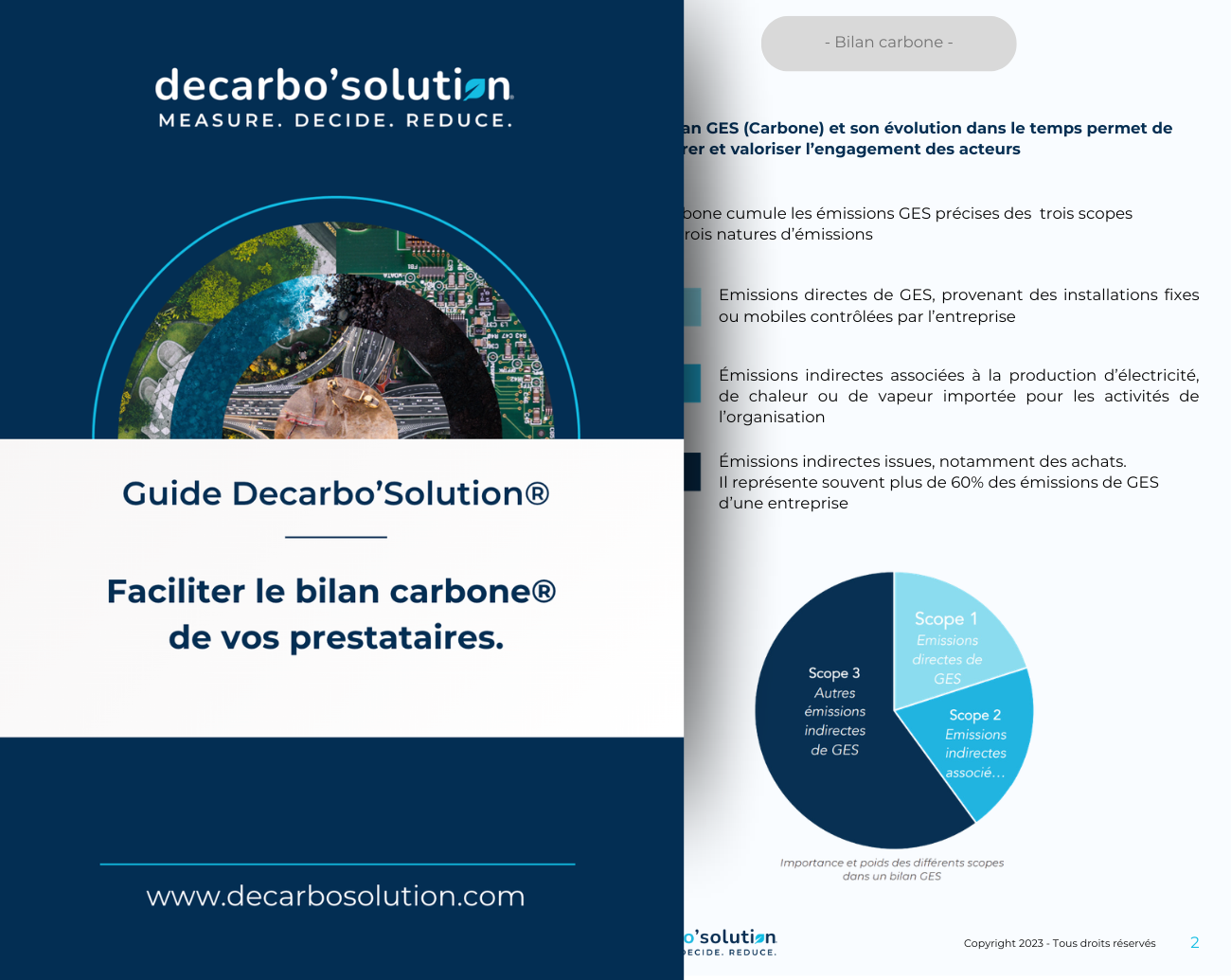
Simplify the GHG assessment for your service providers
Carbon Footprint®, BEGES, GHG Protocol: What Are the Differences?
There are several different methodologies for measuring GHG emissions. Confusing them can lead to compliance errors. Here are the main ones.
🏗️ The Regulatory BEGES — The Greenhouse Gas Emissions Inventory (BEGES) is a legal requirement under French law (Article L.229-25 of the Environmental Code) for companies with more than 500 employees, local governments, and certain public institutions. The Bilan Carbone® method can be used to fulfill this requirement, but it is not a substitute for it: the BEGES is a legal framework, while Bilan Carbone® is a private-sector method.
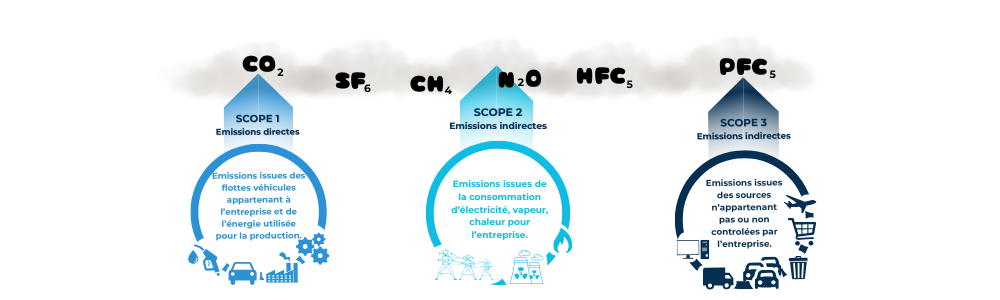
🌱 The GHG Protocol —an international benchmark standard—defines the well-known three-scope classification (direct emissions, energy, and value chain). Most methods, including Bilan Carbone®, are based on this framework.
📊 ISO 14064 — This international standard provides a framework for quantifying and verifying GHG inventories at the organizational level. It is often used to ensure the reliability of data and to have it audited.
♻️ ISO 14067 — Dedicated to the Product Carbon Footprint (PCF), this standard is becoming essential in the construction industry for quantifying the carbon footprint of a material, structure, or service.
📗 Definition
Scopes categorize emissions: Scope 1 covers direct emissions (combustion on construction sites, vehicle fleets); Scope 2 covers purchased energy (electricity, heat); and Scope 3 covers all indirect emissions in the value chain—by far the largest source of emissions in the construction industry.
The challenge for a construction executive is not to choose “the” right standard, but to have a single, consistent, and reusable data foundation—from regulatory compliance assessments all the way through to financial reporting.
Why is the construction industry on the front lines?
Construction and public works are among the sectors with the highest emissions. According to ADEME, direct emissions from the construction sector accounted for 15.5% of national emissions in 2024, or 57.1 MtCO₂eq. But this figure tells only part of the story.
This is because it covers only the operation of buildings. Once the manufacturing of materials, their transportation, new construction, and end-of-life disposal are factored in, the sector’s actual impact rises significantly: the overall carbon footprint of the construction industry is consistently estimated at around one-quarter of France’s total emissions. “Gray” carbon—embodied in concrete, steel, or aluminum—is at the heart of this footprint.
💜 Did you know?
In the construction industry, 60 to 90 percent of the carbon footprint comes from suppliers: materials, subcontractors, and transportation. In other words, the vast majority of a company’s emissions in this sector do not originate within its own facilities, but rather in its supply chain.
The Significance of Scope 3 in the Construction Industry
This reality changes everything. A company that measures only its direct emissions is overlooking virtually its entire impact. Yet without reliable Scope 3 data, it is impossible to provide a serious response to a client requesting a project’s carbon footprint—or to choose between two suppliers based on climate criteria.
Most mid-sized companies have already produced a GHG inventory. But many let it gather dust: a static, outdated snapshot that is of little use in day-to-day operations. It is precisely this gap between “having measured” and “knowing how to manage” that today sets the prepared players apart from the rest.
⚠️ Warning
Effective August 21, 2026, pursuant to the Climate and Resilience Act, all public procurement contracts must include at least one measurable environmental criterion. In the construction industry, this criterion will account for between 10 and 30 percent of the final score. Declarative responses without traceable data will no longer be accepted.
How do you conduct a Bilan Carbone® assessment for a construction company?
The approach follows a proven methodology, which the method formalizes into several steps. Here are the key phases, tailored to the realities of the sector.
Step 1 — Define the scope and boundaries
First, we define the organizational scope (which entities, which construction sites) and the operational scope (which emission sources). In the construction industry, it is crucial to include Scope 3 from the outset: materials, upstream freight, subcontracting, and travel. A scope that is too narrow skews the entire assessment.
Step 2 — Collect Activity Data
This is the most time-consuming step. Energy consumption, liters of fuel, metric tons of purchased materials, kilometers traveled… The data is often scattered across the procurement, CSR, and logistics departments. The quality of the GHG inventory depends directly on the robustness of this data collection.
Step 3 — Calculate Emissions
Each activity data point is multiplied by an emission factor derived from reference databases such as ADEME’s Base Empreinte®, or by more precise and customized factors. For an imported material, a generic factor often overestimates the actual impact—hence the value of primary data from suppliers.
Step 4 — Develop the Action Plan and Reduction Pathway
Calculating emissions is not an end in itself. The method encourages companies to prioritize areas, set goals, and develop a transition plan. Platforms like Decarbo’Solution® allow construction companies to centralize these steps: the Decarbo’Inventory® module organizes the GHG inventory across the three scopes, while Decarbo’Target® transforms the assessment into a quantified reduction trajectory, aligned with SBTi targets and exportable for the executive committee.
💜 Did you know?
It is generally possible to migrate an existing BEGES that was developed using another tool without having to start from scratch. The goal is to build on what already exists in order to move quickly from assessment to operational management.
From Assessment to Management: Turning GHG Reporting into a Business Advantage
Here is the decisive shift in perspective for a construction industry executive. Carbon is no longer just a non-financial indicator: it is a cost center, a tax base, and a measure of competitiveness.
Three concrete strategies emerge.
🏗️ Win contracts. With a criterion that will account for up to 30% of the score, an objective and auditable score becomes a direct selling point. The Decarbo’Tender® module integrates product carbon footprints (PCF, ISO 14067) into requests for proposals and provides a legally sound basis for comparing bids—an asset both for responding to a tender and for managing the process from the client’s perspective.
🌱 Structuring Scope 3 emissions for suppliers. Since the majority of emissions come from procurement, the challenge is to engage the supply chain. Decarbo’Supply® provides suppliers with a free portal for guided calculation of their product’s carbon footprint, and the data from this portal is fed directly into the client’s Scope 3 calculations, without the need for re-entry or guesswork.
📊 Ensuring data reliability for the CSRD and reporting. Comparable and traceable data transforms unreliable reporting into a truly effective management tool.
Here’s a telling example: A manufacturing company we worked with reduced the uncertainty in its Scope 3 emissions from 50% to 5% after organizing its supplier data, identifying 242 metric tons of CO₂ that could be reduced in just a few weeks. What started as a compliance exercise has become a measurable competitive advantage.
⚠️ Warning
The Carbon Border Adjustment Mechanism (CBAM) entered its final phase in 2026. Without proof of the actual carbon footprint of imported steel, cement, or aluminum, the EU applies higher default values —the highest on the market. For a construction company that imports these materials, the lack of a certified product carbon footprint directly results in a surcharge. A product carbon footprint (PCF) compliant with ISO 14067 acts as a tax shield.
Regulatory Requirements and Deadlines to Anticipate
The timeline is getting tighter, and the construction industry is facing challenges on several fronts. Here are some key points to keep in mind as you move forward.
✅ The BEGES — Mandatory for organizations with more than 500 employees; it must be renewed periodically and include an associated transition plan.
✅ The Climate and Resilience Act — Mandatory environmental criteria in 100% of public procurement contracts effective August 21, 2026.
✅ The MACF — Final phase effective in 2026 for imported materials (steel, cement, aluminum, etc.), with a planned extension to processed products by 2028.
✅ The CSRD — A requirement for reliable and auditable sustainability reporting, including Scope 3 emissions across the entire value chain.
📗 Definition
Carbon Competitiveness® refers to a company’s ability to emit fewer greenhouse gases than its competitors—on an equivalent scale and with equivalent quality—and to turn this performance into a sustainable economic advantage—such as winning new markets, protecting profit margins, and improving credit risk.
Planning ahead means having two to three years’ worth of historical data and proven methods at your disposal while competitors are rushing to build. In an industry where carbon emissions are becoming a key selection criterion, this head start translates into market share.
Conclusion: Turn Your Carbon Footprint into a Competitive Advantage
Conducting a Bilan Carbone®assessment using the reference method is no longer just a regulatory formality for the construction industry: it is the starting point for a competitiveness strategy. Faced with pressure from public procurement, MACF taxation, and CSRD requirements, companies that have a firm grasp of their emissions data protect their profit margins and win contracts; those that ignore it suffer the consequences.
The real difference lies not in the calculations, but in how the data is used. Moving from a static GHG inventory to dynamic management requires a single, unified data foundation—from assessment to reduction targets. This is exactly what Decarbo’Solution® offers—a collaborative platform that supports construction companies from measurement (Decarbo’Inventory®) to action (Decarbo’Target®), including supplier engagement (Decarbo’Supply®) and integration into competitive bidding processes (Decarbo’Tender®).
