








Calculez et améliorez le Bilan GES de votre entreprise
Decarbo’Solution® s’adapte à la spécificité de votre activité, priorise les postes les plus émetteurs et définit les principales pistes de réduction de votre entreprise.




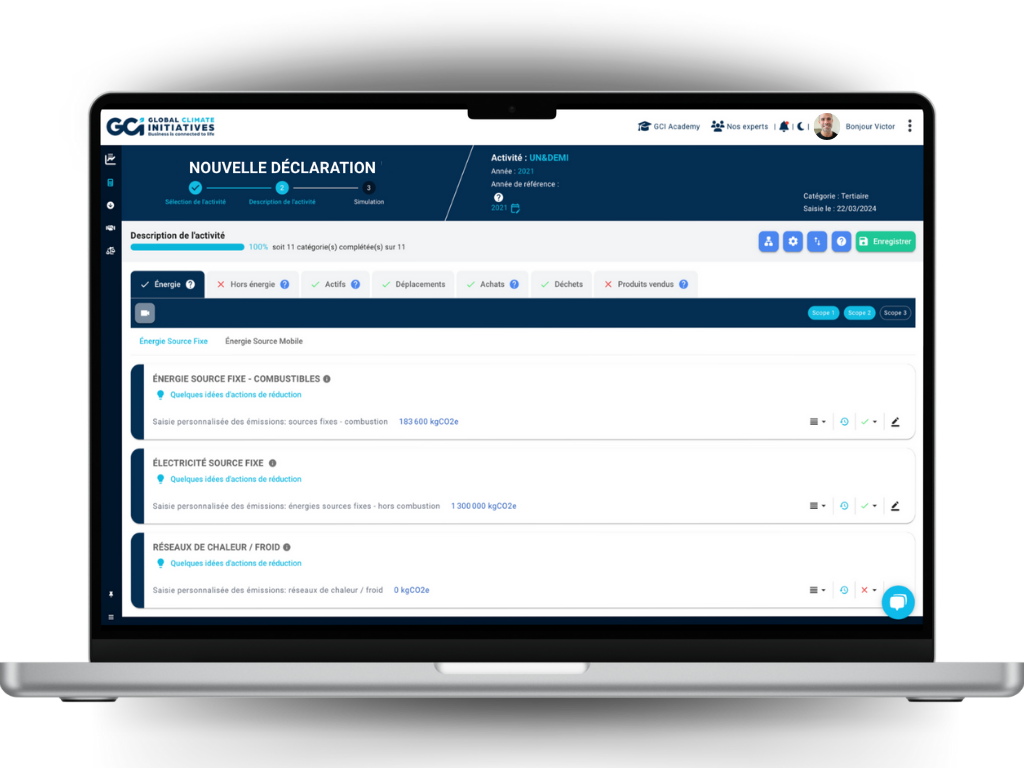

Precise measure of your carbon footprint.

Complete, compliant GHG inventory covering all 3 scopes.

Tailored to your company or organisation's sector.

Identify priority reduction avenues.

Définition : qu’est-ce qu’un bilan GES ?
Le bilan d’émissions de gaz à effet de serre (bilan GES), parfois appelé par abus de langage « bilan carbone » (marque déposée de l’ADEME), est un diagnostic complet qui permet de quantifier l’ensemble des émissions de GES générées directement ou indirectement par une organisation.
Il s’appuie sur la méthodologie définie par l’ADEME et la norme ISO 14064-1, et couvre trois périmètres d’émissions :
Scope 1
Émissions directes
Combustion de combustibles fossiles, fuites de fluides frigorigènes, véhicules de l’entreprise.
Scope 2
Émissions indirectes — énergie
Consommation d’électricité, de chaleur ou de vapeur achetée.
Scope 3
Autres émissions indirectes
Achats, déplacements, transport, fin de vie des produits. Représente souvent plus de 80 % de l’empreinte totale.
Réaliser un bilan GES permet de cartographier ses sources d’émissions, de hiérarchiser les postes les plus émetteurs et de définir un plan d’action de décarbonation aligné sur les objectifs climatiques nationaux et internationaux.
Pourquoi réaliser votre Bilan GES avec Decarbo’Solution® ?
Decarbo’Solution®, spécialiste du scope 3.
Our 12 years of experience guarantee you the most comprehensive and educational service, and access to the world's richest database of emission factors, including those of your suppliers.
- 100% online, user-friendly GHG assessment software
- The market's most precise GHG emissions calculator.
- Prise en main autonome ou accompagné d’un expert carbone pour optimiser vos résultats.
- An efficient integrated reporting and analysis tool
Data collection
Laissez-vous guider par l’ergonomie de Decarbo’Inventory® et réalisez simplement un Bilan GES adapté à votre organisation et votre secteur d’activité.
Questionnaires that are specific and tailored to your company's sector.
Des aides en ligne, des tutoriels, des FAQ et un expert qui vous accompagne pour lever vos interrogations.
Choose and develop your level of analysis.
Multi-user, Multilingual, centralization and supervision of data.

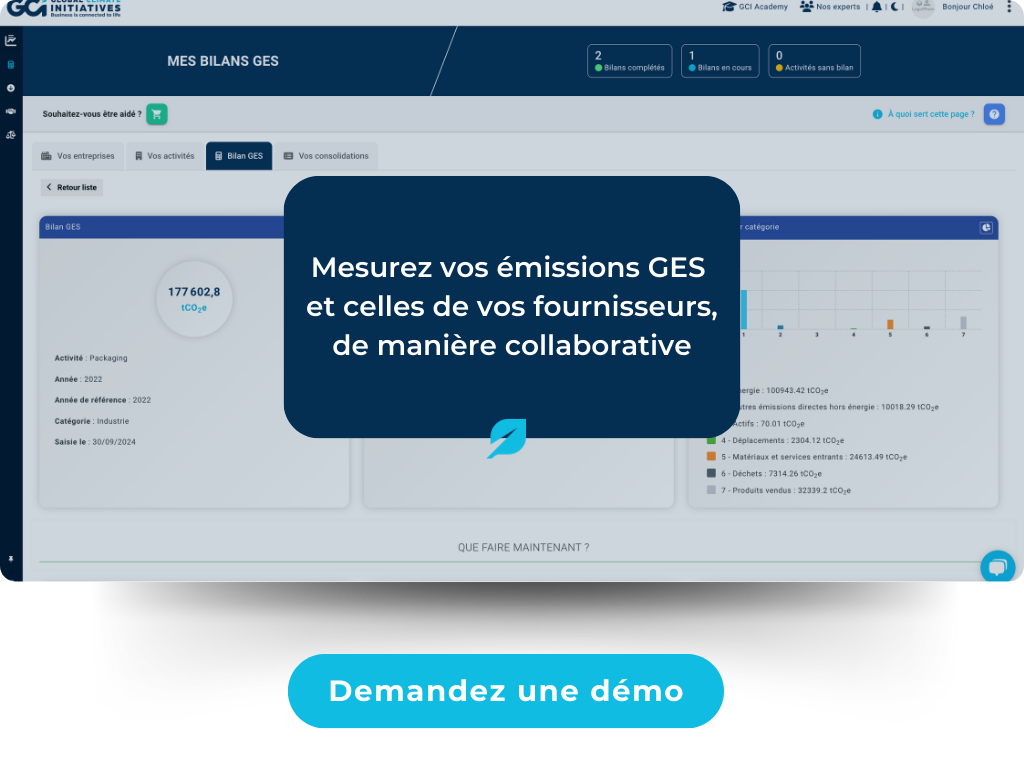
Accurate and compliant calculation
(ISO 14067) of your emission factors and those of your suppliers
Automatic assignment of each emission item calculation to Scope 1, 2 and 3.
Choice of emission factors open to all the reference databases (Base Carbone, Impacts, Ecoinvent, Inies, Beis-Defra, etc) and those of your suppliers.
UNIQUEMENT chez Decarbo’Solution® : Vous pouvez inviter vos fournisseurs à calculer gratuitement les facteurs d’émission des biens et services qu’ils vous proposent, en toute conformité à l’ISO 14067.
A full, compliant and forward looking GHG inventory
Analytical report with hierarchy, detail and precision
Reduction avenues for each emission heading
Specific formatting for uploading to the dedicated ADEME site
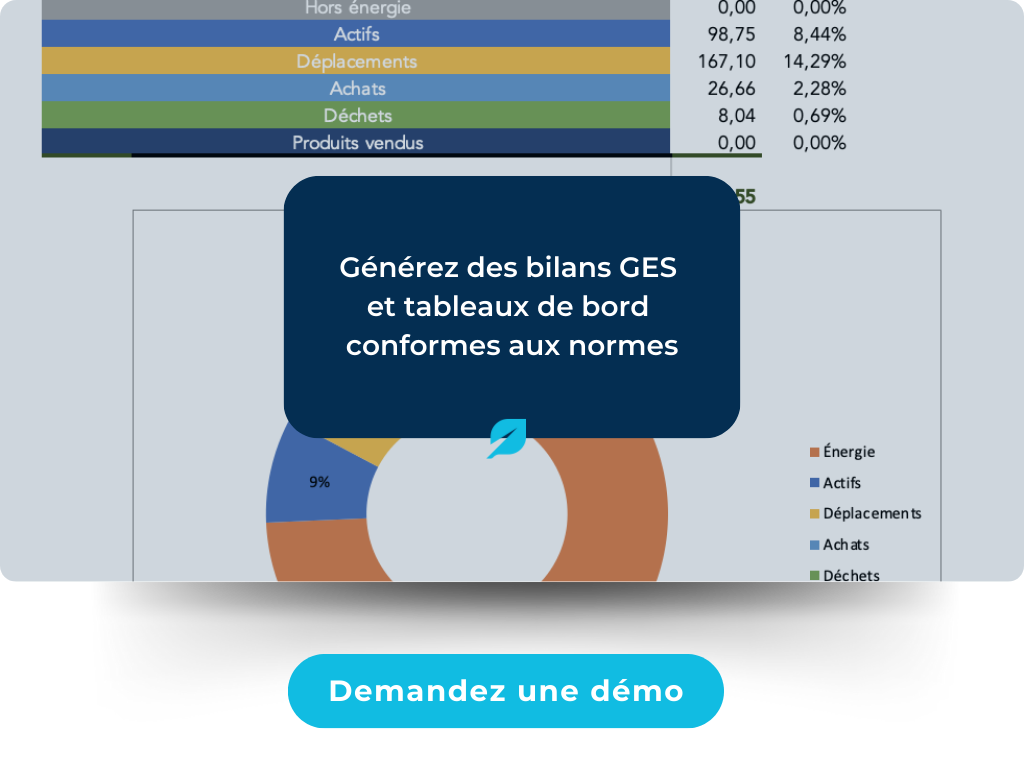
Le SaaS carbone qui génère du cash
Transformez votre conformité carbone en levier économique.
Vérifiez vos surcharges ETS, réduisez votre exposition MACF, sécurisez votre CSRD et gagnez vos appels d'offres. Activable en ligne, dès aujourd'hui.
Our difference, your strength
The calculator adapts to your organisation

Communication & Multimedia

Distribution, transport & logistics

Industry & Energy

Tech & digital

Consulting & Accounting

Health, environment & agriculture

Tourism, hotels, events & sports

Construction, real estate and public works

Community & public organization
More information on GHG assessment

Comment intégrer mes fournisseurs dans mon bilan carbone ?

SFDR : définition, fonctionnement et évolutions en cours

Comprendre l’empreinte carbone des aliments pour mieux orienter les choix alimentaires

Comment trouver des fournisseurs engagés dans la décarbonation ?

Comment fonctionne le marché européen des quotas d’émissions ?

Qu’est-ce que le passeport numérique des produits et quelles entreprises sont concernées ?

Comment noter la performance environnementale d’un produit ?

Bilan Carbone® dans le BTP : la méthode ADEME pour décarboner

Comment réduire les émissions liées aux déplacements de mes salariés ?

Externalités environnementales : le coût caché du BTP
We answer your questions!
How do I calculate my company's GHG footprint?
First of all, carrying out a greenhouse gas assessment (BEGES) enables a company to precisely evaluate its carbon footprint and understand the main source of each of its greenhouse gas emissions.
The main difference between the Bilan Carbone and the Bilan GES lies in the definition of the emissions accounting perimeter.
In the Ademe methodology, the GHG balance calculation takes into account the entire life cycle of a company's products or services. This makes it possible to assess the company's overall GHG emissions and identify any sources of savings.
Greenhouse gas (GHG) emissions are assessed on the basis of consumption, using conversion factors specific to each energy source. This makes it possible to standardize measurements and obtain a quantity of emissions expressed in carbon dioxide equivalent (CO2e).
In other words, it involves multiplying your activity data (in kWh, units, liters, €) by an emission factor (average quantity of greenhouse gas emissions for 1 unit of your activity data).
Why carry out my GHG assessment?
Over and above regulatory obligations (in particular since decree no. 2022-982), carrying out a GHG assessment is an essential step for a company, as it enables it to identify and list the greenhouse gas emissions directly or indirectly linked to its activity.
Carrying out your company's first GHG assessment will enable you to make an initial measurement and identify the main emission sources. This will make it all the easier to identify potential areas for reduction and define a low-carbon strategy for your company.
Performing a GHG assessment regularly over time will provide an opportunity to adjust your action plan and ensure that you're achieving your goals for reducing your company's environmental impact.
What data do I need to provide?
To accurately measure greenhouse gas emissions, you need to identify all your company's emission sources. It is therefore necessary to collect activity data:
- Energy consumption (gas, oil, diesel, petrol, electricity, etc. .....)
- Depreciating assets (real estate, fleet of vehicles, computer equipment, furniture, etc.)
- Purchases of goods (raw materials, materials, food, etc.)
- Purchases of services (internet contract, maintenance and installation of equipment, supplies of services, fees, etc....)
- Movement of people: employee commuting, business travel, visitors and customers, etc. .....
- Haulage
- Disposal
- Use and end of life of products sold.
Although it is recommended to be as exhaustive as possible in identifying emission headings, it is possible to start with financial data and to refine the accuracy of the data over time. We recommend that you carry out your inventory in stages, starting with your largest expenditure items first.
How can I reduce my company's carbon footprint?
Reducing the carbon footprint of your company is a multi-step process:
- Carry out an initial assessment of your carbon footprint.
- Identify the most important emission headings, and find ways to reduce them by improving the accuracy of the data used for measurement.
- Involve your suppliers by asking them to calculate the carbon footprint of the goods and services they supply. The measurement will be all the more accurate and you will then be able to implement a responsible purchasing strategy.
- Set up an action plan and a measurement strategy over time to ensure that it is implemented and effective.
Put BEGES into action
, with Decarbo’Solution®
Cadre légal et réglementaire du bilan GES
En France, la réalisation d’un bilan d’émissions de gaz à effet de serre est encadrée par plusieurs textes législatifs et réglementaires.
Article L229-25 du Code de l'environnement (Loi Grenelle II)
Depuis la loi Grenelle II (2010), les organisations suivantes sont tenues de réaliser un bilan GES réglementaire (BEGES) tous les 4 ans (3 ans pour l’État et les collectivités) :
- Les entreprises de plus de 500 salariés en France métropolitaine (250 en outre-mer)
- Les établissements publics de plus de 250 agents
- Les collectivités territoriales de plus de 50 000 habitants
- L’État et ses services
Ce bilan doit être publié sur la plateforme de l’ADEME et accompagné d’un plan de transition décrivant les actions de réduction envisagées.
Décret n° 2022-982 du 1er juillet 2022
Ce décret a renforcé les obligations existantes en imposant :
- La prise en compte des émissions indirectes significatives (scope 3) dans le bilan réglementaire
- La publication d’un plan de transition incluant des objectifs de réduction chiffrés et un calendrier de mise en œuvre
- Des sanctions financières pouvant atteindre 10 000 € (50 000 € en cas de récidive) en cas de non-réalisation du bilan
CSRD (Corporate Sustainability Reporting Directive)
Depuis janvier 2024, la CSRD étend progressivement les obligations de reporting extra-financier aux entreprises européennes. Elle impose la publication d’informations détaillées sur les émissions de GES selon les normes ESRS (European Sustainability Reporting Standards), incluant :
- Un bilan GES complet (scopes 1, 2 et 3)
- Des objectifs de réduction alignés sur l’Accord de Paris
- Un plan de transition climatique
La CSRD concerne en 2025 les grandes entreprises cotées, puis s’étendra aux PME cotées à partir de 2026.
Pourquoi anticiper même sans obligation légale ?
Au-delà des obligations réglementaires, réaliser un bilan GES volontaire permet de :
- Anticiper les futures réglementations qui s’étendront progressivement à un plus grand nombre d’entreprises
- Répondre aux attentes des investisseurs, donneurs d’ordres et clients en matière de transparence climatique
- Identifier des leviers d’économies en optimisant la consommation d’énergie et de ressources
- Renforcer l’image de marque et l’attractivité employeur de l’entreprise