









GHG Assessment: What's Next? Examples from Our Clients

Conducting a GHG assessment is a key step for any company seeking to understand and reduce its environmental impact. But once the calculation is complete, a crucial question arises: what’s next?
Un bilan carbone ne se limite pas à une simple photographie des émissions de gaz à effet de serre (GES). Il constitue un point de départ stratégique pour intégrer un plan d’action efficace et structuré. Selon le secteur d’activité, la taille de l’organisation et ses objectifs, les entreprises peuvent s’engager dans différentes démarches : optimisation de la consommation énergétique, amélioration des données d’achats, baisse des émissions indirectes, ou encore intégration des résultats dans une certification comme ISO 14064 ou Ecovadis. Pour les très grandes entreprises, l’enjeu prend une dimension particulière, comme le montre notre analyse de l’empreinte carbone de la très grande entreprise.
In France, regulations are increasingly encouraging companies to take concrete steps to reduce their carbon footprint, particularly in light of the requirements set by ADEME and the Paris Agreement. Beyond legal obligations, many organizations use their GHG inventory as a strategic tool: to meet bidding requirements, demonstrate the credibility of their commitments to customers, or structure their transition toward low-carbon products and services.
In this article, we will explore—using concrete examples from Decarbo’Solution® clients—the various motivations that drive organizations to conduct their first greenhouse gas inventory and, above all, the initiatives they subsequently implement to take their emissions reduction efforts a step further.
1.1 Identify effective strategies for reducing one’s carbon footprint
1.2 Strengthen your CSR strategy with certification (e.g., Ecovadis, ISO 14064)
1.3 Meeting Competitive and Regulatory Requirements
1.4 Strengthen Communication and Brand Image
2. The main sources of greenhouse gas emissions in a company
2.1 Scope 1: The company's direct emissions>
2.2 Scope 2: Indirect Emissions Related to Energy Consumption
3. Key Steps for Conducting a Reliable and Compliant GHG Inventory
3.1 Data Collection and Organization
3.2 Calculation of Emissions and Analysis of Results
Why do companies conduct a GHG assessment?
A greenhouse gas (GHG) inventory is much more than just an exercise in calculating greenhouse gas emissions. It is a true strategic tool for organizations seeking to improve their carbon footprint, meet market demands, or anticipate regulatory changes. Depending on the sector, organizations’ motivations can vary widely: some seek to identify effective courses of action, while others aim to obtain certification such as Ecovadis, comply withADEME requirements, or set themselves apart from the competition in a bidding process.
💡Identify effective strategies for reducing your carbon footprint
Some companies already have a strategy to reduce their carbon footprint even before conducting a GHG inventory. They then want to deepen their analysis to identify the most significant emission scopes and implement a targeted action plan.
The specific case of the Schmidt Group illustrates this approach. The company had already implemented several CSR initiatives and wanted to take things further by structuring its efforts. Thanks to its GHG inventory, it was able to better understand the breakdown of its emissions—particularly across Scopes 1, 2, and 3—and focus its efforts on reducing energy consumption and optimizing its procurement.
With this in mind, the accuracy of the information is essential. A better understanding ofemissions flows makes it possible to optimize reduction strategies, particularly by working to decarbonize procurement and improve the environmental performance of products and services.
✅ Strengthen your CSR strategy with certification (e.g., Ecovadis, ISO 14064)
Obtaining certification is another key motivator for many companies. Certifications such as Ecovadis and ISO standards (particularly ISO 14064 on carbon footprints) require a detailed analysis of emissions and a concrete commitment to reducing them.
A greenhouse gas inventory thus provides an accurate snapshot of the current situation and helps structure a credible low-carbon strategy. This can be a major asset in improving a company’s market positioning and meeting the expectations of customers and partners regarding environmental commitment.
⚖️ Meeting competitive and regulatory requirements
‼️StandOut in a Request for Proposals
More and more calls for proposals require concrete commitments to reduce GHG emissions. Large companies and contractors now require their suppliers and partners to measure and limit their carbon footprint, particularly for Scopes 1, 2, and 3.
The specific caseof ASO (Amaury Sport Organisation) is telling: by conducting its GHG inventory, ASO was able to formalize its environmental commitment and strengthen its credibility with stakeholders. Thanks to this initiative, the organization has not only improved its image but also optimized its processes to offer more sustainable events that meet the expectations of clients and investors.
✳️Complywithregulatory requirements
In France, regulations are placing increasingly stringent requirements on companies with regard to financial reporting. The Tertiary Sector Decree, the Climate and Resilience Act, and the European Union’s Corporate Sustainability Reporting Directive ( CSRD ) require greater transparency regarding emissions and the initiatives implemented to reduce them.
ADEME, as the leading authority in this field, provides specific methodologies to guide organizations through this process. A greenhouse gas inventory thus becomes an essential tool for anticipating these changes and avoiding potential penalties or restrictions on market access.
💚Strengthen Your Communication and Brand Image
Some companies conduct a GHG inventory to promote transparency and highlight their commitment to the environment. In a climate where consumers and partners are placing increasing importance on social and environmental responsibility, communicating about a company’s emissions and reduction initiatives can be a major advantage.
The French Badminton Federation (FFBaD) is a prime example of this trend. By conducting a carbon footprint assessment, the federation not only measuredthe environmentalimpact of its activities but also used these results to raise awareness among its members and promote an eco-responsible approach. Such an initiative strengthens the credibility of a brand or institution and helps foster a positive communication strategy.
The main sources of greenhouse gas emissions in a company
A greenhouse gas inventory is based on the identification and quantification of greenhouse gas emissions generated by a company. These emissions are classified into three categories, known as “scopes,” according to the methodology defined by the IPCC and adopted by ADEME. This classification helps structure the analysis and better target efforts to.
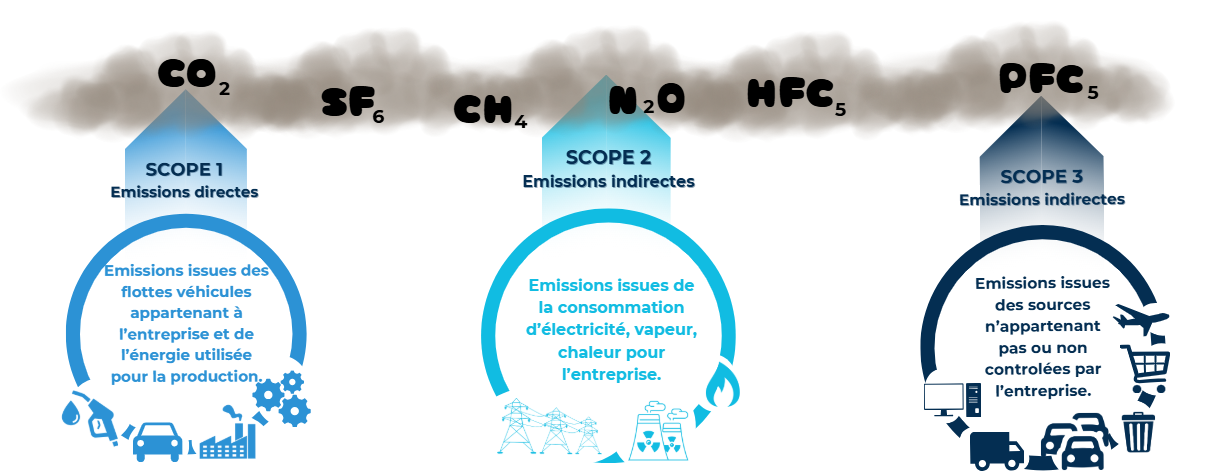
🚘Scope 1: The company’s direct emissions
Scope 1 encompasses all direct emissions resulting from activities controlled bythe company. This primarily includes:
- Fossil fuel consumption for infrastructure (e.g., gas heating, fuel oil)
- Emissions from company vehicles (e.g., vehicle fleet)
- Industrial processes specific to certain sectors (e.g., manufacturing, chemicals, metallurgy)
For example, in the construction industry, the use of diesel-powered construction equipment accounts for a significant portion of direct emissions. Many companies in the sector are seeking to optimize their energy consumption by adopting alternatives such as electrifying their equipment or using biofuels.
The manufacturing industry, for its part, can generate significant direct emissions through its material processing operations.
⚡️ Scope 2: Indirect emissions related to energy consumption
Scope 2 covers indirect emissions generated by the production of electricity, heat, or steam purchased and consumed bythe company. It primarily includes:
- Emissions associated with electricity consumption in buildings (offices, factories, warehouses)
- Energy purchased for heating and air conditioning
A good example is the service sector, where optimizing office electricity consumption can be a major driver of emissions reductions. Initiatives such as improving thermal insulation, installing LED lighting, or using renewable energy suppliers can significantly reducethe carbon footprint.
🔍 Scope 3: Indirect emissions other than energy-related emissions, which often account for the majority
Scope 3 encompasses all indirect emissions that are not included in Scopes 1 and 2 but are related tothe company’s activities. These emissions are often the most significant, sometimes accounting for more than 95% of an organization’s greenhouse gas emissions. They include, in particular:
- Purchases of Goods and Services
- Transportation of Goods and Employees
- Use of the Products Sold
- Waste Management
- Employees' business travel and commutes
In the case of the Schmidt Group, the Scope 3 analysis highlighted the significant impact of the raw materials used in furniture manufacturing, particularly wood and laminated panels. Emissions from this scope accounted for 99.4% of the company’s total emissions. In light of this finding, Schmidt has embarked on a transformation of its supply chain by prioritizing eco-designed and certified materials.
Forevent companies, Scope 3 is particularly critical, as it includes participant travel, logistics, and post-event waste management.The example of ASO shows that incorporating low-carbon strategies—such as promoting carpooling or using recycled materials—can reduce an event’s environmental footprint.
The healthcare sector also faces challenges related to Scope 3 emissions, particularly in the areas of procurement (medications, medical equipment), hospital waste management, and water consumption. By taking these indirect emissions into greater account, healthcare facilities can develop their low-carbon strategies and optimize their GHG footprint.
Key Steps for Conducting a Reliable and Compliant GHG Inventory
Conducting a GHG inventory allows organizations to accurately measure their greenhouse gas emissions, identify the largest sources of emissions, and implement measures to reduce them. To ensure the reliability and compliance of GHG reporting, it is essential to follow a rigorous methodology aligned with the standards established by ADEME, ISO 14064, the GHG Protocol, and the regulations in effect in France and internationally.
📊 Data Collection and Organization
The first step in a GHG inventory is to collect and organize the data needed to quantify emissions across the three scopes. These indicators include, in particular:
- The company 's resource consumption (electricity, natural gas, fuel oil, etc.)
- The Use of Raw Materials and Products
- Business travel and commutes
- Logistics and Transportation
- Emissions Related to Waste and Recycling
- Purchases of Goods and Services
- The end of the life cycle of products sold
The Schmidt Group, for example, conducted a detailed GHG inventory, revealing that 99.4% of its emissions came from Scope 3, primarily from the materials used in the manufacture of its furniture. This analysis enabled the company to shape its carbon reduction strategy by optimizing eco-design and selecting certified materials.
To ensure data accuracy, it is essential to adopt a standardized approach.ISO 14064 and the GHG Protocol provide methodological frameworks that enable companies to structure and verify their greenhouse gas inventories in a rigorous manner.ADEME, for its part, provides emission factors that allow activity data to be converted into metric tons of CO₂e, thereby ensuring a consistent and standardized assessment.
💯Emissions Calculation and Analysis of Results
Once the data has been collected, the next step is to calculate emissions using the emission factors provided byADEME or other international standards. The analysis must be conducted for each emissions category to determine thecompany’s overall carbon footprint.
At this stage, it is recommended that you:
- Classify emissions by scope (Scope 1, 2, and 3)
- Identify the most significant sources of emissions
- Compare the results with the indicators from previous years
- Assess the impacts of strategic decisions on emissions
In the case of the Schmidt Group, the GHG inventory analysis helped identify priority actions related to materials and the supply chain. Other companies, such as those in the construction andevent industries, also conduct detailed analyses to guide their carbon reduction efforts.
📉 Development of an Action Plan to Reduce Emissions
Once emissions have been assessed, the next step is to implement an approach tailored tothe company’s specific characteristics and objectives. This strategy must include:
- Energy-efficiency measures (optimizing electricity and gas consumption, improving building insulation)
- Procurement initiatives (selecting low-carbon suppliers, eco-designed materials, and short supply chains)
- Transportation optimization (greener logistics, reduced travel, telecommuting)
- Reducing Waste and Recycling
- Tracking progress using specific indicators
The Schmidt Group, for example, has chosen to prioritize suppliers of eco-designed materials and integrated solutions to limit the impact of its supply chain. Other companies, particularly in the healthcare sector, are shifting toward responsible procurement and circular economy solutions to reduce their carbon footprint.
📨 Verification and Reporting of Results
Once the GHG inventory and the action plan have been established, it is essential to monitor and regularly update the indicators to measure changes in emissions and the effectiveness of the measures taken. Transparency is also key to showcasing these efforts to stakeholders (customers, investors, partners, and institutions).
In particular, organizations can:
- Publish their GHG inventory in a CSR or non-financial report
- Obtain environmental certifications (ISO 14064, Low-Carbon Label)
- Commit to a carbon-neutral approach aligned with the Paris Agreement
Conducting a GHG assessment is not an end in itself, but rather the beginning of a transformation toward a more responsible and resilient business. By identifying their greenhouse gas emissions, companies obtain accurate data that enables them to develop an effective carbon reduction plan tailored to their industry and specific challenges.
There are various motivations behind this approach: some companies are committed to structuring their CSR strategy, meeting regulatory requirements, strengthening their market position, or improving their image among their stakeholders. But beyond external requirements, this effort provides real added value by optimizing resource use, reducing costs, and anticipating changes in customer and investor expectations.
Thanks to recognized methodologies and the support of expert solutions such as those offered by Decarbo’Solution®, companies can go beyond simply analyzing emissions to implement a genuine low-carbon transition strategy. By relying on standards such as ISO 14064 and the Paris Agreement, they transform their commitments into concrete initiatives, thereby contributing to a more sustainable and competitive economic model.
Our carbon experts are available to provide a free of our platform with no obligation. 🚀

Schmidt Group
Christophe CHRISTEN
Purchasing Methods Manager
The Schmidt Group is France's leading manufacturer of custom-made kitchens, storage furniture, and bathrooms.
To fulfill its commitments, the group has chosen an innovative partner specializing in decarbonizing procurement, offering a collaborative solution: Decarbo’Solution®.

French Badminton Federation
Benjamin GRIZBEC
Project Manager, Disability and Accessibility / Environmental Sustainability
The French Badminton Federation (FFBaD) has chosen Decarbo’Solution® to assess the carbon footprint of its activities as part of its commitment to social performance.
This dynamic partnership continues with the completion of GHG assessments for 20 affiliated clubs, marking a significant milestone in the federation’s transition toward a sustainable approach.
Sources
- https://www.bilancarbone-methode.com/introduction-a-la-transition-bas-carbone/quelle-integration-du-bilan-carbone-r-au-sein-dune-demarche-de-transition-bas-carbone
- https://www.ipcc.ch/
- https://ecovadis.com/fr/
- https://www.iso.org/fr/standard/66453.html
- https://portail-rse.beta.gouv.fr/csrd/csrd-comprendre-la-directive-europeenne-et-ses-enjeux-pour-la-durabilite/
- https://decarbosolution.ai/schmidt-strategie-bas-carbone/
- https://decarbosolution.ai/ffbad-realise-son-bilan-de-ges-sur-la-plateforme-gci-2-2/
- https://decarbosolution.ai/aso-realise-son-bilan-de-ges-sur-la-plateforme-gci/